Search

Invitrogen™
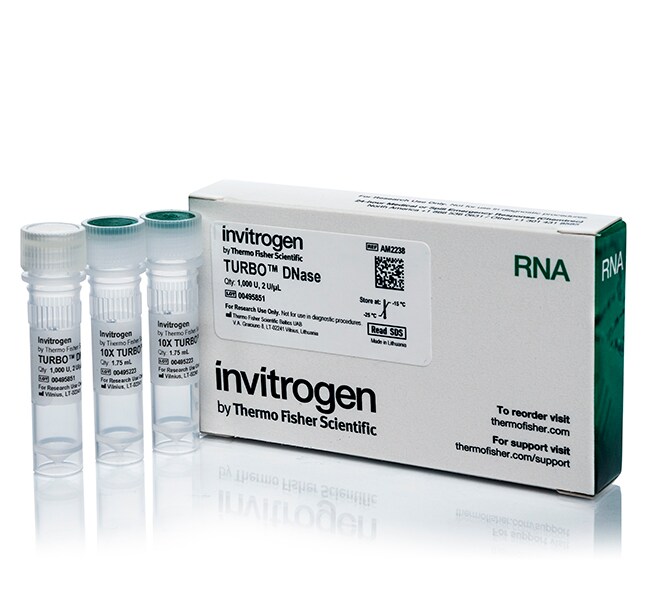
TURBO™ DNase (2 U/μL)
TURBO DNase cleaves double-stranded DNA nonspecifically to leave 5' phosphorylated oligodeoxynucleotides. It has increased affinity for DNA-binding and remains active了解更多信息
Have Questions?
更改视图

| 货号 | 数量 |
|---|---|
| AM2238 | 1000 U |
| AM2239 | 5000 U |
货号 AM2238
价格(CNY)
1,490.00
飞享价
Ends: 31-Dec-2026
2,129.00共减 639.00 (30%)
Each
数量:
1000 U
价格(CNY)
1,490.00
飞享价
Ends: 31-Dec-2026
2,129.00共减 639.00 (30%)
Each
TURBO DNase cleaves double-stranded DNA nonspecifically to leave 5' phosphorylated oligodeoxynucleotides. It has increased affinity for DNA-binding and remains active in the presence of salt.
Note: this product is just the enzyme. If you would like this enzyme plus reagents to inactivate the enzyme and remove divalent cations post-digestion, please see TURBO DNA-free™ Kit.
Features of TURBO DNase include:
• Up to 50x more activity and 350% greater catalytic efficiency
• Efficiently degrades DNA in solutions containing up to 0.25 M salt
• Efficiently digests DNA to oligonucleotides
• Vastly superior in clearing DNA templates from in vitro transcription reactions
• RNase-free and recombinant in origin
Using TURBO DNase
DNase I is commonly used to clear DNA contamination from RNA samples prior to RT-PCR. Conventional DNase I has a poor affinity for DNA and cleaves DNA of low concentration very inefficiently. In addition, DNase I is very salt-sensitive; as little as 20 mM NaCl can reduce the activity of the enzyme by 30%. Finally, DNase I is purified from bovine pancreas, one of the richest natural sources of RNase A. The threat of contaminating RNase activity in DNase I preparations requires that the enzyme be exhaustively purified. In spite of these limitations, the DNase I that researchers use today is the very same enzyme that was first characterized by Kunitz more than a half-century ago.
A different DNase with superior properties to wild-type DNase I
TURBO DNase was developed using a protein engineering approach that introduced amino acid changes into the DNA binding pocket of wild-type DNase I. These changes markedly increase the affinity of the protein for DNA. The result is a versatile enzyme that has a 6-fold lower Km for DNA, and an ability to maintain at least 50% of peak activity in solutions approaching 200 mM monovalent salt, even when the DNA concentration is in the nanomolar (nM) range. When in vitro transcription reactions are treated with either DNase I or TURBO DNase, TURBO DNase removes 63X more of the input plasmid DNA template than the wild-type enzyme. The proficiency of TURBO DNase in binding very low concentrations of DNA means that the enzyme is particularly effective in removing trace quantities of DNA contamination. This becomes important for complete removal of DNA from a sample, since the cleavable DNA substrate is reduced as the DNase reaction proceeds. TURBO DNase thus has a functional advantage over wild-type DNase due to its superior affinity for DNA. This is best exploited in RT-PCR applications, where even a few copies of DNA can lead to a false positive outcome by PCR.
Note: this product is just the enzyme. If you would like this enzyme plus reagents to inactivate the enzyme and remove divalent cations post-digestion, please see TURBO DNA-free™ Kit.
Features of TURBO DNase include:
• Up to 50x more activity and 350% greater catalytic efficiency
• Efficiently degrades DNA in solutions containing up to 0.25 M salt
• Efficiently digests DNA to oligonucleotides
• Vastly superior in clearing DNA templates from in vitro transcription reactions
• RNase-free and recombinant in origin
Using TURBO DNase
DNase I is commonly used to clear DNA contamination from RNA samples prior to RT-PCR. Conventional DNase I has a poor affinity for DNA and cleaves DNA of low concentration very inefficiently. In addition, DNase I is very salt-sensitive; as little as 20 mM NaCl can reduce the activity of the enzyme by 30%. Finally, DNase I is purified from bovine pancreas, one of the richest natural sources of RNase A. The threat of contaminating RNase activity in DNase I preparations requires that the enzyme be exhaustively purified. In spite of these limitations, the DNase I that researchers use today is the very same enzyme that was first characterized by Kunitz more than a half-century ago.
A different DNase with superior properties to wild-type DNase I
TURBO DNase was developed using a protein engineering approach that introduced amino acid changes into the DNA binding pocket of wild-type DNase I. These changes markedly increase the affinity of the protein for DNA. The result is a versatile enzyme that has a 6-fold lower Km for DNA, and an ability to maintain at least 50% of peak activity in solutions approaching 200 mM monovalent salt, even when the DNA concentration is in the nanomolar (nM) range. When in vitro transcription reactions are treated with either DNase I or TURBO DNase, TURBO DNase removes 63X more of the input plasmid DNA template than the wild-type enzyme. The proficiency of TURBO DNase in binding very low concentrations of DNA means that the enzyme is particularly effective in removing trace quantities of DNA contamination. This becomes important for complete removal of DNA from a sample, since the cleavable DNA substrate is reduced as the DNase reaction proceeds. TURBO DNase thus has a functional advantage over wild-type DNase due to its superior affinity for DNA. This is best exploited in RT-PCR applications, where even a few copies of DNA can lead to a false positive outcome by PCR.
仅供科研使用。不可用于诊断程序。
规格
兼容缓冲液10X 反应缓冲液
产品类型DNase
数量1000 U
运输条件干冰
最大浓度2 U/μL
酶DNase
产品线Ambion,TURBO
Unit SizeEach
内容与储存
TURBO™ DNase 和 10X 反应缓冲液应储存于–20°C 下。