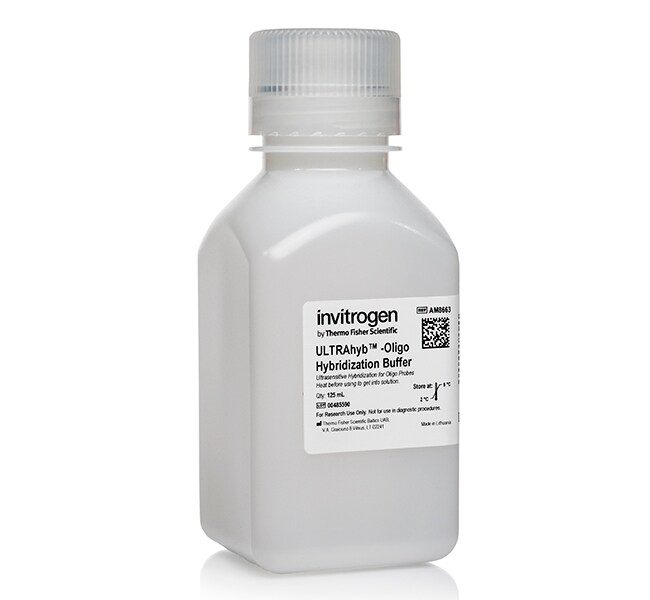
ULTRAhyb™-Oligo
Invitrogen17万+抗体限时买二赠一,靶点广,灵活用!
ULTRAhyb™-Oligo
Invitrogen™

ULTRAhyb™-Oligo

Ambion™ ULTRAhyb™-Oligo 采用了独特的配方,与寡核苷酸探针配合用于 Northern 分析。它包含杂交促进剂和封闭试剂独特混合物,大大提高了杂交水平,因此现在仅需数小时就能显现过去需要数天才能观察到的信号。以一个含 125 mL 的瓶装形式提供了解更多信息
Have Questions?
货号数量
AM8663125 mL
货号 AM8663
价格(CNY)
1,449.00
飞享价
Ends: 31-Dec-2025
3,074.00
共减 1,625.00 (53%)
Each
添加至购物车
数量:
125 mL
请求批量或定制报价
价格(CNY)
1,449.00
飞享价
Ends: 31-Dec-2025
3,074.00
共减 1,625.00 (53%)
Each
添加至购物车
Ambion™ ULTRAhyb™-Oligo 采用了独特的配方,与寡核苷酸探针配合用于 Northern 分析。它包含杂交促进剂和封闭试剂独特混合物,大大提高了杂交水平,因此现在仅需数小时就能显现过去需要数天才能观察到的信号。以一个含 125 mL 的瓶装形式提供。

•提高 Northern 印迹分析的灵敏度
• 每个印迹采用较少探针
• 杂交时间缩短至仅 2 小时

灵敏度提高至 100x 或杂交时间缩短至仅 2 小时
使用标准杂交缓冲液,印迹上仅 1–5% 的靶分子与探针杂交,这使得印迹法成为一种相对不灵敏的核酸分析方法(Vernier 等人。(1996) Anal Biochem 235:11-19)。使用 ULTRAhyb™ 超灵敏杂交缓冲液完成杂交反应,从而可以检测低至 10,000 个分子。长度为 26-45 的寡核苷酸与 ULTRAhyb™-Oligo 配合使用。非常适合与具有 78°–90°C 的 Tm 值和 47–62% GC 含量的寡核苷酸配合使用。但应该根据经验确定不同 GC 含量和 Tm 值的寡核苷酸探针的最适杂交温度。

配套产品:
推荐 BrightStar™ -Plus 带正电荷尼龙膜(SKU# AM10100、AM10102 或 AM10104)与 ULTRAhyb™-Oligo 配合使用。
仅供科研使用。不可用于诊断程序。
规格
缓冲液杂交缓冲液
产品类型寡核苷酸缓冲液
数量125 mL
运输条件室温
Unit SizeEach
内容与储存
储存于 4°C。

常见问题解答 (FAQ)

什么类型的膜与你们的ULTRAhyb-Oligo溶液相兼容?

ULTRAhyb-Oligo溶液包含25%福尔马林,只和带正电或中性的尼龙膜相互兼容。

What membranes are compatible with your ULTRAhyb-Oligo solution?

ULTRAhyb-Oligo solution contains 25% formamide and is only compatible with positively charged or neutral nylon membranes.

With the ULTRAhyb-Oligo Hybridization Buffer, why am I getting cross-hybridization?

The extreme sensitivity of ULTRAhyb-Oligo Hybridization Buffer may allow detection of RNAs that are not the expected full-length target. Although the probe binding could be legitimate (hybridization to alternatively spliced, partially degraded, or closely related mRNAs), some might be hybridization to RNAs with only partial homology to the target. The easiest way to reduce signal from cross hybridization (either cause) is to simply reduce the exposure time.
Here are other possible causes for cross-hybridization and solutions offered:
- Hybridization stringency may be inadequate. We recommend increasing the hybridization temperature by 2-5 degrees C and increasing the wash temperature by 5-10 degrees C.
- The probe contains non-target sequence. If the oligonucleotide has sequence homology with other mRNAs, vectors, etc., we recommend redesigning the probe to avoid sequence homology with targets other than the intended target.

With the ULTRAhyb-Oligo Hybridization Buffer, why am I getting low signal on my blot?

Here are possible causes and solutions:
- Not enough probe was used or low specific activity probe was used. The amount and specific activity of probe needed to obtain radioactive signal above background depends largely on the amount of target on the blot and the specific activity of the labeled probe. Maximize signal by using a molar excess of probe labeled to the highest possible specific activity.

- Hybridization and/or washes are too stringent. If the oligonucleotide has a very low GC content or a low Tm, then lowering the hybridization temperature by 2-5 degrees C may increase the signal by reducing the hybridization stringency. Note that this may increase background and cross-hybridization. Alternatively washing can be done at room temperature instead of at 42 degrees C.

With the ULTRAhyb-Oligo Hybridization Buffer, I am getting high background on my blot. Why is this?

Here are possible causes and solutions:
- There could be precipitates in the ULTRAhyb-Oligo Hybridization Buffer. Inadequate solubilization of the hybridization buffer is one of the primary causes of high background. While warming the buffer at 68 degrees C, we recommend thoroughly mixing it with a gentle swirling motion. Ensure that there is no precipitate in the buffer before adding it to the blot. ULTRAhyb-Oligo Hybridization Buffer may start to precipitate at temperatures below 25-30 degrees C.

- Prehybridization may have been inadequate. We recommend increasing the blot prehybridization time from 30 min to 1 hr.

- Unincorporated radionucleotides may have been present. We recommend that free label be removed with a spin column (i.e., Ambion NucAway Spin Columns, Cat. No. AM10070) before adding the oligonucleotide probe to the hybridization solution.

- Washing may have been inadequate. We recommend the following:
-Ensure that your wash buffer contains SDS. Wash buffers lacking SDS are not recommended for use with ULTRAhyb-Oligo Hybridization Buffer.
-Do the post-hybridization washes in 5X SSC or SSPE, 0.5% SDS for 2 x 30 min. Increasing the salt concentration will help remove probe that is non-specifically bound to the membrane through electrostatic interactions.
-Double the post-hybridization wash time in 2X SSC or SSPE, 0.5% SDS from 2 x 30 min to 4 x 30 min.
-If none of the previous suggestions reduce non-specific background sufficiently, try increasing the post-hybridization wash temperature by 5-10 degrees C. This should be the last resort as it may remove hybridized probe in addition to reducing background.