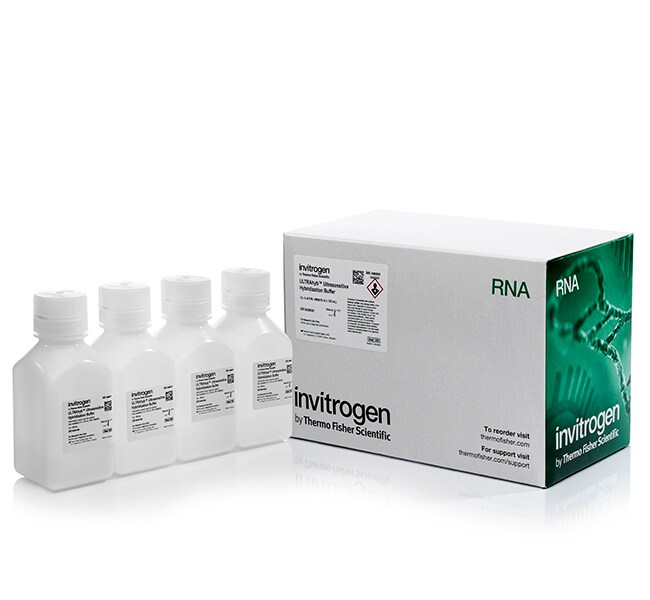
ULTRAhyb™超灵敏杂交缓冲液
Invitrogen17万+抗体限时买二赠一,靶点广,灵活用!
ULTRAhyb™超灵敏杂交缓冲液
Invitrogen™

ULTRAhyb™超灵敏杂交缓冲液

Ambion™ ULTRAhyb™ 含有一种独特的杂交促进剂和封闭剂混合物,可以大大提高杂交的水平,因此,过去需要数天时间才能显现的信号,现在数小时内就能显现出来。以一个含 125 mL 的瓶装形式提供。•可提高任何印迹杂交实验的灵敏度• 提高随机引物 DNA了解更多信息
Have Questions?
更改视图buttonViewtableView
货号数量
AM86694 x 125 mL
AM8670125 mL
货号 AM8669
价格(CNY)
4,331.00
飞享价
Ends: 31-Dec-2025
9,744.00
共减 5,413.00 (56%)
Each
添加至购物车
数量:
4 x 125 mL
请求批量或定制报价
价格(CNY)
4,331.00
飞享价
Ends: 31-Dec-2025
9,744.00
共减 5,413.00 (56%)
Each
添加至购物车
Ambion™ ULTRAhyb™ 含有一种独特的杂交促进剂和封闭剂混合物,可以大大提高杂交的水平,因此,过去需要数天时间才能显现的信号,现在数小时内就能显现出来。以一个含 125 mL 的瓶装形式提供。

•可提高任何印迹杂交实验的灵敏度
• 提高随机引物 DNA 探针的灵敏度至 100x;RNA 探针的灵敏度至 20x
• 每次印迹杂交所需使用的探针更少
• 杂交时间缩短至仅 2 小时

灵敏度提高至 100x 或者杂交时间缩短至仅 2 小时
使用标准杂交缓冲液,印迹上仅 1–5% 的靶分子与探针杂交,这使得印迹成为一种相对不敏感的核酸分析方法(Vernier 等人。(1996) Anal Biochem 235:11-19)。使用 ULTRAhyb™ 超灵敏杂交缓冲液,杂交反应接近完成,因此可以检测到多达 10,000 个分子。

对于任何杂交方案
,ULTRAhyb™ 在 norutherns、Southerns 和点/槽印迹杂交中,与同位素和非同位素标记的 RNA 和 DNA 探针均兼容。产品含有 50% 甲酰胺,并与带正电荷的膜兼容(参见配件产品)。与标准杂交缓冲液相比,ULTRAhyb™ 仅需不到 10–100x 的非同位素 DNA 探针,从而可以使用单标记反应进行更多杂交。

配件产品:
推荐将 BrightStar™ -Plus 带正电荷尼龙膜(SKU# AM10100、AM10102 或 AM10104)与 ULTRAhyb™ 配合使用。NorthernMax™ 洗涤缓冲液(SKU# AM8673 和 AM8674)是与 ULTRAhyb™ 配合使用的理想选择。ULTRAhyb™-寡核苷酸 (SKU# AM8663) 专为寡核苷酸探针配制。
仅供科研使用。不可用于诊断程序。
规格
缓冲液杂交缓冲液
产品类型超灵敏杂交缓冲液
数量4 x 125 mL
运输条件室温
Unit SizeEach
内容与储存
储存于 4°C。

常见问题解答 (FAQ)

With the ULTRAhyb Ultrasensitive Hybridization Buffer, why am I getting cross-hybridization?

The extreme sensitivity of ULTRAhyb Ultrasensitive Hybridization Buffer may detect RNAs that are not the expected full-length target. Although much of the probe binding can be legitimate (hybridization to alternatively spliced, partially degraded, or closely related mRNAs), some might be hybridization to RNAs with only partial homology to the target. We recommend using a more specific probe if possible. Here are other possible causes for cross-hybridization and solutions offered:
- The hybridization stringency may have been inadequate. Increasing the hybridization and wash temperature 3-10 degrees C can greatly reduce the levels of non-target hybridization. Simply reducing the amount of time used to expose the blot to film might also alleviate the problem.

- The probes might have contained non-target sequence. The presence of vector sequence within the probe can cause hybridization to RNAs sharing sequence homology with the vector. If the probe template contains vector sequence, cleave it by restriction digestion and then gel purify the sequence of interest before labeling.

- Too much non-isotopic probe may have been present. Non-isotopic probes can have problems with cross-hybridization, especially when they are used at 42 degrees C. We have observed that lowering the probe concentration 10 to 100-fold in the hybridization reaction will greatly reduce non-specific hybridization while having little if any impact on target-specific hybridization.

With the ULTRAhyb Ultrasensitive Hybridization Buffer, why am I getting low signal on my blot?

Here are possible causes and solutions:
- Not enough probe (or label) was used. Using less than the recommended amounts of probe, using low specific activity probe, or using less than full-length probes can lead to low signal. We recommend checking each of these factors if low sensitivity is observed.

- The hybridization and washes may have been too stringent. We recommend lowering the hybridization temperature or the wash time and temperature. This may be especially helpful for oligonucleotide probes. Note that reducing stringency can lead to higher background and cross-hybridization.

With the ULTRAhyb Ultrasensitive Hybridization Buffer, why am I getting high background on my blot?

Here are possible causes and solutions:
- There could be precipitates in the ULTRAhyb Ultrasensitive Hybridization Buffer. Inadequate solubilization of the hybridization buffer is one of the primary causes of high background. We recommend increasing the amount of time used to preheat the buffer and ensure that there is no precipitate in the buffer before adding it to the blot. ULTRAhyb Ultrasensitive Hybridization Buffer may start to precipitate at temperatures below 25-30 degrees C.

- Prehybridization may have been inadequate. We recommend increasing the blot prehybridization time from 30 min to 1 hr.

- The probe may have been too old. We recommend using fresh probe. Isotopic probes that are several days old tend to produce higher background than freshly prepared probes. This is attributed to probe size; radiolytic decay reduces the size of the probe molecules over time.

- Unincorporated radionucleotides may have been present. Although we don't ordinarily recommend removing free nucleotides, we have occasionally observed high background from unincorporated label. We recommend removing free label by precipitation (0.5 M NH4OAc and 2 volumes EtOH) or with a spin column designed for this purpose.

- Hybridization stringency may have been inadequate. We recommend the following:
-If hybridizing at 42 degrees C, try raising the hybridization temperature to 4 degrees C, or even to 55 degrees C.
-If hybridizing at 68 degrees C, hybridization stringency is unlikely to be causing background. In our experience, raising the hybridization temperature above 68 degrees C does not decrease background.

- Ionic interactions could have led to high background. If the background signal makes the blot look uniformly dark, we recommned adding a high salt wash to minimize ionic interactions between the probe and the hybridization membrane. To do this, after the ordinary washes, add a 2 x 15 min wash in 5X SSC or SSPE, 0.5% SDS at 68 degrees C for RNA probes, or at 60 degrees C for DNA probes.

- Washing may have been inadequate. We recommend the following:
-Double check that your wash buffers contain SDS. Wash buffers lacking SDS are not recommended for use with ULTRAhyb Ultrasensitive Hybridization Buffer. Doubling the wash times and/or washing at higher temperatures can reduce background. Wash temperatures can be raised from 42 degrees C to 55 degrees C or 60 degrees C.
-If you are washing at 68 degrees C, inadequate washing is probably not causing your high background. In our experience, raising wash temperatures above 68 degrees C does not decrease background.