Search


引用和文献 (16)
Invitrogen™
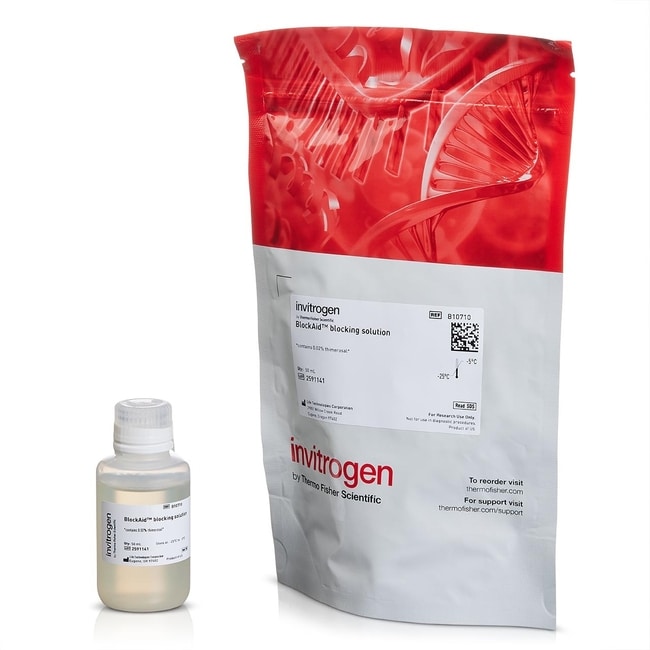
BlockAid™ 封闭液
BlockAid™ 封闭液比常用的封闭试剂(如牛血清白蛋白、正常血清或酪蛋白)更适用于细胞或组织切片。其为蛋白封闭组分的优化混合物,无需稀释。BlockAid™ 封闭液可用作初始封闭试剂,然后再应用一抗以尽量减少非特异性抗体结合,也可以将该封闭液用作一抗和二抗的稀释液。该试剂适用于细胞或组织免疫荧光应用。它还经过验证可用于链霉素亲和素偶联物和微球蛋白偶联物了解更多信息
| 货号 | 数量 |
|---|---|
| B10710 | 50 mL |
货号 B10710
价格(CNY)
2,597.00
Each
数量:
50 mL
价格(CNY)
2,597.00
Each
BlockAid™ 封闭液比常用的封闭试剂(如牛血清白蛋白、正常血清或酪蛋白)更适用于细胞或组织切片。其为蛋白封闭组分的优化混合物,无需稀释。BlockAid™ 封闭液可用作初始封闭试剂,然后再应用一抗以尽量减少非特异性抗体结合,也可以将该封闭液用作一抗和二抗的稀释液。该试剂适用于细胞或组织免疫荧光应用。它还经过验证可用于链霉素亲和素偶联物和微球蛋白偶联物。
BlockAid™ 封闭液的重要特点:
•出色的背景还原性能—优于传统封闭液
• 即用型—无需稀释或制备储备液
• 通用型—可以与任何一抗或二抗、链霉素亲和素偶联物、微球蛋白偶联物或 Qdot™ 偶联物一起使用
较大程度地减少了抗体非特异性蛋白结合的背景,这对提高灵敏度和最大信背比来说是必不可少的。这在寻找低表达抗原时、在使用具有高自发荧光的样品时或对于固有信号微弱的技术(如使用直接标记的一抗或使用超高分辨率成像)尤其重要。
BlockAid™ 封闭液的重要特点:
•出色的背景还原性能—优于传统封闭液
• 即用型—无需稀释或制备储备液
• 通用型—可以与任何一抗或二抗、链霉素亲和素偶联物、微球蛋白偶联物或 Qdot™ 偶联物一起使用
较大程度地减少了抗体非特异性蛋白结合的背景,这对提高灵敏度和最大信背比来说是必不可少的。这在寻找低表达抗原时、在使用具有高自发荧光的样品时或对于固有信号微弱的技术(如使用直接标记的一抗或使用超高分辨率成像)尤其重要。
仅供科研使用。不可用于诊断程序。
规格
数量50 mL
试剂类型封闭⁄背景抑制试剂
运输条件湿冰
产品线BlockAid
类型封闭溶液
Unit SizeEach
内容与储存
在冰箱中(-5°C 至 -30°C)储存。
常见问题解答 (FAQ)
我用了一种神经元特异性抗体标记我的神经元,怎样才能减少非特异性抗体结合?
我应该用哪些成分封闭用于流式细胞仪分析的细胞?
我的抗体标记后在细胞或组织中看到非特异性背景结合,可能是什么原因呢?
我该选用哪种抗体浓度进行细胞分析?
我清楚自己需要封闭样品,阻止自己的抗体发生非特异性结合,但该选用哪种封闭剂?
引用和文献 (16)
引用和文献
Abstract
Restriction of receptor movement alters cellular response: physical force sensing by EphA2.
Journal:Science
PubMed ID:20223987
'Activation of the EphA2 receptor tyrosine kinase by ephrin-A1 ligands presented on apposed cell surfaces plays important roles in development and exhibits poorly understood functional alterations in cancer. We reconstituted this intermembrane signaling geometry between live EphA2-expressing human breast cancer cells and supported membranes displaying laterally mobile ephrin-A1. Receptor-ligand binding,
Proinflammatory and vasodilator effects of nociceptin/orphanin FQ in the rat mesenteric microcirculation are mediated by histamine.
Journal:Am J Physiol Heart Circ Physiol
PubMed ID:17766480
'Nociceptin/orphanin FQ (N/OFQ) is the endogenous ligand for the N/OFQ peptide receptor (NOP). N/OFQ causes hypotension and vasodilation, and we aimed to determine the role of histamine in inflammatory microvascular responses to N/OFQ. Male Wistar rats (220-300 g, n = 72) were anesthetized with thiopental (30 mg/kg bolus, 40-90 mg
Green- and red-fluorescent nanospheres for the detection of cell surface receptors by flow cytometry.
Journal:J Immunol Methods
PubMed ID:9831388
'Fluorescent probes serve as sensitive tools for obtaining structural and functional information in cellular systems. In spite of the high sensitivity provided by fluorescent reagents, cell surface receptors expressed in low numbers often escape detection with commonly used fluorescent probes. R-Phycoerythrin (R-PE), a molecule with a very high quantum yield,
Micromechanical tests of adhesion dynamics between neutrophils and immobilized ICAM-1.
Journal:Biophys J
PubMed ID:14747356
'Strong, integrin-mediated adhesion of neutrophils to endothelium during inflammation is a dynamic process, requiring a conformational change in the integrin molecule to increase its affinity for its endothelial counterreceptors. To avoid general activation of the cell, Mg(2+) was used to induce the high-affinity integrin conformation, and micromechanical methods were used
Reversible self-assembly and directed assembly of DNA-linked micrometer-sized colloids.
Journal:Proc Natl Acad Sci U S A
PubMed ID:15758072
'We present a technique for the directed assembly and self-assembly of micrometer-scale structures based on the control of specific DNA linkages between colloidal particles. The use of DNA links combined with polymer brushes provides an effective way to regulate the range and magnitude of addressable forces between pairs (and further