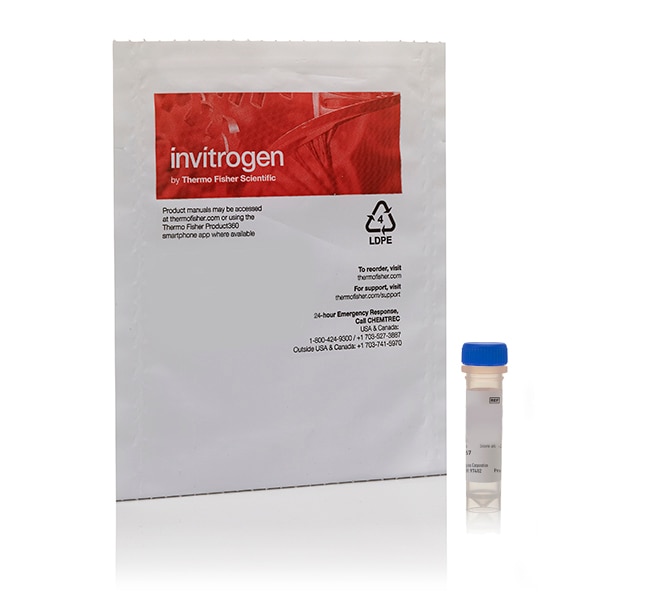
酪酰胺偶联物
Invitrogen17万+抗体限时买二赠一,靶点广,灵活用!
酪酰胺偶联物
Invitrogen™

酪酰胺偶联物

Thermo Fisher Scientific 提供各种明亮的 Alexa Fluor™、Alexa Fluor™ Plus 或 Biotin XX 酪酰胺偶联物。这些酪酰胺偶联物用于酪酰胺信号放大 (TSA),也称为催化报告基因沉积 (CARD)。
Have Questions?
更改视图buttonViewtableView
货号偶联物激发/发射
B40954Alexa Fluor™ 546556/573 nm
B40952Alexa Fluor™ 350347/442 nm
B40953Alexa Fluor™ 488495/519 nm
B40955Alexa Fluor™ 555555/565 nm
B40956Alexa Fluor™ 568579/604 nm
B40957Alexa Fluor™ 594591/617 nm
B40958Alexa Fluor™ 647650/668 nm
B40951Biotin-XX
货号 B40954
价格(CNY)
5,376.00
Each
添加至购物车
偶联物:
Alexa Fluor™ 546
激发/发射:
556/573 nm
价格(CNY)
5,376.00
Each
添加至购物车
Thermo Fisher Scientific 提供各种明亮的 Alexa Fluor™、Alexa Fluor™ Plus 或 Biotin XX 酪酰胺偶联物。这些酪酰胺偶联物用于酪酰胺信号放大 (TSA),也称为催化报告基因沉积 (CARD)。与标准成像方法相比,使用 TSA 可将信号放大至多200倍。该试剂可与任何偶联至 HRP 的抗体配合用于酪酰胺信号放大,以检测低丰度靶标。在多通路荧光成像中可实现多达7通路检测。
这些酪酰胺试剂用于酪酰胺信号放大 (TSA),也称为催化报告基因沉积 (CARD)。与标准成像方法相比,使用 TSA 可将信号放大至多200倍。这些试剂可单独提供,但也可以作为我们的 SuperBoost™ 酪酰胺信号放大试剂盒(单独提供)的一部分提供。它们可与任何偶联至 HRP 的抗体配合用于酪酰胺信号放大,以检测低丰度靶标。在多通路荧光免疫细胞化学 (ICC)、免疫组织化学 (IHC) 和原位杂交 (ISH) 中,可实现多达7通路检测。

特点包括:
• 荧光成像为低水平或难以检测的靶点提供了出色的灵敏度
• 使用标准过滤器,可实现简单的实验方案和检测
• 适用于高分辨率多通路图像—与 TO-PRO-3、二抗和其他 SuperBoost 试剂盒共标记
• 所需的一抗是标准 ICC/IHC/ISH 实验的1/10–1/100

当按照指示使用时,酪酰胺试剂可以将灵敏度至高提高到标准成像方法的200倍。这些试剂有助于对结果进行优化,从而可以清晰地观察到标准成像方法无法展示的关键区域。它们使用简单,易适应标准 ICC、IHC 或 FISH 实验方案,可用于任何细胞或组织类型。可以使用任何类型的显微镜对酪酰胺试剂标记的细胞进行成像,产生高分辨率的多通路图像。

仅供科研使用。不可用于诊断程序。
规格
偶联物Alexa Fluor™ 546
激发/发射556/573 nm
运输条件经批准可在室温下或置于湿冰上运输
克隆性
适用于(应用)IHC, IF, ICC, ISH
产品线Alexa Fluor™
数量1 小瓶
Unit SizeEach
内容与储存
  • 1 小瓶足以用于 150 个玻片的 Alexa Fluor 酪胺试剂
  • 储存于 2°C 至 8°C
  • 根据说明储存时,产品在接收后可保持稳定 6 个月。

常见问题解答 (FAQ)

我用了一种神经元特异性抗体标记自己的神经元,但我无法从偶联荧光染料的一抗中获得足够的信号。我该如何改善?

以下是我们的建议:

•使用我们偶联了明亮的、光稳定性Alexa Fluor 染料的二抗。每个荧光二抗IgG分子上标记有2-8个荧光基团,每个一抗含有三个潜在的二抗结合位点,能够提供大约10-20荧光团/抗体的信号放大等级。
•此外,也可采用生物素结合的二抗以及荧光素-链霉亲和素偶联物检测一抗,或者采用链霉亲和素桥连Qdot 生物素等生物素结合的报告载体来检测一抗。尽管额外的孵育和内源性生物素封闭步骤会增加处理时间,但链霉亲和素标记也会提高检测灵敏度。
•对于低丰度的靶标,为得到最佳信噪比,可能要对信号进行放大。酪胺信号放大技术(TSA)是一种酶介导的检测方法,其利用辣根过氧化物酶(HRP)的催化活性产生具备反应活性的荧光团标记酪胺自由基。这些短寿命的酪胺自由基共价结合到相互作用位点临近的残基上,在HRP-靶相互作用位点上产生放大的荧光信号。
•如需提升快速漂白染料的检测灵敏度,我们的SlowFade Diamond或ProLong Diamond 抗猝灭试剂已经证实可增加光稳定性,降低固定细胞、组织和无细胞制备物中的初始荧光淬灭。
•请访问此网页(https://www.thermofisher.com/us/en/home/references/newsletters-and-journals/bioprobes-journal-of-cell-biology-applications/bioprobes-issues-2011/bioprobes-66-october-2011/guide-to-immunocytochemistry.html)了解进一步的优化的要点。

我的抗原丰度极低,如何放大信号?

放大抗体检测效果的常用方法是生物素-链霉亲和素检测,使生物素化的二抗结合偶联染料的链霉亲和素。该方法能够将信号放大约2-8倍,但在此之前必须先封闭内源性生物素。另一种方法是使用酪胺信号放大技术,将辣根过氧化物酶偶联物与染料标记的酪胺配合使用。该方法能够将信号放大约10-20倍,但在此之前必须先封闭内源性过氧化物酶。最后一种方法是使用Qdot纳米晶体抗体或链霉亲和素偶联物,根据Qdot颜色,该方法可产生高于标准有机染料偶联物40倍的信号。

I used a neuron-specific antibody to label my neurons. I can't get enough signal from my fluorescent dye conjugated primary antibody. What can I do to improve it?

Here are our recommendations:

Use one of our extensive selection of secondary antibodies conjugated to bright, photostable Alexa Fluor dyes. The degree of labeling for each conjugate is 2-8 fluorophores per IgG molecule, with potentially three secondary antibody-binding sites per primary antibody, providing signal amplification of approximately 10-20 fluorophores per primary antibody.
Alternatively, primary antibody labeling can be detected with a biotinylated secondary antibody in conjunction with either a fluorescent streptavidin or a streptavidin bridge followed by a biotinylated reporter such as Qdot biotin. Although processing times increase with additional incubation and endogenous biotin-blocking steps, detection sensitivity also improves as a result of the labeled streptavidin.
For low-abundance targets, signal amplification may be necessary for optimal signal-to-noise ratios. Tyramide signal amplification (TSA) is an enzyme-mediated detection method that utilizes the catalytic activity of horseradish peroxidase (HRP) to generate reactive fluorophore-labeled tyramide radicals. These short-lived tyramide radicals covalently couple to nearby residues, producing an amplified fluorescent signal localized at the HRP-target interaction site.
For improved detection sensitivity with rapidly bleaching dyes, our SlowFade Diamond or ProLong Diamond antifade reagents have been shown to increase photostability and reduce initial fluorescence quenching in fixed cells, fixed tissues, and cell-free preparations.
Please review this web page for further optimization tips (https://www.thermofisher.com/us/en/home/references/newsletters-and-journals/bioprobes-journal-of-cell-biology-applications/bioprobes-issues-2011/bioprobes-66-october-2011/guide-to-immunocytochemistry.html).

Find additional tips, troubleshooting help, and resources within our Cell Analysis Support Center.

I have a very low-abundance antigen. How can I amplify my signal?

A common method for amplifying antibody detection is biotin-streptavidin detection, where a biotinylated secondary antibody is combined with subsequent labeling with a dye-conjugated streptavidin. This will amplify the signal by approximately 2-8 times, but endogenous biotin must be blocked beforehand. Another option is to use tyramide-signal amplification, where a horseradish peroxidase conjugate is used with a dye-labeled tyramide. This will amplify the signal by approximately 10-20 times, but endogenous peroxidase will need to be blocked. A final option may be to use a Qdot nanoparticle antibody or streptavidin conjugate, which can yield a signal as much as 40 times higher than a standard organic dye conjugate, depending on the Qdot color.

Find additional tips, troubleshooting help, and resources within our Cell Analysis Support Center.