Search

Thermo Scientific™
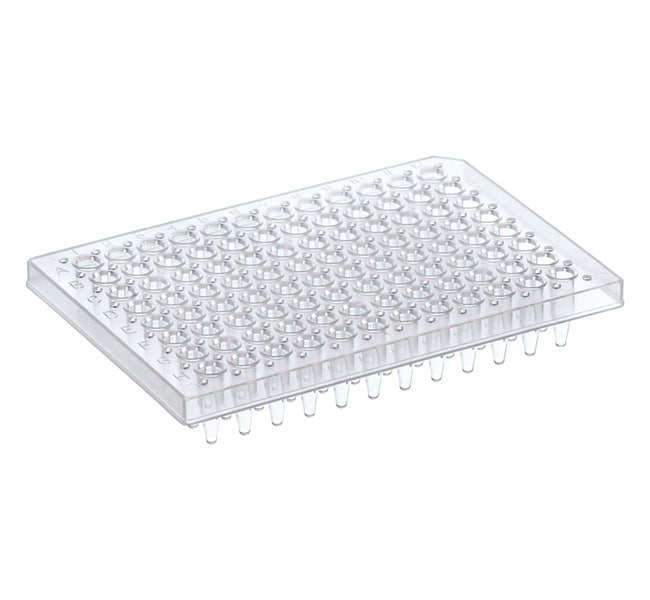
PCR 板,96 孔,半裙边,平面,带条形码
The Thermo Scientific 96-Well Semi-Skirted Plates, Flat Deck, Barcoded are compatible with all ABI platforms, including sequencers, with no adapters了解更多信息
| 货号 | 数量 |
|---|---|
| BC1400 | 25 plates |
货号 BC1400
价格(CNY)
501.00
飞享价
Ends: 31-Dec-2026
1,011.00共减 510.00 (50%)
Each
数量:
25 plates
价格(CNY)
501.00
飞享价
Ends: 31-Dec-2026
1,011.00共减 510.00 (50%)
Each
The Thermo Scientific 96-Well Semi-Skirted Plates, Flat Deck, Barcoded are compatible with all ABI platforms, including sequencers, with no adapters necessary. The PCR plastics are designed, manufactured, and tested to ensure PCR performance. The industry-leading manufacturing process and innovative product design deliver reliable, high-performance products that generate accurate and reproducible PCR data.
These plates are available as SuperPlate, which is 4x more rigid than standard plates, making these plates ideal for robotic handling. They feature a cut corner at the A12 location.
Highlights
• Directly compatible with all major major thermal cyclers, including ABI platforms including sequencers with no adapters necessary
• Flat plate deck facilitates sealing and handling
• Available as SuperPlate providing 4x more rigidity for superior robotic handling (BC2400)
• Raised rim design around each well enables secure sealing and safeguards against evaporation
• Uniform, thin well walls deliver maximum and consistent heat transfer
• Black lettered versions feature black alpha-numeric lettering to allow for easy well identification
• White plates are optimized for qPCR by increasing sensitivity and reducing variability in fluorescence detection
• Cut corner: A12
Applications
• PCR
• qPCR/Real-Time PCR
Barcoding
The barcodes are the industry standard code 128. The label itself can withstand temperatures from -196°C up to 120°C to ensure that the barcodes stay on the plate throughout your entire workflow. It also has a special coating to virtually eliminate any ‘rubbing off' of the code during handling. The dual barcodes are located on the opposite numeric and opposite alpha sides of the plate.
Related Products
PCR Plate, 96-well, semi-skirted, flat deck, white, barcoded
SuperPlate PCR Plate, 96-well, semi-skirted, flat deck, barcoded
SuperPlate PCR Plate, 96-well, semi-skirted, flat deck, white, barcoded
These plates are available as SuperPlate, which is 4x more rigid than standard plates, making these plates ideal for robotic handling. They feature a cut corner at the A12 location.
Highlights
• Directly compatible with all major major thermal cyclers, including ABI platforms including sequencers with no adapters necessary
• Flat plate deck facilitates sealing and handling
• Available as SuperPlate providing 4x more rigidity for superior robotic handling (BC2400)
• Raised rim design around each well enables secure sealing and safeguards against evaporation
• Uniform, thin well walls deliver maximum and consistent heat transfer
• Black lettered versions feature black alpha-numeric lettering to allow for easy well identification
• White plates are optimized for qPCR by increasing sensitivity and reducing variability in fluorescence detection
• Cut corner: A12
Applications
• PCR
• qPCR/Real-Time PCR
Barcoding
The barcodes are the industry standard code 128. The label itself can withstand temperatures from -196°C up to 120°C to ensure that the barcodes stay on the plate throughout your entire workflow. It also has a special coating to virtually eliminate any ‘rubbing off' of the code during handling. The dual barcodes are located on the opposite numeric and opposite alpha sides of the plate.
Related Products
PCR Plate, 96-well, semi-skirted, flat deck, white, barcoded
SuperPlate PCR Plate, 96-well, semi-skirted, flat deck, barcoded
SuperPlate PCR Plate, 96-well, semi-skirted, flat deck, white, barcoded
规格
认证/合规经过认证,无 RNA 酶/无 DNA 酶
适用于(设备)实时 PCR 系统或热循环仪
包装25 块板
产品类型PCR 微孔板
数量25 plates
反应速度标准
边缘样式半高
孔容积(公制)0.3 mL
工作容积(公制)0.2 mL
条形码包括条形码
颜色清除
材质聚丙烯
孔数量96
Unit SizeEach