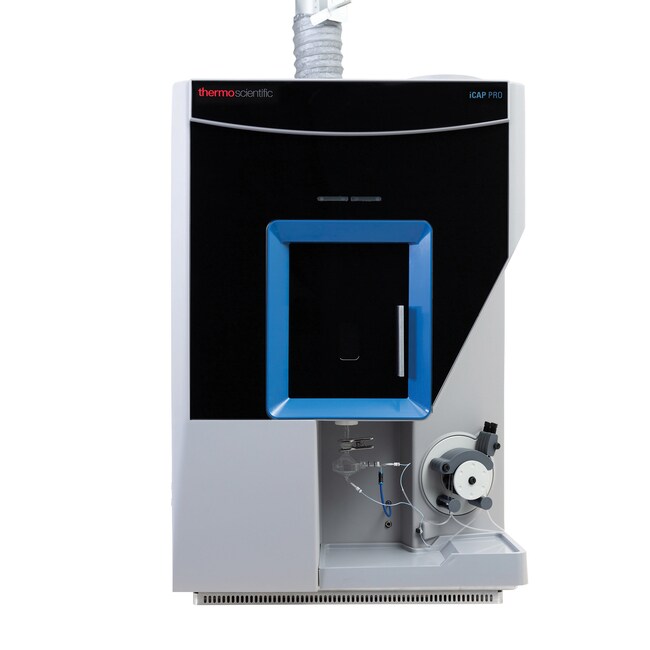
Which ICP-OES and ICP-MS instruments are available from Thermo Fisher Scientific?
Thermo Fisher Scientific has over thirty years of experience in designing and manufacturing ICP systems. We offer both ICP-OES and ICP-MS products. Our ICPOES products offer both dedicated radial and dual radial/axial views. In our ICP-MS portfolio, we offer both single and triple quadrupole mass spectrometers together with high-resolution magnetic sector mass spectrometers:
- Thermo Scientific iCAP 7000 Plus ICP-OES Series (https://www.thermofisher.com/uk/en/home/industrial/spectroscopy-elemental-isotope-analysis/trace-elemental-analysis/inductively-coupled-plasma-optical-emission-spectrometry-icp-oes.html)
- Thermo Scientific iCAP RQ ICP-MS (https://www.thermofisher.com/order/catalog/product/IQLAAGGAAQFAQKMBIT)
- Thermo Scientific iCAP TQ ICP-MS (https://www.thermofisher.com/order/catalog/product/731546)
- Thermo Scientific ELEMENT 2 High-Resolution ICP-MS Series (https://www.thermofisher.com/order/catalog/product/IQLAAEGAAMFABWMAFB)
- Thermo Scientific ELEMENT XR High-Resolution ICP-MS (https://www.thermofisher.com/order/catalog/product/IQLAAEGAAMFABWMAFB)
The iCAP RQ ICP-MS (https://www.thermofisher.com/order/catalog/product/IQLAAGGAAQFAQKMBIT) is the
recommended model for pharmaceutical elemental impurities.
Will ICP-OES detection limits be capable of handling the 'big 4' in final product when the permitted daily exposure (PDE) is higher than 10 g·day-1?
In general, ICP-OES is perfectly capable of achieving the required detection limits of USP chapter <232>. However, there can be two limiting factors: Due to the definition of PDE values for individual elements, the larger the daily dose is for a given drug product, the lower is the detection limit required. There are also ways to improve the detection capabilities of an ICP-OES in cases where more sensitivity is required, e.g., by means of a hydride generation system. Such a system can typically increase the detection sensitivity for e.g., Arsenic (As) and thus helps to still achieve the required detection limits.
What effects may compromise my analysis results using ICP-OES or ICP-MS?
Interferences are of most concern in ICP-MS. One can basically distinguish two types of interferences: spectral interferences and physical interferences. Mostly, polyatomic interferences are observed, but can mostly be efficiently suppressed by using an instrument equipped with a collision/reaction cell system.
Other interferences observed are isobaric interferences, for example, caused by two elements present in a sample that have isotopes with a common mass number. Mathematical correction using another isotope of the interfering element and calculating the contribution to the signal by means of the isotopic abundance is a way to overcome these interferences.
Doubly charged ions can interfere with some elements, especially if a high concentration of an element with a low 2nd ionization potential is present in a sample, e.g., samarium (Sm), a member of the rare earth elements, that would interfere with the detection of As at m/z 75.
In addition, ionization effects may lead to false positives, for example, if carbon is present in a sample (e.g., after direct dissolution of a sugar containing product in water), As may show an elevated response. Microwave digested samples are normally not affected.
Can I use ICP-OES or ICP-MS as a screening tool?
Both ICP-OES as well as ICP-MS can acquire full spectra to identify all elements present in a sample. This function is not only useful for method development where it helps to identify the origin of interference but it can also be used as part of a risk-based testing approach. If suppliers issue certificates for given elements, these can be removed from quantitative testing, and instead be systematically screened for in a spot-testing approach to assure compliance at all times.
Can I use autodilution to help in the preparation of standards and samples for ICP-OES and ICP-MS analysis?
Yes, autodilution can be used on both ICP-OES and ICP-MS to automate and streamline preparation of calibration standards and perform final sample dilutions. Autodilution systems are also based on valve systems similar to segmented flow introduction systems and are capable of generating different calibration curves (e.g., for drug products with varying daily dosage) from a single stock solution. This reduces the workload for laboratory personnel and also reduces the amount of human interaction with the samples. If a given sample exceeds the calibration range or leads to an internal standard response outside the allowed acceptance criteria, a sample can be automatically diluted and the analysis is repeated. At the same time, autodilution systems are completely integrated into the Qtegra ISDS (https://www.thermofisher.com/order/catalog/product/IQLAAEGABSFAOVMBCZ) operating software, so that all dilution (prescriptive or automatic) steps are documented in a compliant software environment.