Search


引用和文献 (15)
Invitrogen™
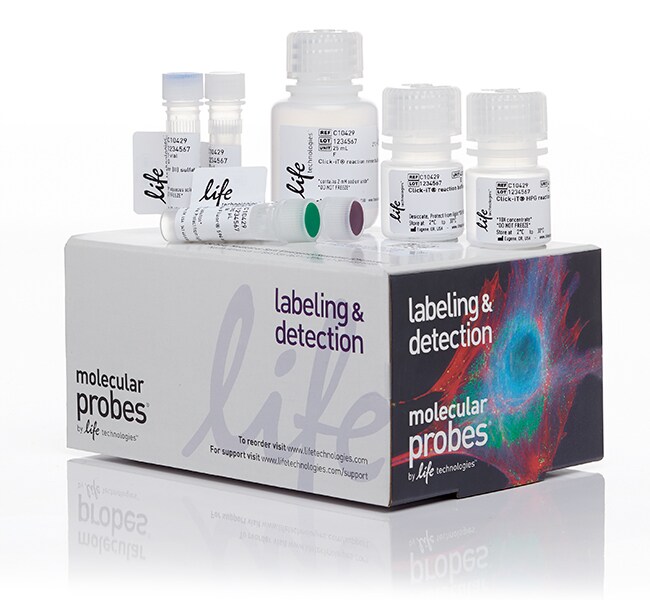
Click-iT™ HPG Alexa Fluor™ 594蛋白合成检测试剂盒
Click-iT™ HPG Alexa Fluor™ 594 蛋白合成检测试剂盒为使用荧光显微镜检查、高内涵成像或流式细胞分析检测新生蛋白合成提供了一种快速、灵敏、无毒和无放射性的方法。试剂盒中包括了解更多信息
| 货号 | 数量 |
|---|---|
| C10429 | 25 片盖玻片或两个 96 孔板 |
货号 C10429
价格(CNY)
7,540.00
飞享价
Ends: 31-Dec-2026
10,472.00共减 2,932.00 (28%)
Each
数量:
25 片盖玻片或两个 96 孔板
价格(CNY)
7,540.00
飞享价
Ends: 31-Dec-2026
10,472.00共减 2,932.00 (28%)
Each
Click-iT™ HPG Alexa Fluor™ 594 蛋白合成检测试剂盒为使用荧光显微镜检查、高内涵成像或流式细胞分析检测新生蛋白合成提供了一种快速、灵敏、无毒和无放射性的方法。试剂盒中包括 L-高炔丙基甘氨酸(HPG,蛋氨酸的氨基酸类似物,含炔基)和 Alexa Fluor™ 594 叠氮化物。用 HPG 饲喂培养细胞,在活性蛋白合成过程中掺入蛋白中。添加 Alexa Fluor™ 594 叠氮化物会导致绿色荧光叠氮化物和炔烃之间的化学选择性连接或点击反应,从而通过基于成像的分析检测修饰蛋白。
•无放射性替代— 替代传统 35S-蛋氨酸
•可视化大分子蛋白动态— 荧光标记蛋白,使得可测定其定位,包括聚集
• 特异性 — 标记和检测标签之间选择性、特异性反应
• 稳定性— 产物包含一个不可逆共价键
• 多通路 — 与 Click™-iT AHA(叠氮化物氨基酸和炔烃染料)配合使用以检测空间和时间差异
• 适用于生物样品— 易检测、高灵敏度和低背景(无论复杂性如何)
Click-iT™ HPG Alexa Fluor™ 594 蛋白合成检测试剂盒已在 HeLa、A549 和 U-2 OS 细胞中使用多种抑制蛋白合成的试剂(包括环己酰亚胺和茴香霉素)成功进行了检测。还使用 HeLa 细胞中蛋白酶体抑制剂(MG132 和硼替佐米)和自噬阻滞剂(氯喹)证明了这些探头用于监测蛋白降解的适用性。
此外,由于 Click-iT™ HPG Alexa Fluor ™ 594 蛋白合成检测试剂盒和 Click-iT™ AHA Alexa Fluor™ 488 HCS 试剂盒之间的 Click-iT™ 化学差异,这些试剂盒可联合用于新生蛋白合成差异的空间或时间测定。
•无放射性替代— 替代传统 35S-蛋氨酸
•可视化大分子蛋白动态— 荧光标记蛋白,使得可测定其定位,包括聚集
• 特异性 — 标记和检测标签之间选择性、特异性反应
• 稳定性— 产物包含一个不可逆共价键
• 多通路 — 与 Click™-iT AHA(叠氮化物氨基酸和炔烃染料)配合使用以检测空间和时间差异
• 适用于生物样品— 易检测、高灵敏度和低背景(无论复杂性如何)
Click-iT™ HPG Alexa Fluor™ 594 蛋白合成检测试剂盒已在 HeLa、A549 和 U-2 OS 细胞中使用多种抑制蛋白合成的试剂(包括环己酰亚胺和茴香霉素)成功进行了检测。还使用 HeLa 细胞中蛋白酶体抑制剂(MG132 和硼替佐米)和自噬阻滞剂(氯喹)证明了这些探头用于监测蛋白降解的适用性。
此外,由于 Click-iT™ HPG Alexa Fluor ™ 594 蛋白合成检测试剂盒和 Click-iT™ AHA Alexa Fluor™ 488 HCS 试剂盒之间的 Click-iT™ 化学差异,这些试剂盒可联合用于新生蛋白合成差异的空间或时间测定。
仅供科研使用。不可用于诊断程序。
规格
颜色橙红色
检测方法荧光
适用于(设备)荧光显微镜、荧光成像仪
产品规格液体
标签类型Alexa Fluor 染料
产品线Click-iT
产品类型蛋白合成检测试剂盒
数量25 片盖玻片或两个 96 孔板
标记目标蛋白
标签或染料Alexa Fluor 594
Unit SizeEach
内容与储存
- 储存于 2°C 至 6°C
- 切勿冷冻
- 避免长时间暴露于光下,可在光下做短时间操作。
引用和文献 (15)
引用和文献
Abstract
Selective identification of newly synthesized proteins in mammalian cells using bioorthogonal noncanonical amino acid tagging (BONCAT).
Journal:Proceedings of the National Academy of Sciences of the United States of America
PubMed ID:16769897
In both normal and pathological states, cells respond rapidly to environmental cues by synthesizing new proteins. The selective identification of a newly synthesized proteome has been hindered by the basic fact that all proteins, new and old, share the same pool of amino acids and thus are chemically indistinguishable. We
In situ visualization and dynamics of newly synthesized proteins in rat hippocampal neurons.
Journal:Nature neuroscience
PubMed ID:20543841
Protein translation has been implicated in different forms of synaptic plasticity, but direct in situ visualization of new proteins is limited to one or two proteins at a time. Here we describe a metabolic labeling approach based on incorporation of noncanonical amino acids into proteins followed by chemoselective fluorescence tagging
Two-color labeling of temporally defined protein populations in mammalian cells.
Journal:Bioorganic & medicinal chemistry letters
PubMed ID:18774715
The proteome undergoes complex changes in response to disease, drug treatment, and normal cellular signaling processes. Characterization of such changes requires methods for time-resolved protein identification and imaging. Here, we describe the application of two reactive methionine (Met) analogues, azidohomoalanine (Aha) and homopropargylglycine (Hpg), to label two protein populations in
Fluorescence visualization of newly synthesized proteins in mammalian cells.
Journal:Angewandte Chemie (International ed. in English)
PubMed ID:17036290
Noncanonical amino acid tagging enables the selective fluorescent visualization of newly synthesized proteins in mammalian cells (see the picture). Susceptibility to tagging is determined by the spatial and temporal character of the protein synthesis, thus providing a complement to methods which identify relevant members of the proteome.
Spatial coupling of mTOR and autophagy augments secretory phenotypes.
Journal:Science (New York, N.Y.)
PubMed ID:21512002
Protein synthesis and autophagic degradation are regulated in an opposite manner by mammalian target of rapamycin (mTOR), whereas under certain conditions it would be beneficial if they occurred in unison to handle rapid protein turnover. We observed a distinct cellular compartment at the trans side of the Golgi apparatus, the