Search


引用和文献 (8)
Invitrogen™
Click-iT™ Plus OPP Alexa Fluor™ 647 蛋白合成检测试剂盒

Click-iT™ Plus OPP Alexa Fluor™ 647 蛋白合成检测试剂盒为使用荧光显微镜检查或高内涵成像检测蛋白合成提供了一种快速、灵敏和无放射性的方法。检测时,在含蛋氨酸的完全培养基中 O-炔丙基嘌呤霉素了解更多信息
| 货号 | 数量 |
|---|---|
| C10458 | 1 个试剂盒 |
货号 C10458
价格(CNY)
6,759.00
飞享价
Ends: 31-Dec-2025
9,161.00共减 2,402.00 (26%)
Each
数量:
1 个试剂盒
价格(CNY)
6,759.00
飞享价
Ends: 31-Dec-2025
9,161.00共减 2,402.00 (26%)
Each
Click-iT™ Plus OPP Alexa Fluor™ 647 蛋白合成检测试剂盒为使用荧光显微镜检查或高内涵成像检测蛋白合成提供了一种快速、灵敏和无放射性的方法。检测时,在含蛋氨酸的完全培养基中 O-炔丙基嘌呤霉素(O-propargyl-puromycin,以下简称 OPP)有效地整合到新翻译的蛋白质中,并通过快速、高特异性和温和的点击反应与明亮、光稳定的 Alexa Fluor™ 荧光染料结合。
试剂盒的特点包括:
•无需更改培养基—在完整、含蛋氨酸的培养基中操作,无需去除细胞培养基
• 多通路—Click-iT™ Plus 技术可保留 GFP 信号并结合荧光偶联鬼笔环肽
• 无放射性—可替代传统 35S-蛋氨酸方法
•体内使用—已发表结果证实可在体内使用测定蛋白翻译
此试剂盒含有 O-炔丙基-嘌呤霉素 (OPP),这是嘌呤霉素的炔烃类似物(也单独提供),以及 Alexa Fluor™ 647 吡啶甲基叠氮化物和进行点击反应的所有必要试剂。可将 OPP 添加到培养细胞中,以在活性蛋白合成期间整合到蛋白质中。添加 Alexa Fluor™ 647 吡啶甲基叠氮化物和点击反应试剂使吡啶甲基叠氮化物染料与 OPP 炔烃之间实现化学选择性连接或“点击”反应,使得可通过成像分析检测经修饰蛋白。
点击反应使用生物正交(生物独特)部分对增殖细胞进行荧光标记,有助于产生低背景和高检测灵敏度。由于反应条件温和,Click-iT™ Plus 分析可检测蛋白翻译事件,同时可保留细胞形态、荧光标记鬼笔环肽的结合以及 GFP 的荧光信号。
与传统方法中使用的 35S-蛋氨酸不同,OPP 不是氨基酸类似物,因此它可以直接添加到完全培养基中的细胞中或者用于测定体内的蛋白合成。
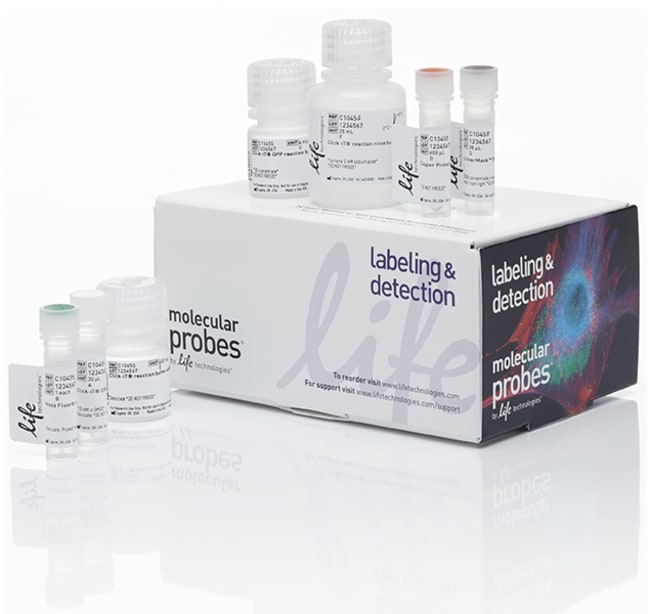
此试剂盒含有标记和检测贴壁细胞样品中新翻译蛋白内掺入 OPP 所需的所有组分。此试剂盒包括足量试剂,每次检测使用 1 mL 反应缓冲液标记 25 片 18 mm × 18 mm 盖玻片。
试剂盒的特点包括:
•无需更改培养基—在完整、含蛋氨酸的培养基中操作,无需去除细胞培养基
• 多通路—Click-iT™ Plus 技术可保留 GFP 信号并结合荧光偶联鬼笔环肽
• 无放射性—可替代传统 35S-蛋氨酸方法
•体内使用—已发表结果证实可在体内使用测定蛋白翻译
此试剂盒含有 O-炔丙基-嘌呤霉素 (OPP),这是嘌呤霉素的炔烃类似物(也单独提供),以及 Alexa Fluor™ 647 吡啶甲基叠氮化物和进行点击反应的所有必要试剂。可将 OPP 添加到培养细胞中,以在活性蛋白合成期间整合到蛋白质中。添加 Alexa Fluor™ 647 吡啶甲基叠氮化物和点击反应试剂使吡啶甲基叠氮化物染料与 OPP 炔烃之间实现化学选择性连接或“点击”反应,使得可通过成像分析检测经修饰蛋白。
点击反应使用生物正交(生物独特)部分对增殖细胞进行荧光标记,有助于产生低背景和高检测灵敏度。由于反应条件温和,Click-iT™ Plus 分析可检测蛋白翻译事件,同时可保留细胞形态、荧光标记鬼笔环肽的结合以及 GFP 的荧光信号。
与传统方法中使用的 35S-蛋氨酸不同,OPP 不是氨基酸类似物,因此它可以直接添加到完全培养基中的细胞中或者用于测定体内的蛋白合成。
此试剂盒含有标记和检测贴壁细胞样品中新翻译蛋白内掺入 OPP 所需的所有组分。此试剂盒包括足量试剂,每次检测使用 1 mL 反应缓冲液标记 25 片 18 mm × 18 mm 盖玻片。
For Research Use Only. Not for use in diagnostic procedures.
规格
适用于(应用)使用荧光显微镜检查或高内涵成像进行蛋白合成检测
环保功能Less hazardous
产品线Click-iT
产品类型Click-iT™ Plus OPP Alexa Fluor™ 647 蛋白合成检测试剂盒
数量1 个试剂盒
试剂类型Nascent 蛋白质标记试剂
标签或染料Alexa Fluor 647
Unit SizeEach
内容与储存
该试剂盒包含:Click-iT™ OPP 试剂、Alexa Fluor™ 染料吡啶甲基叠氮化物、Click-iT™ OPP 反应缓冲液、铜保护剂、Click-iT™ 反应缓冲液添加剂、Click-iT™ 反应生成缓冲液和 NuclearMask™ 蓝色染色剂。在 2° 至 8°C 下储存。干燥避光保存。
常见问题解答 (FAQ)
I will be performing a cell proliferation assay using Click-iT EdU kit. At what point can I stop overnight, or do I have to perform all the steps continuously?
Can the Click-iT Plus OPP Alexa Fluor 647 Protein Synthesis Assay Kit (Cat. No. C10458) be used for detection in flow cytometry?
引用和文献 (8)
引用和文献
Abstract
Transcriptome analysis of a CHO cell line expressing a recombinant therapeutic protein treated with inducers of protein expression.
Journal:
PubMed ID:26325199
'The search for specific productivity (qP) determinants in Chinese hamster ovary (CHO) cells has been the focus of the biopharmaceutical cell line engineering efforts aimed at creating '
Suppression of the GTPase-activating protein RGS10 increases Rheb-GTP and mTOR signaling in ovarian cancer cells.
Journal:
PubMed ID:26319900
The regulator of G protein signaling 10 (RGS10) protein is a GTPase activating protein that accelerates the hydrolysis of GTP and therefore canonically inactivates G proteins, ultimately terminating signaling. Rheb is a small GTPase protein that shuttles between its GDP- and GTP-bound forms to activate mTOR. Since RGS10 suppression augments
Nucleolar Enrichment of Brain Proteins with Critical Roles in Human Neurodevelopment.
Journal:Mol Cell Proteomics
PubMed ID:27053602
'To study nucleolar involvement in brain development, the nuclear and nucleolar proteomes from the rat cerebral cortex at postnatal day 7 were analyzed using LC-MS/iTRAQ methodology. Data of the analysis are available via ProteomeXchange with identifier PXD002188. Among 504 candidate nucleolar proteins, the overrepresented gene ontology terms included such cellular
The VHL short variant involves in protein quality control.
Journal:Gene
PubMed ID:27196060
'The von Hippel-Lindau (VHL) is the most important and frequently mutated gene in human clear cell renal cell carcinoma (ccRCC). In contrast to its long counterpart, the internal translational variant of VHL protein (VHLs) is evolutionarily conserved. Herein we present evidence that VHLs associates with ribosome complex via interaction with
Requirement of Neuronal Ribosome Synthesis for Growth and Maintenance of the Dendritic Tree.
Journal:J Biol Chem
PubMed ID:26757818
'The nucleolus serves as a principal site of ribosome biogenesis but is also implicated in various non-ribosomal functions, including negative regulation of the pro-apoptotic transcription factor p53. Although disruption of the nucleolus may trigger the p53-dependent neuronal death, neurotoxic consequences of a selective impairment of ribosome production are unclear. Here,