Search

Invitrogen™
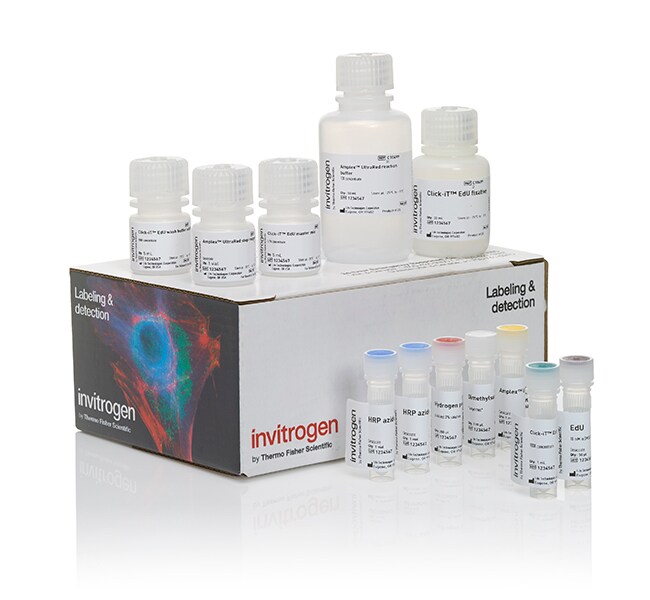
用于微孔板的 Click-iT™ EdU 增殖测定
The Click-iT EdU Proliferation Assay for Microplates provides a more simplified and robust method for the measurement of mammalian cell了解更多信息
| 货号 | 数量 |
|---|---|
| C10499 | 400 次检测 |
货号 C10499
价格(CNY)
5,507.00
飞享价
Ends: 31-Dec-2026
7,648.00共减 2,141.00 (28%)
Each
数量:
400 次检测
价格(CNY)
5,507.00
飞享价
Ends: 31-Dec-2026
7,648.00共减 2,141.00 (28%)
Each
The Click-iT EdU Proliferation Assay for Microplates provides a more simplified and robust method for the measurement of mammalian cell proliferation compared to traditional BrdU-based methods. After incorporation of EdU (a modified thymidine analogue) into newly synthesize DNA, horse radish peroxidase (HRP) is covalently attached via the highly specific click reaction. Amplex UltraRed Reagent, an HRP substrate, is then added and the resulting fluorescence signal detected. Because of the highly specific attachment of HRP to EdU, this assay results in highly sensitive and reliable measurement of mammalian cell proliferation in a microplate format.
Click-iT EdU Proliferation Assay for Microplates features include:
• Improved performance—direct conjugation of HRP to incorporated EdU improves assay sensitivity and accuracy
• Increased reliability—assay format results in low well-to-well variability
• Simplified protocol—results in reduced time to data; easier to follow protocol
• Multiplex enabled—assay can be easily multiplexed with other cell health reagents resulting in more data per sample
Measuring cell proliferation is a fundamental method of assessing cell health, determining genotoxicity, and evaluating anti-cancer drugs. The most accurate method of measuring proliferation is by direct detection of DNA synthesis. Originally this was accomplished through incorporation of a radioactive nucleoside (e.g., 3H-thymidine). This method was replaced by antibody-based detection of the nucleoside analog bromo-deoxyuridine (BrdU). After incorporation of BrdU into the newly synthesized DNA, denaturation is required to expose the BrdU molecules to the anti-BrdU antibody. The denaturation involves harsh methods (HCl, heat, or enzymes) and is time consuming and difficult to perform consistently.
The Click-iT EdU Proliferation Assay is an alternative to the BrdU assay. The nucleoside analog EdU (5-ethynyl-2´-deoxyuridine) is added to live cells and incorporated into DNA during active DNA synthesis. The incorporated EdU contains an alkyne group which is covalently joined to the azide group present in HRP using a highly specific copper-catalyzed covalent reaction ('click reaction'). Amplex UltraRed Reagent is then added and its conversion by HRP into a highly fluorescent product is recorded using a fluorescence microplate reader (excitation: 568, emission: 585 nm). With a high extinction coefficient, good quantum efficiency, and resistance to auto-oxidation, Amplex UltraRed Reagent delivers higher sensitivity and a broader assay range than other fluorogenic or colorimetric HRP substrates. It also offers versatility through detection by either fluorescence or absorbance measurement.
Compared to anti-BrdU-based microplate proliferation assays, the Click-iT EdU Proliferation Assay uses small reaction moieties and does not require antibodies or DNA denaturation, both of which can reduce assay performance. Additionally, streptavidin-biotin binding is not required, eliminating the necessary biotin blocking steps required by cells possessing high levels of endogenous biotin.
Click-iT EdU Proliferation Assay for Microplates features include:
• Improved performance—direct conjugation of HRP to incorporated EdU improves assay sensitivity and accuracy
• Increased reliability—assay format results in low well-to-well variability
• Simplified protocol—results in reduced time to data; easier to follow protocol
• Multiplex enabled—assay can be easily multiplexed with other cell health reagents resulting in more data per sample
Measuring cell proliferation is a fundamental method of assessing cell health, determining genotoxicity, and evaluating anti-cancer drugs. The most accurate method of measuring proliferation is by direct detection of DNA synthesis. Originally this was accomplished through incorporation of a radioactive nucleoside (e.g., 3H-thymidine). This method was replaced by antibody-based detection of the nucleoside analog bromo-deoxyuridine (BrdU). After incorporation of BrdU into the newly synthesized DNA, denaturation is required to expose the BrdU molecules to the anti-BrdU antibody. The denaturation involves harsh methods (HCl, heat, or enzymes) and is time consuming and difficult to perform consistently.
The Click-iT EdU Proliferation Assay is an alternative to the BrdU assay. The nucleoside analog EdU (5-ethynyl-2´-deoxyuridine) is added to live cells and incorporated into DNA during active DNA synthesis. The incorporated EdU contains an alkyne group which is covalently joined to the azide group present in HRP using a highly specific copper-catalyzed covalent reaction ('click reaction'). Amplex UltraRed Reagent is then added and its conversion by HRP into a highly fluorescent product is recorded using a fluorescence microplate reader (excitation: 568, emission: 585 nm). With a high extinction coefficient, good quantum efficiency, and resistance to auto-oxidation, Amplex UltraRed Reagent delivers higher sensitivity and a broader assay range than other fluorogenic or colorimetric HRP substrates. It also offers versatility through detection by either fluorescence or absorbance measurement.
Compared to anti-BrdU-based microplate proliferation assays, the Click-iT EdU Proliferation Assay uses small reaction moieties and does not require antibodies or DNA denaturation, both of which can reduce assay performance. Additionally, streptavidin-biotin binding is not required, eliminating the necessary biotin blocking steps required by cells possessing high levels of endogenous biotin.
仅供科研使用。不可用于诊断程序。
规格
检测方法荧光
产品规格96 孔板
环保功能危害更小
数量400 次检测
运输条件经批准可在室温下或置于湿冰上运输
适用于(应用)增殖测定试剂盒
适用于(设备)微孔板读数仪
产品线CyQUANT
产品类型增殖测定试剂盒
Unit SizeEach
内容与储存
储存于 -20°C 干燥环境下,避光。