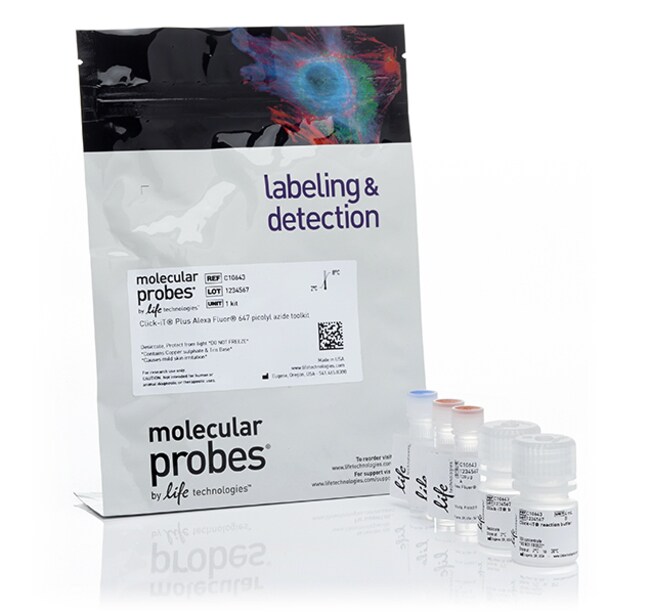
Click-iT™ Plus Alexa Fluor™ 647 吡啶甲基叠氮化物工具包
Invitrogen™

Click-iT™ Plus Alexa Fluor™ 647 吡啶甲基叠氮化物工具包

Click-iT™ Plus Alexa Fluor™ 吡啶甲基叠氮化物工具包包含进行与对铜敏感的化合物进行铜催化点击反应所需的所有试剂,同时保留标准叠氮化物/炔烃点击反应的全部优势。吡啶甲基叠氮化物可与螯合铜有效反应,因此可尽可能减少点击反应中的游离铜,从而防止不需要的铜与蛋白(如 GFP、RPE了解更多信息
Have Questions?
货号数量
C106431 个试剂盒
货号 C10643
价格(CNY)
6,908.00
Each
添加至购物车
数量:
1 个试剂盒
价格(CNY)
6,908.00
Each
添加至购物车
Click-iT™ Plus Alexa Fluor™ 吡啶甲基叠氮化物工具包包含进行与对铜敏感的化合物进行铜催化点击反应所需的所有试剂,同时保留标准叠氮化物/炔烃点击反应的全部优势。吡啶甲基叠氮化物可与螯合铜有效反应,因此可尽可能减少点击反应中的游离铜,从而防止不需要的铜与蛋白(如 GFP、RPE)、核酸(如 RNA、寡核苷酸)甚至小分子(例如鬼笔环肽)的副反应。

• 灵活—优化您本身的用于检测或标记任何体外或细胞内和组织样品中含炔烃生物分子的 Click–iT™ 反应
• 明亮而灵敏—优越的荧光 Alexa Fluor™ 染料,与吡啶甲基叠氮化物的效率结合
• 便利—包含创建理想点击反应所需的所有缓冲液和试剂

每个 Click-iT™ Plus 吡啶甲基叠氮化物工具包包括 100 µg Alexa Fluor™ 染料-吡啶甲基叠氮化物和所有使用理想的铜和螯合物浓度创建反应混合物用于任何点击化学性标记或检测应用所需的所有试剂。产品手册中提供了设计和优化您选择的吡啶甲基叠氮化物/炔烃点击反应的指南。此外,与使用相同反应条件的标准叠氮化物相比,Click-iT™ Plus 吡啶甲基叠氮化物具有更高的灵敏度和更快的反应时间。
仅供科研使用。不可用于诊断程序。
规格
描述Click-iT™ Plus Alexa Fluor ™647 吡啶甲基叠氮化物工具包,5 mg,固体,650 nm 发射,670 nm 激发,1 年有效期,2 至 8°C 储存要求,无害绿色环保特性,用于标记化学
激发/发射650/670
适用于(应用)标记化学、细胞分析、点击化学、点击化学糖蛋白分析、点击化学代谢标记和新生蛋白合成、点击化学细胞增殖、点击新生 RNA 检测和捕获
产品规格固体
套装内容1 x 100 μg Alexa Fluor™ 染料 - 吡啶甲基叠氮化物,1 x 4 mL Click-iT™ 反应缓冲液,1 x 1.5 mL 铜 (II) 硫酸盐,1 x 500 μL 铜保护剂,1 Click-iT™ 缓冲液添加剂
产品线Click-iT™
产品类型Click-iT™ Plus Alexa Fluor™ 647 吡啶甲基叠氮化物工具包
数量1 个试剂盒
标签或染料Alexa Fluor 647
Unit SizeEach
内容与储存
  • 1 x 100 μg Alexa Fluor™ 染料-吡啶甲基叠氮化物
  • 1 x 4 mL Click-iT™ 反应缓冲液
  • 1 x 1.5 mL 铜 (II) 硫酸盐
  • 1 x 500 μL 铜保护剂
  • 1 份 Click-iT™ 缓冲液添加剂
在 2 至 8°C 下储存

常见问题解答 (FAQ)

What is the fluorescence excitation and emission maxima of Alexa Fluor 647 dye?

Alexa Fluor 647 has an excitation/emission maxima of 650/670 nm.

Find additional tips, troubleshooting help, and resources within our Cell Analysis Support Center.

What are the main characteristics of a Click-iT reaction?

Click reactions have several general characteristics: the reaction is efficient, no extreme temperatures or solvents are required, the reaction is complete within 30 minutes, the components of the reaction are bio-inert, and perhaps most importantly, no side reactions occur-the label and detection tags react selectively and specifically with one another. This final point is a key advantage of this powerful detection technique; it is possible to apply click chemistry-labeled molecules to complex biological samples and detect them with unprecedented sensitivity due to the extremely low background of the reaction.

Find additional tips, troubleshooting help, and resources within our Cell Analysis Support Center.

I will be performing a cell proliferation assay using Click-iT EdU kit. At what point can I stop overnight, or do I have to perform all the steps continuously?

One may store the sample after fixation overnight in PBS at 4oC. For longer storage (<1 week) , store in buffer with 1-2% formaldehyde or in formalin to limit microbial growth. If you use sodium azide as a microbial inhibitor, it must be completely removed prior to the Click-iT reaction.

Find additional tips, troubleshooting help, and resources within our Cell Viability, Proliferation, Cryopreservation, and Apoptosis Support Center.

Can I combine Click-iT or Click-iT Plus reactions with phalloidin conjugates used for actin staining?

We do not recommend using phalloidin conjugates for staining actin in combination with traditional Click-iT or Click-iT Plus reactions since phalloidin is extremely sensitive to the presence of copper.

For staining actin in combination with traditional Click-iT or Click-iT Plus reactions, we recommend using anti-α-actin antibodies for staining actin in the cytoskeleton. You can find a list of our actin antibodies here.

Another option would be to use the Click-iT Plus Alexa Fluor Picolyl Azide Toolkit (Cat. Nos. C10641, C10642, C10643). These Click-iT Plus toolkits provide Copper and Copper protectant separately which makes it easier to titrate the copper concentration to obtain optimal labeling with minimal copper-mediated damage. You may need to optimize the click reaction with the lowest possible concentration of copper and then perform the phalloidin staining.

Find additional tips, troubleshooting help, and resources within our Cell Analysis Support Center.