Search


引用和文献 (8)
Invitrogen™
One Shot™ TOP10F' 化学感受态大肠杆菌
One Shot™ TOP10F´ 化学感受态大肠杆菌与 TOP10 细胞相同,只不过增加了一个 F´ 附加体。以 1了解更多信息
Have Questions?
更改视图

| 货号 | 数量 |
|---|---|
| C303003 | 20 x 50μL |
| C303006 | 40 x 50μL |
货号 C303003
价格(CNY)
3,266.00
飞享价
Ends: 31-Dec-2026
4,083.00共减 817.00 (20%)
Each
数量:
20 x 50μL
价格(CNY)
3,266.00
飞享价
Ends: 31-Dec-2026
4,083.00共减 817.00 (20%)
Each
One Shot™ TOP10F´ 化学感受态大肠杆菌与 TOP10 细胞相同,只不过增加了一个 F´ 附加体。以 1 x 10⁹ cfg/µg 超螺旋 DNA 的转化效率提供 TOP10 感受态细胞,此种细胞适用于高效克隆与质粒增殖。
使用 One Shot™ TOP10F´ 化学感受态大肠杆菌
F´ 附加体可携带四环素抗性基因,可从具有 f1 复制起点的载体中分离出单链 DNA。此外,F'´附加体携带 lacIq 阻遏物,可阻遏使用 IPTG 从trc、tac 和 lac 启动子中进行的诱导性表达。TOP10F´ 细胞需要 IPTG 诱导才可进行蓝白斑筛选。
使用 One Shot™ TOP10F´ 化学感受态大肠杆菌
F´ 附加体可携带四环素抗性基因,可从具有 f1 复制起点的载体中分离出单链 DNA。此外,F'´附加体携带 lacIq 阻遏物,可阻遏使用 IPTG 从trc、tac 和 lac 启动子中进行的诱导性表达。TOP10F´ 细胞需要 IPTG 诱导才可进行蓝白斑筛选。
仅供科研使用。不可用于诊断程序。
规格
耐抗生素细菌Yes (Streptamycin, Tetracycline)
蓝色/白色筛查是
是否可克隆甲基化 DNA是
克隆不稳定 DNA不适合克隆不稳定DNA
是否含 F' 附加体包含F'附加体
高通量能力不兼容高通量应用(手动)
提高质粒质量是
制备无甲基化 DNA不适合制备未甲基化DNA
产品线One Shot
产品类型感受态细胞
数量20 x 50μL
减少克隆重组现象是
运输条件Dry Ice
T1 噬菌体 - 抗性 (tonA)否
转化效率级别高效率 (> 10^9 cfu⁄μg)
产品规格One Shot
促进剂Trc、Tac、Lac
种属大肠杆菌
Unit SizeEach
内容与储存
包含:
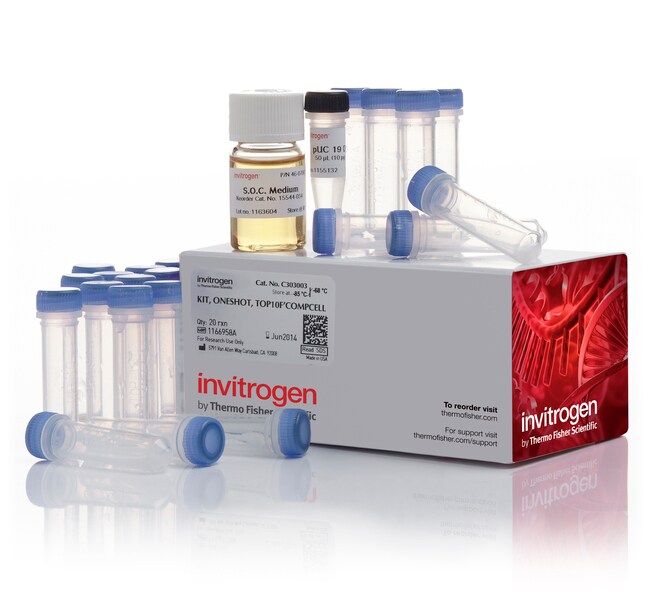
• One Shot™ TOP10F′ 化学感受态大肠杆菌:21 小瓶,各 50 µL
• pUC19 DNA (10 pg/µL):1 小瓶,50 µL
• S.O.C. 培养基:1 瓶,6 mL
感受态细胞储存在 -80°C 下。pUC19 DNA 储存在 -20°C 下。SOC 培养基储存在 4°C 或室温下。
• One Shot™ TOP10F′ 化学感受态大肠杆菌:21 小瓶,各 50 µL
• pUC19 DNA (10 pg/µL):1 小瓶,50 µL
• S.O.C. 培养基:1 瓶,6 mL
感受态细胞储存在 -80°C 下。pUC19 DNA 储存在 -20°C 下。SOC 培养基储存在 4°C 或室温下。
常见问题解答 (FAQ)
TOP10细胞与TOP10F’细胞的区别是什么?
我正在尝试克隆一个毒性可能非常大的插入片段。我使用过DH5α和TOP10细胞进行转化但是没有在平板上得到克隆。你们能为我提供一些建议吗?
What is the difference between TOP10 and TOP10F' cells?
I am trying to clone an insert that is supposedly pretty toxic. I used DH5? and TOP10 cells for the transformation and got no colonies on the plate. Do you have any suggestions for me?
What advantages do your Stbl2 cells offer over other cloning strains?
引用和文献 (8)
引用和文献
Abstract
Metabolism of 4 beta -hydroxycholesterol in humans.
Journal:J Biol Chem
PubMed ID:12077124
'One of the major oxysterols in the human circulation is 4 beta-hydroxycholesterol formed from cholesterol by the drug-metabolizing enzyme cytochrome P450 3A4. Deuterium-labeled 4 beta-hydroxycholesterol was injected into two healthy volunteers, and the apparent half-life was found to be 64 and 60 h, respectively. We have determined earlier the half-lives
Functional and molecular characterization of nucleobase transport by recombinant human and rat equilibrative nucleoside transporters 1 and 2. Chimeric constructs reveal a role for the ENT2 helix 5-6 region in nucleobase translocation.
Journal:J Biol Chem
PubMed ID:12006583
'The human (h) and rat (r) equilibrative (Na(+)-independent) nucleoside transporters (ENTs) hENT1, rENT1, hENT2, and rENT2 belong to a family of integral membrane proteins with 11 transmembrane domains (TMs) and are distinguished functionally by differences in sensitivity to inhibition by nitrobenzylthioinosine and coronary vasoactive drugs. Structurally, the proteins have a
Mutation at the catalytic site of topoisomerase I in CEM/C2, a human leukemia cell line resistant to camptothecin.
Journal:Cancer Res
PubMed ID:7882333
'We developed previously a resistant cell line, CEM/C2, from the human leukemia cell line CCRF-CEM by stepwise selection in camptothecin. This cell line is 974-fold more resistant to camptothecin than parental cells. Resistance is only partially explained by 2-fold reductions in topoisomerase I protein and mRNA levels. We further investigated
Characterization of a novel 23-kilodalton protein of unactive progesterone receptor complexes.
Journal:Mol Cell Biol
PubMed ID:8114727
'Immunoprecipitation of unactivated avian progesterone receptor results in the copurification of hsp90, hsp70, and three additional proteins, p54, p50, and p23. p23 is also present in immunoaffinity-purified hsp90 complexes along with hsp70 and another protein, p60. Antibody and cDNA probes for p23 were prepared in an effort to elucidate the
Cloning of cockroach allergen, Bla g 4, identifies ligand binding proteins (or calycins) as a cause of IgE antibody responses.
Journal:J Biol Chem
PubMed ID:8537384
An allergen cloned from a Blattella germanica (German cockroach) cDNA library, encoded a 182-amino acid protein of 20,904 Da. This protein, designated B. germanica allergen 4 (Bla g 4), was expressed as a glutathione S-transferase fusion protein in Escherichia coli and purified by affinity chromatography and high-performance liquid chromatography. The