Search


引用和文献 (5)
Invitrogen™
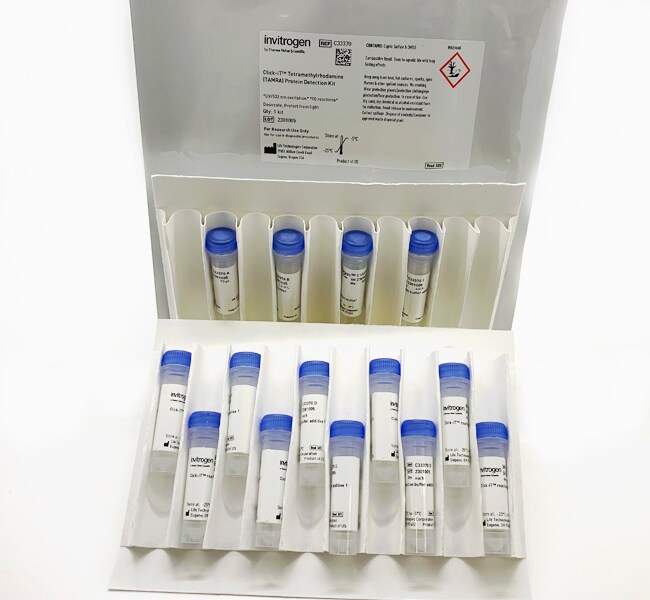
Click-iT™ 四甲基罗丹明 (TAMRA) 蛋白质分析检测试剂盒
Click-iT™ 四甲基罗丹明 (TAMRA) 糖蛋白检测试剂盒提供了一种简单而可靠的两步法技术的第二部分,可用于通过一维或二维凝胶电泳鉴定和表征糖蛋白。在第二步中,使用 Click-iT™ 代谢标记试剂或 Click-iT™ 酶促标记体系将叠氮化物把手掺入蛋白质聚糖结构之后,通过叠氮化物和炔烃之间的化学选择性连接或 click了解更多信息
| 货号 | 数量 |
|---|---|
| C33370 | 1 Kit |
货号 C33370
价格(CNY)
4,066.00
飞享价
Ends: 31-Dec-2026
5,494.00共减 1,428.00 (26%)
Each
数量:
1 Kit
价格(CNY)
4,066.00
飞享价
Ends: 31-Dec-2026
5,494.00共减 1,428.00 (26%)
Each
Click-iT™ 四甲基罗丹明 (TAMRA) 糖蛋白检测试剂盒提供了一种简单而可靠的两步法技术的第二部分,可用于通过一维或二维凝胶电泳鉴定和表征糖蛋白。在第二步中,使用 Click-iT™ 代谢标记试剂或 Click-iT™ 酶促标记体系将叠氮化物把手掺入蛋白质聚糖结构之后,通过叠氮化物和炔烃之间的化学选择性连接或 click 反应检测叠氮化物修饰的糖蛋白。然后,使用 Multiplexed Proteomics™ 技术、SYPRO™ Ruby 总蛋白染料以及 PRO-Q™ Emerald 糖蛋白染料对含有 TAMRA 标记糖蛋白的凝胶进行染色,从而在同一块凝胶上进行糖蛋白亚类、总蛋白和总糖蛋白的差异分析。Click-iT™ 修饰的糖蛋白还兼容下游 LC-MS/MS 和 MALDI MS 分析用于进一步鉴定。
仅供科研使用。不可用于诊断程序。
规格
检测方法荧光
标记目标蛋白质(糖蛋白)
标签或染料TAMRA™ 异构体、TMR(四甲基罗丹明)
产品类型TAMRA 蛋白分析检测试剂盒
数量1 Kit
运输条件室温
产品线Click-iT
Unit SizeEach
内容与储存
在冷冻冰箱(-5°C 至 -30°C)中储存。
常见问题解答 (FAQ)
I am using Click-iT AHA (L-azidohomoalanine) kit to label nascent proteins in live cells, then detecting with TAMRA alkyne after fixation and permeabilization and a click reaction. But I'm seeing nucleolar labeling in the cells. It this expected?
引用和文献 (5)
引用和文献
Abstract
Protein synthesis in distal axons is not required for growth cone responses to guidance cues.
Journal:J Neurosci
PubMed ID:19158291
'Recent evidence suggests that growth cone responses to guidance cues require local protein synthesis. Using chick neurons, we investigated whether protein synthesis is required for growth cones of several types to respond to guidance cues. First, we found that global inhibition of protein synthesis stops axonal elongation after 2 h.
Direct in-gel fluorescence detection and cellular imaging of O-GlcNAc-modified proteins.
Journal:J Am Chem Soc
PubMed ID:18683930
'We report an advanced chemoenzymatic labeling strategy for direct fluorescence detection of O-GlcNAc proteins in gels that facilitates proteomic studies and greatly extend the reach of existing technologies. These new tools also enable the expression and dynamics of O-GlcNAc modifications to be monitored by imaging in cells and tissues.
The cytoplasmic tail dileucine motif LL572 determines the glycosylation pattern of membrane-type 1 matrix metalloproteinase.
Journal:J Biol Chem
PubMed ID:18955496
'Membrane-type 1 matrix metalloproteinase (MT1-MMP; MMP-14) drives fundamental physiological and pathological processes, due to its ability to process a broad spectrum of substrates. Because subtle changes in its activity can produce profound physiological effects, MT1-MMP is tightly regulated. Currently, many aspects of this regulation remain to be elucidated. It has
A novel approach to tag and identify geranylgeranylated proteins.
Journal:Electrophoresis
PubMed ID:19784953
A recently developed proteomic strategy, the
Regulation of calcium/calmodulin-dependent kinase IV by O-GlcNAc modification.
Journal:J Biol Chem
PubMed ID:19506079
Similar to phosphorylation, GlcNAcylation (the addition of O-GlcNAc to Ser(Thr) residues on polypeptides) is an abundant, dynamic, and inducible post-translational modification. GlcNAcylated proteins are crucial in regulating virtually all cellular processes, including signaling, cell cycle, and transcription. Here we show that calcium/calmodulin-dependent kinase IV (CaMKIV) is highly GlcNAcylated in vivo.