Search


引用和文献 (6)
Invitrogen™
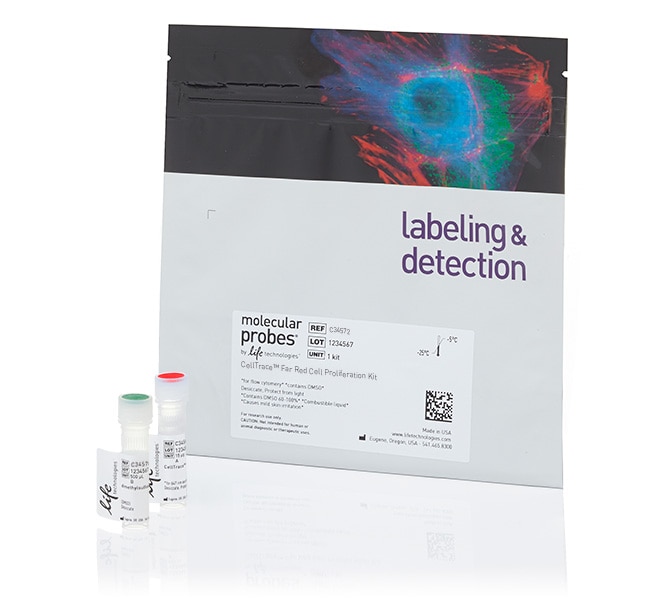
CellTrace™ 远红外细胞增殖试剂盒,用于流式细胞分析
CellTrace™ 远红细胞增殖试剂盒适用于体外和体内标记细胞,采用染料稀释法通过流式细胞分析追踪多代细胞。•卓越的性能—明亮的单峰染色可实现多代细胞可视化信号• 荧光信号长期稳定—染色后染料可在细胞中保留数天• 通用性—多种颜色可供选择,轻松结合抗体或细胞功能标志物(如 GFP)• 简单而可靠的染色方案查看用于流式细胞分析的所有 CellTrace™了解更多信息
Have Questions?
更改视图

| 货号 | 数量 |
|---|---|
| C34572 | 20 Assays |
| C34564 | 1套试剂盒 |
货号 C34572
价格(CNY)
1,036.00
飞享价
Ends: 31-Dec-2025
1,376.00共减 340.00 (25%)
Each
数量:
20 Assays
价格(CNY)
1,036.00
飞享价
Ends: 31-Dec-2025
1,376.00共减 340.00 (25%)
Each
CellTrace™ 远红细胞增殖试剂盒适用于体外和体内标记细胞,采用染料稀释法通过流式细胞分析追踪多代细胞。
•卓越的性能—明亮的单峰染色可实现多代细胞可视化信号
• 荧光信号长期稳定—染色后染料可在细胞中保留数天
• 通用性—多种颜色可供选择,轻松结合抗体或细胞功能标志物(如 GFP)
• 简单而可靠的染色方案
查看用于流式细胞分析的所有 CellTrace™ 细胞增殖试剂盒的选择指南。
卓越的荧光染色效果
使用染料稀释法成功地进行增殖分析需要极明亮的染料,以便在数次细胞分裂后区分荧光标记的细胞和自发荧光。CellTrace™ 远红染料能实现高强度荧光染色,在细胞固有的自发荧光掩盖标记荧光信号之前,可实现六代或更多代增殖细胞的可视化。本试剂盒能获得一致、均匀的染色结果,群体中细胞之间的荧光变异很小,无需复杂的建模软件即可明显区分细胞代数。
信号保留时间长
与标记细胞脂质膜的染色剂不同,CellTrace™ 远红染色剂轻松穿过质膜,并与细胞内的物质共价结合,即使处于细胞培养环境中数天,荧光染料仍然保留良好,并且比较稳定,能提供一致的荧光信号。CellTrace™ 远红染料可共价结合细胞表面和细胞内的所有游离胺,细胞毒性极小,对细胞增殖能力或细胞生物学影响很小。
易于与其他荧光基团进行多重分析
CellTrace™ 远红染料的红色激发波长为 630 nm,发射波长为 661 nm,且因为与其他常见染料(Alexa Fluor™ 488、FITC 和 RPE)和荧光蛋白(绿色荧光蛋白 (GFP) 和 mCherry)的光谱重叠有限,使其非常适用于进行多重分析。
简单而可靠的染色方案
CellTrace™ 远红细胞增殖试剂盒含有方便一次性使用的样品瓶装染料粉末,可用于小规模实验,免于染料制备过量。使用前,用无水 DMSO 溶解小瓶内容物,制成储备液。对无蛋白培养基中的 1 mL 细胞染色,通常使用 1 µL 储备液。细胞应在室温下染色 20 分钟,染色期间轻轻搅拌。用完全培养基简单清洗一下即可淬灭溶液中残余的染料。
•卓越的性能—明亮的单峰染色可实现多代细胞可视化信号
• 荧光信号长期稳定—染色后染料可在细胞中保留数天
• 通用性—多种颜色可供选择,轻松结合抗体或细胞功能标志物(如 GFP)
• 简单而可靠的染色方案
查看用于流式细胞分析的所有 CellTrace™ 细胞增殖试剂盒的选择指南。
卓越的荧光染色效果
使用染料稀释法成功地进行增殖分析需要极明亮的染料,以便在数次细胞分裂后区分荧光标记的细胞和自发荧光。CellTrace™ 远红染料能实现高强度荧光染色,在细胞固有的自发荧光掩盖标记荧光信号之前,可实现六代或更多代增殖细胞的可视化。本试剂盒能获得一致、均匀的染色结果,群体中细胞之间的荧光变异很小,无需复杂的建模软件即可明显区分细胞代数。
信号保留时间长
与标记细胞脂质膜的染色剂不同,CellTrace™ 远红染色剂轻松穿过质膜,并与细胞内的物质共价结合,即使处于细胞培养环境中数天,荧光染料仍然保留良好,并且比较稳定,能提供一致的荧光信号。CellTrace™ 远红染料可共价结合细胞表面和细胞内的所有游离胺,细胞毒性极小,对细胞增殖能力或细胞生物学影响很小。
易于与其他荧光基团进行多重分析
CellTrace™ 远红染料的红色激发波长为 630 nm,发射波长为 661 nm,且因为与其他常见染料(Alexa Fluor™ 488、FITC 和 RPE)和荧光蛋白(绿色荧光蛋白 (GFP) 和 mCherry)的光谱重叠有限,使其非常适用于进行多重分析。
简单而可靠的染色方案
CellTrace™ 远红细胞增殖试剂盒含有方便一次性使用的样品瓶装染料粉末,可用于小规模实验,免于染料制备过量。使用前,用无水 DMSO 溶解小瓶内容物,制成储备液。对无蛋白培养基中的 1 mL 细胞染色,通常使用 1 µL 储备液。细胞应在室温下染色 20 分钟,染色期间轻轻搅拌。用完全培养基简单清洗一下即可淬灭溶液中残余的染料。
仅供科研使用。不可用于诊断程序。
规格
检测方法荧光
染料类型含1小瓶 CellTrace™ 远红外染料和1小瓶 DMSO (100μL)
形式实心
产品规格管
数量20 Assays
试剂类型CFSE & 相关化合物
运输条件室温
溶解度DMSO(二甲亚砜)
发射661
适用于(设备)流式细胞仪
产品线CellTrace
产品类型细胞增殖试剂盒
Unit SizeEach
内容与储存
含1小瓶 CellTrace™ 远红外染料和1小瓶 DMSO (100 μL)。在冰箱中(-5°C 至 -30°C)储存。
常见问题解答 (FAQ)
我储存了CellTrace细胞增殖试剂的DMSO储液。相比于新鲜溶解的染料储液,我所获得的细胞信号较差。为何这种产品储存后会失效?
我使用CellTrace细胞增殖试剂时无法获得清晰分离的细胞增殖峰,如何改善峰分离效果?
我能储存CellTrace试剂的储备液么且你们建议如何储存?
CellTrace细胞增殖试剂工作原理是什么?
我想用核酸染料来追踪我的细胞,比如DAPI或者Hoechst染料。您有什么建议吗?
引用和文献 (6)
引用和文献
Abstract
Microfluidic Encapsulation Supports Stem Cell Viability, Proliferation, and Neuronal Differentiation.
Journal:Tissue Eng Part C Methods
PubMed ID:29258387
'Stem cell encapsulation technology demonstrates much promise for the replacement of damaged tissue in several diseases, including spinal cord injury (SCI). The use of biocompatible microcapsules permits the control of stem cell fate in situ to facilitate the replacement of damaged/lost tissue. In this work, a novel customized microfluidic device
Synergistic activity of sorafenib and betulinic acid against clonogenic activity of non-small cell lung cancer cells.
Journal:Cancer Sci
PubMed ID:28846180
The highly selective multi-targeted agent sorafenib is an inhibitor of a number of intracellular signaling kinases with anti-proliferative, anti-angiogenic and pro-apoptotic effects in various types of tumors, including human non-small cell lung cancer (NSCLC). Betulin displays a broad spectrum of biological and pharmacological properties, including anticancer and chemopreventive activity. Combination
Coordinated Splicing of Regulatory Detained Introns within Oncogenic Transcripts Creates an Exploitable Vulnerability in Malignant Glioma.
Journal:Cancer Cell
PubMed ID:28966034
Glioblastoma (GBM) is a devastating malignancy with few therapeutic options. We identify PRMT5 in an in vivo GBM shRNA screen and show that PRMT5 knockdown or inhibition potently suppresses in vivo GBM tumors, including patient-derived xenografts. Pathway analysis implicates splicing in cellular PRMT5 dependency, and we identify a biomarker that predicts sensitivity
Hypoxic Stress Decreases c-Myc Protein Stability in Cardiac Progenitor Cells Inducing Quiescence and Compromising Their Proliferative and Vasculogenic Potential.
Journal:Sci Rep
PubMed ID:28851980
Cardiac progenitor cells (CPCs) have been shown to promote cardiac regeneration and improve heart function. However, evidence suggests that their regenerative capacity may be limited in conditions of severe hypoxia. Elucidating the mechanisms involved in CPC protection against hypoxic stress is essential to maximize their cardioprotective and therapeutic potential. We
Microparticles shed from multidrug resistant breast cancer cells provide a parallel survival pathway through immune evasion.
Journal:BMC Cancer
PubMed ID:28166767
Breast cancer is the most frequently diagnosed cancer in women. Resident macrophages at distant sites provide a highly responsive and immunologically dynamic innate immune response against foreign infiltrates. Despite extensive characterization of the role of macrophages and other immune cells in malignant tissues, there is very little known about the