Search


引用和文献 (6)
Invitrogen™
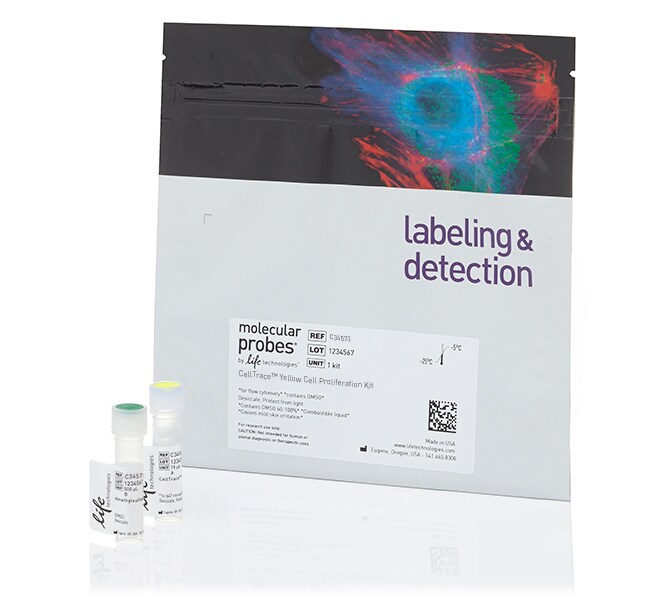
CellTrace™ Yellow 细胞增殖试剂盒(用于流式细胞分析)
CellTrace™ Yellow 细胞增殖试剂盒适用于体外和体内标记细胞,采用染料稀释法通过流式细胞分析追踪多代细胞。本试剂专门设计用于 532 nm 或 561 nm 激光激发,易于与其他常用激光激发的试剂和抗体配合使用进行多重分析了解更多信息
Have Questions?
更改视图

| 货号 | 数量 |
|---|---|
| C34573 | 20 次检测 |
| C34567 | 180 次检测 |
货号 C34573
价格(CNY)
1,030.00
飞享价
Ends: 31-Dec-2025
1,369.00共减 339.00 (25%)
Each
数量:
20 次检测
价格(CNY)
1,030.00
飞享价
Ends: 31-Dec-2025
1,369.00共减 339.00 (25%)
Each
CellTrace™ Yellow 细胞增殖试剂盒适用于体外和体内标记细胞,采用染料稀释法通过流式细胞分析追踪多代细胞。本试剂专门设计用于 532 nm 或 561 nm 激光激发,易于与其他常用激光激发的试剂和抗体配合使用进行多重分析。
•卓越的性能—明亮的单峰染色可实现多代细胞可视化
•长期信号稳定性—染色后染料可在细胞中保留数天
•通用性—多种颜色可供选择,易于与细胞功能抗体或标志物结合使用
•简单—稳健的染色方案
卓越的荧光染色效果
使用染料稀释法成功地进行增殖分析需要极亮的染料,来区分数次细胞分裂后的荧光标记细胞和自动荧光。CellTrace Yellow 染料能产生高强度荧光染色,在细胞固有的自动荧光掩盖标记荧光信号之前,实现六代或更多代增殖细胞的可视化。本试剂盒能获得一致、均匀的染色结果,群体中细胞之间的荧光变异很小,无需复杂的建模软件即可明显区分细胞代数。
信号保留时间长
与标记细胞脂质膜的染色剂不同,CellTrace Yellow 染料容易穿过细胞膜,并与细胞内的物质共价结合,即使细胞培养数天,荧光染料仍然保留良好,并且比较稳定,能提供一致的荧光信号。CellTrace Yellow 染料可共价结合细胞表面和细胞内的所有游离胺,细胞毒性极小,对细胞增殖能力或细胞生物学影响很小。
易于与其他荧光基团进行多重分析
CellTrace Yellow 染料的黄色激发波长为 546 nm,发射波长为 579 nm,且因为与其他常见染料(如 Alexa Fluor™ 488 和 FITC)和绿色荧光蛋白 (GFP) 的光谱重叠有限,使其非常适用于进行多重分析。
使用 SpectraViewer 帮助您进行实验规划。
简单而可靠的染色方案
CellTrace 远红外细胞增殖试剂盒含有便利的单次使用样品瓶装染料粉末,可用于小规模实验,无需制备过量染料。使用前,用无水 DMSO 溶解样品瓶内容物,制成储备液。染色 1 mL 无蛋白培养基的细胞通常使用 1 µL 储备液。在室温下染色 20 分钟即可,染色期间轻轻搅拌。随后,用完全培养基简单清洗一下,然后淬灭溶液中残余的染料。
仅供科研使用。不可用于诊断程序。
规格
检测方法荧光
染料类型CellTrace™ Yellow
形式固体
产品规格管
数量20 次检测
试剂类型CFSE & 相关化合物
运输条件室温
溶解度DMSO(二甲亚砜)
发射579
Excitation Wavelength Range532 或 561,532
适用于(应用)增殖测定试剂盒
适用于(设备)流式细胞仪
产品线CellTrace
产品类型细胞增殖试剂盒
Unit SizeEach
内容与储存
- 1 样品瓶 CellTrace™ Yellow 染料
- 100 µL DMSO
- 在冰箱中(-5°C 至 -30°C)储存
常见问题解答 (FAQ)
我储存了CellTrace细胞增殖试剂的DMSO储液。相比于新鲜溶解的染料储液,我所获得的细胞信号较差。为何这种产品储存后会失效?
我使用CellTrace细胞增殖试剂时无法获得清晰分离的细胞增殖峰,如何改善峰分离效果?
我能储存CellTrace试剂的储备液么且你们建议如何储存?
CellTrace细胞增殖试剂工作原理是什么?
我想用核酸染料来追踪我的细胞,比如DAPI或者Hoechst染料。您有什么建议吗?
引用和文献 (6)
引用和文献
Abstract
Deriving Quantitative Cell Biological Information from Dye-Dilution Lymphocyte Proliferation Experiments.
Journal:Methods Mol Biol
PubMed ID:29388101
'The dye-dilution assay is a powerful tool to study lymphocyte expansion dynamics. By combining time course dye-dilution experiments with computational analysis, quantitative information about cell biological parameters, such as percentage of cells dividing, time of division, and time of death, can be produced. Here, we describe the method to generate
Triple co-culture of human alveolar epithelium, endothelium and macrophages for studying the interaction of nanocarriers with the air-blood barrier.
Journal:Acta Biomater
PubMed ID:31004840
'Predictive in vitro models are valuable alternatives to animal experiments for evaluating the transport of molecules and (nano)particles across biological barriers. In this work, an improved triple co-culture of air-blood barrier was set-up, being exclusively constituted by human cell lines that allowed to perform experiments at air-liquid interface. Epithelial NCI-H441
Isolation and Activation of Murine Lymphocytes.
Journal:J Vis Exp
PubMed ID:27842342
'B and T cells, with their extremely diverse antigen-receptor repertoires, have the ability to mount specific immune responses against almost any invading pathogen(1,2). Understandably, such intricate abilities are controlled by a large number of molecules involved in various cellular processes to ensure timely and spatially regulated immune responses(3). Here, we
Superior properties of CellTrace Yellow™ as a division tracking dye for human and murine lymphocytes.
Journal:Immunol Cell Biol
PubMed ID:29363164
The discovery of cell division tracking properties of 5-(and-6)-carboxyfluorescein diacetate succinimidyl ester (CFSE) by Lyons and Parish in 1994 led to a broad range of new methods and numerous important biological discoveries. After labeling, CFSE is attached to free amine groups and intracellular proteins in the cytoplasm and nucleus of
Autoreactive, Low-Affinity T Cells Preferentially Drive Differentiation of Short-Lived Memory B Cells at the Expense of Germinal Center Maintenance.
Journal:Cell Rep
PubMed ID:30566861
B cell fate decisions within a germinal center (GC) are critical to determining the outcome of the immune response to a given antigen. Here, we characterize GC kinetics and B cell fate choices in a response to the autoantigen myelin oligodendrocyte glycoprotein (MOG) and compare the response with a standard