Search


引用和文献 (1)
Invitrogen™
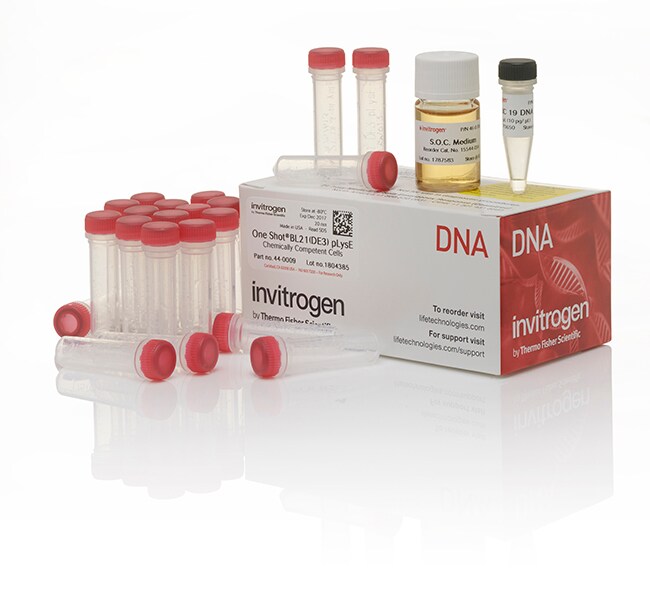
One Shot™ BL21(DE3)pLysE 化学感受态大肠杆菌
One Shot BL21(DE3)pLysE Chemically Competent E. coli cells are ideal for use with bacteriophage T7 promoter-based expression systems such as了解更多信息
| 货号 | 数量 |
|---|---|
| C656503 | 20 x 50μL |
货号 C656503
价格(CNY)
2,582.00
飞享价
Ends: 31-Dec-2026
3,228.00共减 646.00 (20%)
Each
数量:
20 x 50μL
价格(CNY)
2,582.00
飞享价
Ends: 31-Dec-2026
3,228.00共减 646.00 (20%)
Each
One Shot BL21(DE3)pLysE Chemically Competent E. coli cells are ideal for use with bacteriophage T7 promoter-based expression systems such as pRSET and pET. The pLysE plasmid carried by the BL21(DE3)pLysE strain produces higher amounts of T7 lysozyme than pLysS to further reduce basal level expression of the gene of interest. Like pLysS, pLysE confers resistance to chloramphenicol (CamR) and contains the p15A origin for compatibility with plasmids containing the ColE1 or pMB1 origin (i.e. pUC- or pBR322- derived plasmids). Recombinant proteins that are nontoxic to E. coli are generally expressed at higher levels in BL21(DE3) cells as compared to the BL21(DE3)pLysE strain with tighter expression control. The BL21(DE3)pLysE strain is recommended for use when expressing toxic genes (alternatively, BL21-AI could be considered).
The BL21 (DE3) E. coli strain is one of the most popular host strains to produce recombinant proteins and adapted in research or industrial applications (e.g., first biopharmaceutical recombinant human insulin). This strain had been engineered to carry the λDE3 lysogen that contains the T7 RNA polymerase gene under control of the lacUV5 promoter. IPTG is required to induce expression of the T7 RNA polymerase cascade system that in turn transcribe the T7 promoter regulated target gene.
BL21(DE3) is a derivative of the E. coli B strain that does not contain the lon protease and is also deficient in the outer membrane protease OmpT. The lack of two key proteases reduces degradation of heterologous proteins expressed in the strains. Additionally, several other strain features make them especially suited for protein production, namely fast growth in minimal medium, a lower acetate production when grown in high glucose media, and the ability to reach high cell density.
One Shot BL21(DE3)pLysE Chemically Competent E. coli offer:
• Transformation efficiency of >1 x 10⁷ cfu/μg control plasmid DNA
• Ion and OmpT protease deficiency reduces degradation of recombinant protein
• IPTG-inducible lacUV5 promoter controls expression of the T7 RNA polymerase
• pLysE (CamR) plasmid for reduced basal expression in uninduced cells
• hsdS mutation allows efficient transformation of unmethylated DNA
• Fast growth in minimal medium and ability to reach high cell density
BL21(DE3)pLysE E. coli are ideal for use with T7 promoter-based expression vectors. Like BL21(DE3)pLysS E. coli, BL21(DE3)pLysE cells carry the lambda DE3 lysogen. In addition, BL21(DE3)pLysE cells contain the pLysE plasmid, which constitutively expresses T7 lysozyme. T7 lysozyme reduces the basal expression of target genes by inhibiting T7 RNA polymerase. The pLysE plasmid in BL21(DE3)pLysE expresses higher levels of T7 lysozyme than the pLysS plasmid in BL21(DE3)pLysS. The BL21(DE3)pLysE strain provides tighter control of T7 RNA polymerase, which is necessary when the recombinant protein to be expressed is toxic.
Easy-to-use One Shot format
BL21(DE3)pLysE Chemically Competent E. coli cells are supplied in the convenient, single-reaction One Shot format. The single-tube, single-use format allows all steps of the transformation protocol, up to plating, to take place in the same tube, thereby helping save time and prevent contamination.
Genotype
F–ompT hsdSB (rB–, mB–) gal dcm (DE3) pLysE(CamR)
Find the strain and format that you need
We offer other E. coli strains for protein expression.
For expression of toxic proteins, consider BL21-AI One Shot Chemically Competent E. coli.
BL21 Star (DE3) and other strains are available in MultiShot formats for high throughput applications.
Explore bacterial growth media formats.
We offer a variety of systems for the expression of recombinant proteins in E. coli, the Champion pET expression system provides the highest level of protein production available in any expression system.
仅供科研使用。不可用于诊断程序。
规格
耐抗生素细菌Yes (Chloramphenicol)
蓝色/白色筛查否
是否可克隆甲基化 DNA是
是否含 F' 附加体缺乏 F’附加体
高通量能力不兼容高通量应用(手动)
提高质粒质量否
提高蛋白稳定性Yes (lon, ompT)
提高 RNA 稳定性Yes (pLysE)
制备无甲基化 DNAYes (dcm)
产品线One Shot
产品类型感受态细胞
数量20 x 50μL
减少克隆重组现象否
运输条件Dry Ice
T1 噬菌体 - 抗性 (tonA)否
有毒蛋白质No
转化效率级别亚克隆效率 (10^6-10^7 cfu⁄µg)
产品规格One Shot
促进剂T7
种属大肠杆菌
Unit SizeEach
内容与储存
• BL21 Star (DE3)pLysE Chemically Competent E. coli (21 x 50 μL); store at –80°C
• pUC19 DNA (1 x 50 μL); store at –20°C
• S.O.C. Medium (6 mL); store at 4°C or room temperature
• pUC19 DNA (1 x 50 μL); store at –20°C
• S.O.C. Medium (6 mL); store at 4°C or room temperature
常见问题解答 (FAQ)
我的目的基因对细菌细胞有毒性作用。可采取哪些预防措施?
如何能够知道蛋白质发生降解或者存在密码子使用偏好?
我得到了包涵体,该怎么办?
我的蛋白得率很低,应该如何进行改善?
我的细胞生长非常缓慢,也没有得到任何蛋白表达。我该如何解决这个问题?
引用和文献 (1)
引用和文献
Abstract
A novel group of oleosins is present inside the pollen of Arabidopsis.
Journal:J Biol Chem
PubMed ID:11929861
In plants, subcellular triacylglycerol granules in seeds (oil bodies) and floral tapetum (tapetosomes) are stabilized by amphipathic structural protein called oleosin. We hereby report a novel group of oleosins that is present inside the pollen of Arabidopsis thaliana. We have used the conserved sequence of oleosins to locate, via the