Search

Invitrogen™
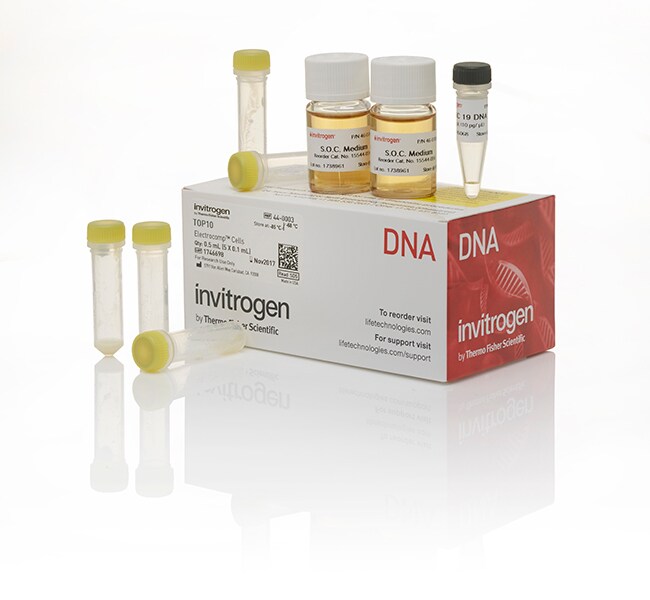
TOP10 Electrocomp™ 试剂盒
TOP10 大肠杆菌的转化效率为 1 × 10¹⁰ cfu/µg 超螺旋 DNA,适用于高效克隆和质粒增殖。其可稳定复制高拷贝数质粒。TOP10了解更多信息
Have Questions?
更改视图

| 货号 | 数量 |
|---|---|
| C66411 | 10 x 100μL |
| C66455 | 5 x 100μL |
货号 C66411
价格(CNY)
3,582.00
飞享价
Ends: 31-Dec-2026
4,478.00共减 896.00 (20%)
Each
数量:
10 x 100μL
价格(CNY)
3,582.00
飞享价
Ends: 31-Dec-2026
4,478.00共减 896.00 (20%)
Each
TOP10 大肠杆菌的转化效率为 1 × 10¹⁰ cfu/µg 超螺旋 DNA,适用于高效克隆和质粒增殖。其可稳定复制高拷贝数质粒。
TOP10 细胞的基因型与 DH10B™株相似,具有以下特点:
•hsdR 用于通过 PCR 扩增高效转化未甲基化 DNA
•mcrA 用于通过基因组制备高效转化甲基化
•lacZΔM15 用于蓝/白斑筛选重组克隆
• 由于无需进行核酸内切酶 I 的非特异性酶切,endA1 用于在下游应用中获得更清洁的 DNA 制备物和更好的结果
•recA1 用于降低克隆 DNA 中的非特异性重组
One Shot™ TOP10 试剂盒提供了化学感受态或电转感受态大肠杆菌,适用于您特定的转化需求。TOP10 大肠杆菌还提供了高通量 MultiShot™ 规格。
注:此试剂盒含有足够用于 12 x 40 µL 反应或 25 x 20 µL 反应的电转感受态细胞。有关反应规模建议,请参见产品手册。
基因型:
F-mcrA Δ(mrr-hsdRMS-mcrBC) φ80lacZΔM15 ΔlacX74 recA1 araD139 Δ(ara-leu)7697 galU galK rpsL endA1 nupG
TOP10 细胞的基因型与 DH10B™株相似,具有以下特点:
•hsdR 用于通过 PCR 扩增高效转化未甲基化 DNA
•mcrA 用于通过基因组制备高效转化甲基化
•lacZΔM15 用于蓝/白斑筛选重组克隆
• 由于无需进行核酸内切酶 I 的非特异性酶切,endA1 用于在下游应用中获得更清洁的 DNA 制备物和更好的结果
•recA1 用于降低克隆 DNA 中的非特异性重组
One Shot™ TOP10 试剂盒提供了化学感受态或电转感受态大肠杆菌,适用于您特定的转化需求。TOP10 大肠杆菌还提供了高通量 MultiShot™ 规格。
注:此试剂盒含有足够用于 12 x 40 µL 反应或 25 x 20 µL 反应的电转感受态细胞。有关反应规模建议,请参见产品手册。
基因型:
F-mcrA Δ(mrr-hsdRMS-mcrBC) φ80lacZΔM15 ΔlacX74 recA1 araD139 Δ(ara-leu)7697 galU galK rpsL endA1 nupG
仅供科研使用。不可用于诊断程序。
规格
耐抗生素细菌Yes (Streptomycin)
蓝色/白色筛查是
是否可克隆甲基化 DNA是
克隆不稳定 DNA不适合克隆不稳定DNA
是否含 F' 附加体缺乏 F’附加体
高通量能力不兼容高通量应用(手动)
提高质粒质量是
质粒可用于 > 20 kb 质粒
制备无甲基化 DNA不适合制备未甲基化DNA
产品线DH10B,Electrocomp
产品类型电转化仪试剂盒
数量10 x 100μL
减少克隆重组现象是
运输条件Dry Ice
T1 噬菌体 - 抗性 (tonA)否
转化效率级别高效率 (> 10^9 cfu⁄µg)
产品规格One Shot
种属大肠杆菌
Unit SizeEach
内容与储存
• 10 x 100 μL TOP10 Electrocomp E. coli
• 50 μL pUC19 vector (10 pg/μL)
Store at –80°C.
• 15 mL S.O.C. Medium
Store at room temperature.
• 50 μL pUC19 vector (10 pg/μL)
Store at –80°C.
• 15 mL S.O.C. Medium
Store at room temperature.