Search


引用和文献 (65)
Invitrogen™
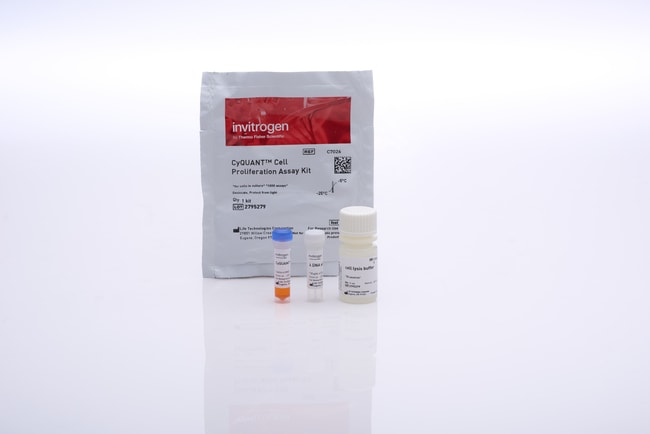
CyQUANT™ NF 细胞增殖检测
CyQUANT™ NF 细胞增殖检测提供了在微孔板内对群体内细胞进行定量的快速灵敏方法。CyQUANT™ NF 细胞增殖检测的特点为:•比 MTT 或 AlamarBlue™ 测定试剂盒更灵敏•线性检测范围为每孔100至20,000个细胞了解更多信息
Have Questions?
更改视图

| 货号 | 细胞类型 | 数量 |
|---|---|---|
| C7026 | For cells in culture | 1000 次检测 |
| C35011 | Direct Cell | 10 Microplates |
| C35013 | Direct Red Cell | 10块微孔板 |
| C35012 | Direct Cell | 100 Microplates |
| C35007 | NF Cell | 200 Assays |
| C35006 | NF Cell | 1000 Assays |
| C7027 | Cell Lysis Buffer | 50 mL |
货号 C7026
价格(CNY)
4,108.00
飞享价
Ends: 31-Dec-2026
5,627.00共减 1,519.00 (27%)
Each
细胞类型:
For cells in culture
数量:
1000 次检测
价格(CNY)
4,108.00
飞享价
Ends: 31-Dec-2026
5,627.00共减 1,519.00 (27%)
Each
CyQUANT™ NF 细胞增殖检测提供了在微孔板内对群体内细胞进行定量的快速灵敏方法。
CyQUANT™ NF 细胞增殖检测的特点为:
•比 MTT 或 AlamarBlue™ 测定试剂盒更灵敏
•线性检测范围为每孔100至20,000个细胞(96孔微孔板)
•测定试剂盒可以在一小时内完成
快速简单的细胞增殖检测方法
CyQUANT™ NF 细胞增殖测定试剂盒不需要细胞裂解、长时间孵育、放射性标记或从细胞中去除染色剂。CyQUANT™ NF 检测无需进行原始 CyQUANT™ 细胞增殖检测的冻融细胞裂解步骤,代之以一种细胞通透性的 DNA 结合染料和一种质膜通透性的试剂。CyQUANT™ NF 细胞增殖测定试剂盒可以在96孔或384孔微孔板内使用,有两种包装形式:200次测定试剂盒 (C35007),适用于较小样本量,以及1000次测定试剂盒 (C35006),适用于高通量应用。
AlamarBlue™ 是 TREK Diagnostic Systems 公司的注册商标。
CyQUANT™ NF 细胞增殖检测的特点为:
•比 MTT 或 AlamarBlue™ 测定试剂盒更灵敏
•线性检测范围为每孔100至20,000个细胞(96孔微孔板)
•测定试剂盒可以在一小时内完成
快速简单的细胞增殖检测方法
CyQUANT™ NF 细胞增殖测定试剂盒不需要细胞裂解、长时间孵育、放射性标记或从细胞中去除染色剂。CyQUANT™ NF 检测无需进行原始 CyQUANT™ 细胞增殖检测的冻融细胞裂解步骤,代之以一种细胞通透性的 DNA 结合染料和一种质膜通透性的试剂。CyQUANT™ NF 细胞增殖测定试剂盒可以在96孔或384孔微孔板内使用,有两种包装形式:200次测定试剂盒 (C35007),适用于较小样本量,以及1000次测定试剂盒 (C35006),适用于高通量应用。
AlamarBlue™ 是 TREK Diagnostic Systems 公司的注册商标。
仅供科研使用。不可用于诊断程序。
规格
细胞渗透性非细胞通透性
细胞类型For cells in culture
描述CyQUANT™ 细胞增殖检测,用于培养中的细胞
检测方法荧光
染料类型其他标记或染料
激发/发射480/520
产品规格96 孔板
数量1000 次检测
运输条件室温
颜色绿色
发射波长范围520 nm
Excitation Wavelength Range480 nm
适用于(应用)增殖测定试剂盒
适用于(设备)微孔板读数仪
产品线CyQUANT
产品类型细胞增殖测定试剂盒
Unit SizeEach
内容与储存
含有 CyQUANT™ GR 染料、细胞裂解缓冲液和噬菌体 λ DNA。
常见问题解答 (FAQ)
哪种细胞增殖实验能用于3D培养体系?
你们提供测定神经元细胞健康的产品吗?
Can CyQUANT Cell Proliferation Assay, for cells in culture (Cat. No. C7026) be used on organoids in Matrigel medium?
What is the composition of the cell lysis buffer in CyQUANT Cell Proliferation Assay, for cells in culture (Cat. No. C7026)?
Which cell proliferation assays can I use with 3D culture systems?
引用和文献 (65)
引用和文献
Abstract
Growth factor-induced proliferation in corneal epithelial cells is mediated by 12(S)-HETE.
Journal:Experimental eye research
PubMed ID:12697425
PURPOSE: Previous studies in our laboratory have shown that 12(S)-hydroxyeicosatetraenoic acid (12(S)-HETE), a product of 12-lipoxygenase (12-LOX) activity, is the predominant metabolite formed in rabbit corneas after injury. The present study was undertaken to investigate the effects of epidermal growth factor (EGF), hepatocyte growth factor (HGF), and keratinocyte growth factor
Caspase activation contributes to delayed death of heat-stressed striatal neurons.
Journal:J Neurochem
PubMed ID:14622126
'Hyperthermia can contribute to brain damage both during development and post-natally. We used rat embryonic striatal neurons in culture to study mechanisms underlying hyperthermia-induced neuronal death. Heat stress at 43 degrees C for 2 h produced no obvious signs of damage during the first 12 h after the stress, but
Endothelial cell surface F1-F0 ATP synthase is active in ATP synthesis and is inhibited by angiostatin.
Journal:Proc Natl Acad Sci U S A
PubMed ID:11381144
'Angiostatin blocks tumor angiogenesis in vivo, almost certainly through its demonstrated ability to block endothelial cell migration and proliferation. Although the mechanism of angiostatin action remains unknown, identification of F(1)-F(O) ATP synthase as the major angiostatin-binding site on the endothelial cell surface suggests that ATP metabolism may play a role
Overexpression of Na(+)/K (+)-ATPase parallels the increase in sodium transport and potassium recycling in an in vitro model of proximal tubule cellular ageing.
Journal:J Membr Biol
PubMed ID:17334838
'Na(+)/K(+)-ATPase plays a key role in the transport of Na(+) throughout the nephron, but ageing appears to be accompanied by changes in the regulation and localization of the pump. In the present study, we examined the effect of in vitro cell ageing on the transport of Na(+) and K(+) ions
Identification of the binding site for fibrinogen recognition peptide gamma 383-395 within the alpha(M)I-domain of integrin alpha(M)beta2.
Journal:J Biol Chem
PubMed ID:11278633
'The leukocyte integrin alpha(M)beta(2) (Mac-1, CD11b/CD18) is a cell surface adhesion receptor for fibrinogen. The interaction between fibrinogen and alpha(M)beta(2) mediates a range of adhesive reactions during the immune-inflammatory response. The sequence gamma(383)TMKIIPFNRLTIG(395), P2-C, within the gamma-module of the D-domain of fibrinogen, is a recognition site for alpha(M)beta(2) and alpha(X)beta(2).