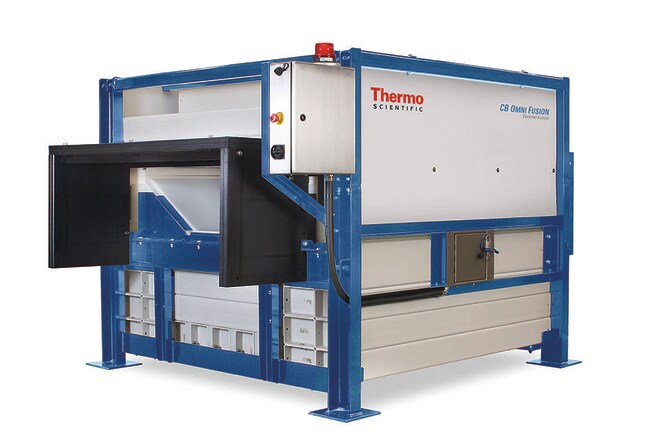
Copper ore sorting seems to be gaining ground as a foundation for better efficiency. Do you have any advice on issues to consider?
The benefits of ore sorting against a backdrop falling ore grades are difficult to argue. However, ore sorting projects can be associated with considerable CAPEX. Most of the costs is in material handling with diverting, routing, conveying and transport since once sensed, the ore is "sorted" meaning diverted to a waste stream. However, the return on investment on the capital and operating costs will rely on the ability of an analyzer to differentiate the incoming material. The difference in return from even a marginal difference in performance is make or break in this application.
Although bulk and particle sensing and ore sorting is not a new technology, it has been slowly adopted by the mining industry. As pioneers in the field of neutron activation analysis - Prompt Gamma Neutron Activation Analysis (PGNAA) and Pulsed Fast Thermal Neutral Activation (PFTNA) - we understand its strengths, its limitations, and how best to implement it.
Not all PGNAA/PFTNA technology is equally powerful, and some are not adequate. Source strength, detector quality, and system design all play a role in determining performance and it pays to understand how. For example, measurement uniformity, across the entire incoming ore stream is vital and not feasible with systems with just a single central detector.
In summary, the analyzer you choose for ore sorting is critical so we recommend considering the options carefully and getting advice. And do the calculation. Look at the performance on offer and see what it might mean in terms of the bottom line. You'll find an example of this type of calculation in our eBook (http://assets.thermofisher.com/TFS-Assets/CAD/brochures/copper-ore-processing-ebook.pdf).
Why should PGNAA/PFTNA be used in copper mining?
Neutron activation analysis techniques such as Prompt Gamma Neutron Activation Analysis (PGNAA) or Pulsed Fast Thermal Neutral Activation (PFTNA) are well-suited to bulk ore sorting. Bombarding materials with neutrons cause the elements to emit secondary, prompt gamma rays, creating an identifying 'fingerprint'. PGNAA and PFTNA analyzers penetrate the entire incoming ore stream, ensuring that the whole material stream is analyzed equally and accurately.
Where should an online analyzer in sinter applications be located?
Online analyzers for sinter are situated directly on the conveyor belt and penetrate the entire raw material cross-section, providing minute-by-minute, uniform measurement of the entire material stream, not just a sub-sample. The location chosen for an online elemental analyzer should be after the agglomeration drum, taking into account safe access for installation and maintenance as well as environmental protection for service personnel.
Other critical factors to be considered in placement of sinter feed analysis equipment include:
- Belt width and troughing angle
- Maximum and minimum feed rates
- Belt speed
- Range of belt loading
- Maximum burden height of material
- Location of existing sampling infrastructure
- Iron ore mineralogy
- Intended process control strategy
Read more about products used in the sintering process and iron and steel manufacturing on our Iron Ore Sintering Process in Steel Manufacturing web page (https://www.thermofisher.com/us/en/home/industrial/cement-coal-minerals/iron-ore-sintering-process-steel-manufacturing.html).
How does an online analyzer for sinter work?
Online sinter feed analysis systems utilize prompt gamma neutron activation analysis (PGNAA) and Pulsed Fast Thermal Neutron Activation (PFTNA) to determine the elemental composition of bulk raw materials. Both of these techniques, which are non-contact, non-destructive analytical techniques, are known collectively as neutron activation analysis, and function by bombarding materials with neutrons.
The neutrons interact with elements in the materials, which then emit secondary, prompt high energy gamma rays that travel through the many centimeters of material and can be measured with a large area gamma ray detector without contacting the material. Because prompt gamma rays are measured, the speed of the material passing through the analyzer does not affect the measurement. Similar to X-ray fluorescence (XRF), each element emits a characteristic energy signature as it returns to a stable state.
For more in-depth information, visit the PGNAA and PFTNA Technology page (https://www.thermofisher.com/us/en/home/industrial/cement-coal-minerals/cement-coal-minerals-learning-center/cement-analysis-production-information/pgnaa-pftna-technology.html).
What are the benefits of using an online elemental analyzer to control the sinter feed composition?
An online elemental analyzer (https://www.thermofisher.com/order/catalog/product/CBOMNIFUSION) can help control the sinter feed basicity and provide a more consistent feed to the sinter strand. The benefits of real-time chemical analysis data include:
- More consistent sinter product - improves sinter quality and stabilizes feed to the blast furnace
- Increased sinter strand and blast furnace throughput due to reduced sinter product variability
- Decreased return fines lowers material handling costs
- Reduced load on laboratory, allowing capacity to be used elsewhere without incurring additional costs
- Net reduction in cost per ton of sinter production
- Increased operational flexibility by maintaining feed KPIs closer to operational limits and strategic use of the raw mix materials