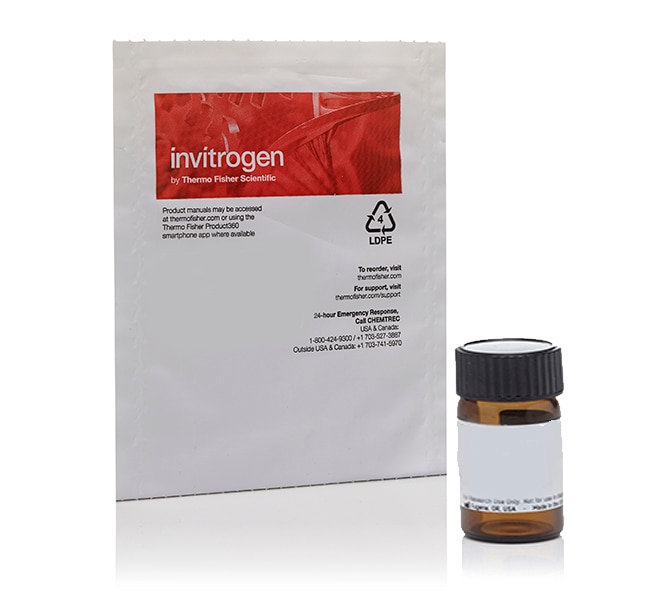
Dil Stain (1,1'-Dioctadecyl-3,3,3',3'-Tetramethylindocarbocyanine Perchlorate ('DiI'; DiIC18(3)))
Invitrogen17万+抗体限时买二赠一,靶点广,灵活用!
Dil Stain (1,1'-Dioctadecyl-3,3,3',3'-Tetramethylindocarbocyanine Perchlorate ('DiI'; DiIC<sub>18</sub>(3)))
Invitrogen™

Dil Stain (1,1'-Dioctadecyl-3,3,3',3'-Tetramethylindocarbocyanine Perchlorate ('DiI'; DiIC18(3)))

DiI is a lipophilic membrane stain that diffuses laterally to stain the entire cell. It is weakly fluorescent until incorporatedRead more
Have Questions?
Change viewbuttonViewtableView
Catalog NumberQuantity
D282100 mg
D391125 mg
Catalog number D282
Price (CNY)
4,245.00
Online Exclusive
Ends: 31-Dec-2025
5,755.00
Save 1,510.00 (26%)
Each
Add to cart
Quantity:
100 mg
Price (CNY)
4,245.00
Online Exclusive
Ends: 31-Dec-2025
5,755.00
Save 1,510.00 (26%)
Each
Add to cart

DiI is a lipophilic membrane stain that diffuses laterally to stain the entire cell. It is weakly fluorescent until incorporated into membranes. This orange/red-fluorescent dye, which is spectrally similar to tetramethylrhodamine, is often used as a long-term tracer for neuronal and other cells. DiI is also available as a solution (Cat. No. V-22885), as a paste (Cat. No. N-22880) or as a solid (Cat. No. D-282).

Prepare stock solutions of lipophilic tracers in dimethyl formamide (DMF), dimethylsulfoxide (DMSO), or ethanol at 1 to 2.5 mg/mL.

For Research Use Only. Not for use in diagnostic procedures.
Specifications
ColorRed-Orange
Detection MethodFluorescence
Emission565 nm
Excitation Wavelength Range549 nm
For Use With (Equipment)Fluorescence Microscope
Quantity100 mg
Shipping ConditionRoom Temperature
Product TypeLiphophilic Tracer
SubCellular LocalizationCell Membranes, Lipids
Unit SizeEach
Contents & Storage
Store at room temperature and protect from light.

Frequently asked questions (FAQs)

I'm labeling live cells with Vybrant DiI or DiD lipophilic cyanine dyes. DiI gives a nice even membrane labeling, but DiD is more "spotty". What can be done?

This is expected. DiD (which is far-red fluorescent) is never as uniform as DiI (which is orange fluorescent). If uniformity is desired, try increasing the label time and concentration, but it still isn't likely to be as uniform as DiI. CellMask Deep Red Plasma Membrane stain is much more uniform and is about the same wavelength as DiD. However, if you intend to do cell tracking over days, CellMask stain has not been tried for that application.

Find additional tips, troubleshooting help, and resources within our Cell Analysis Support Center.

I want to perform a cell fusion assay, where one cell line is labeled with one color and the other cell line with another color, and combine with a nucleic acid stain. What do you recommend?

A typical method is to label one cell line with orange fluorescent DiI C18 and the other cell line with green fluorescent DiO C18. These orange and green lipophilic cyanine dyes will stain the membranes of cells. Cells that fuse will then have both dyes, yielding a yellow color (when images are overlaid or cells are imaged in a dual-bandpass filter). These live cells can then be labeled with Hoechst 33342 (a cell-permeant blue DNA stain comparable in wavelength to DAPI), but only as an endpoint just before imaging (since DNA stains can interrupt DNA function).

Find additional tips, troubleshooting help, and resources within our Cell Analysis Support Center.

I need to look at live cell morphology deformation over the course of a few hours. What sort of membrane dye would be useful for this?

Lipophilic cyanine dyes, such as DiI (Cat. No. D282), DiO (Cat. No. D275), DiD (Cat. No. D7757) or DiR (Cat. No. D12731), are commonly used. The longer the alkyl chain on the dye, the better the retention in lipophilic environments.

Find additional tips, troubleshooting help, and resources within our Cell Analysis Support Center.

Why do I lose all signal from my neuronal tracer when I do a methanol fixation on my cells?

If the tracer you chose is a lipophilic dye and fix with methanol, the lipids are lost with the methanol. If you have to use methanol fixation then choose a tracer that will covalently bind to proteins in the neurons.

Find additional tips, troubleshooting help, and resources within our Cell Analysis Support Center.

I stained my cells with a lipophilic cyanine dye, like DiI, but the signal was lost when I tried to follow up with antibody labeling. Why?

Since these dyes insert into lipid membranes, any disruption of the membranes leads to loss of the dye. This includes permeabilization with detergents like Triton X-100 or organic solvents like methanol. Permeabilization is necessary for intracellular antibody labeling, leading to loss of the dye. Instead, a reactive dye such as CFDA SE should be used to allow for covalent attachment to cellular components, thus providing for better retention upon fixation and permeabilization.

Find additional tips, troubleshooting help, and resources within our Cell Analysis Support Center.

Citations & References (1161)

Citations & References
Abstract
Using fluorescent dyes for fate mapping, lineage analysis, and axon tracing in the chick embryo.
Authors:Clarke JD
Journal:Methods in molecular biology (Clifton, N.J.)
PubMed ID:19030810
Angiotensin II induces LOX-1, the human endothelial receptor for oxidized low-density lipoprotein.
Authors:Morawietz H,Rueckschloss U,Niemann B,Duerrschmidt N,Galle J,Hakim K,Zerkowski HR,Sawamura T,Holtz J
Journal:Circulation
PubMed ID:10468518
Neural transplant staining with DiI and vital imaging by 2-photon laser-scanning microscopy.
Authors:Potter SM, Pine J, Fraser SE
Journal:Scanning Microsc Suppl
PubMed ID:9601539
We are developing a multielectrode silicon "neuroprobe" for maintaining a long-term, specific, two-way electrical interface with nervous tissue. Our approach involves trapping a neuron (from an embryonic rat hippocampus) in a small well with a stimulation/recording electrode at its base. The well is covered with a grillwork through which the ... More
Cultured postnatal rat septohippocampal neurons change intracellular calcium in response to ethanol and nerve growth factor.
Authors:Webb B, Suarez SS, Heaton MB, Walker DW
Journal:Brain Res
PubMed ID:9459553
Ethanol exposure affects cellular mechanisms involved in the regulation of calcium (Ca2+) homeostasis. Neurotrophins, such as nerve growth factor (NGF), stabilize intracellular Ca2+([Ca2+]i) during a variety of neurotoxic insults. In this study, changes in [Ca2+]i during treatment with ethanol and NGF were measured at the cell body of neurons using ... More
Evaluation of a flow cytometric fluorescence quenching assay of phagocytosis of sensitized sheep erythrocytes by polymorphonuclear leukocytes.
Authors:Van Amersfoort ES, Van Strijp JA
Journal:Cytometry
PubMed ID:7875036
A number of reports have been published describing phagocytosis assays for flow cytometric analysis. In some of these, the fluorescence quenching technique has been used to discriminate between adherent and ingested particles. In this report, we have evaluated the efficacy of a quantitative fluorescence quenching technique with crystal violet and ... More