Search


引用和文献 (9)
Invitrogen™
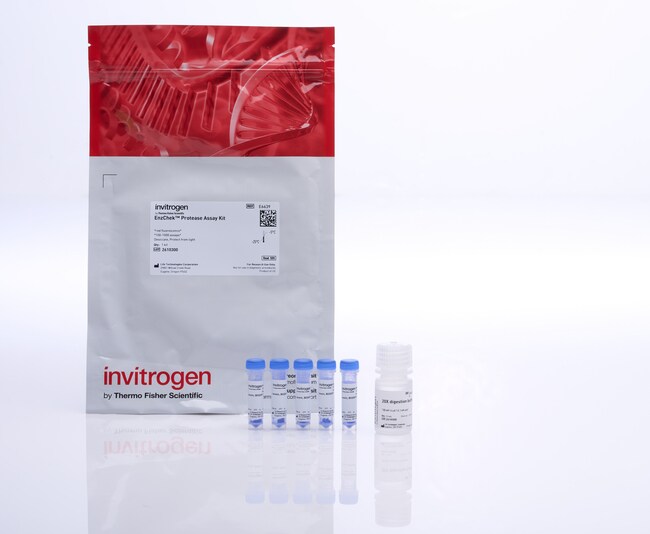
EnzChek™ 蛋白酶检测试剂盒,红色荧光,100-1000 次检测
EnzChek™ 蛋白酶检测试剂盒(红色荧光)是一种快速、简单的直接荧光检测方法,可用于检测金属蛋白酶、丝氨酸蛋白酶、酸性蛋白酶和巯基蛋白酶。可使用荧光微孔板读数仪测量伴随出现的荧光强度增加,后者与蛋白酶活性成正比。查看我们完整的荧光微孔板检测产品线。•通用机制允许测量各种蛋白酶•可用于持续测量蛋白酶动力学•激发/发射波长与了解更多信息
| 货号 | 数量 |
|---|---|
| E6639 | 1 Kit |
货号 E6639
价格(CNY)
6,719.00
Each
数量:
1 Kit
价格(CNY)
6,719.00
Each
EnzChek™ 蛋白酶检测试剂盒(红色荧光)是一种快速、简单的直接荧光检测方法,可用于检测金属蛋白酶、丝氨酸蛋白酶、酸性蛋白酶和巯基蛋白酶。可使用荧光微孔板读数仪测量伴随出现的荧光强度增加,后者与蛋白酶活性成正比。
查看我们完整的荧光微孔板检测产品线。
•通用机制允许测量各种蛋白酶
•可用于持续测量蛋白酶动力学
•激发/发射波长与 Texas Red™ 染料相似 (589/617 nm)
EnzChek™ 蛋白酶测定试剂盒包含一种酪蛋白衍生物,后者已被红色荧光 BODIPY™ TR-X 染料广泛标记,从而导致荧光染料淬灭。蛋白酶催化水解会释放出具有强烈荧光的 BODIPY™ TR-X 染料标记多肽,可用来定量检测溶液中的蛋白酶活性。红色荧光 BODIPY™ TR-X 染料的激发和发射光谱与 Texas Red™ 荧光基团类似。
查看我们完整的荧光微孔板检测产品线。
•通用机制允许测量各种蛋白酶
•可用于持续测量蛋白酶动力学
•激发/发射波长与 Texas Red™ 染料相似 (589/617 nm)
EnzChek™ 蛋白酶测定试剂盒包含一种酪蛋白衍生物,后者已被红色荧光 BODIPY™ TR-X 染料广泛标记,从而导致荧光染料淬灭。蛋白酶催化水解会释放出具有强烈荧光的 BODIPY™ TR-X 染料标记多肽,可用来定量检测溶液中的蛋白酶活性。红色荧光 BODIPY™ TR-X 染料的激发和发射光谱与 Texas Red™ 荧光基团类似。
仅供科研使用。不可用于诊断程序。
规格
检测方法荧光强度
数量1 Kit
运输条件室温
底物属性基于蛋白的底物
底物类型蛋白酶底物
目标酶蛋白酶
适用于(应用)蛋白酶检测
适用于(设备)荧光微孔板读数仪
产品线EnzChek
产品类型蛋白酶检测
Unit SizeEach
内容与储存
在冷冻冰箱(-5°C 至 -30°C)中避光储存。
常见问题解答 (FAQ)
What is the optimal pH range for protease activity detection using the EnzChek Protease Assay Kit?
What is the shelf life for EnzChek Protease Assay kits (Cat. Nos. E6638, E6639)?
How long is the reconstituted BODIPY substrate in the EnzChek Protease Assay Kit, red fluorescence, 100-1000 assays (Cat. No. E6639) stable?
引用和文献 (9)
引用和文献
Abstract
Quenched BODIPY dye-labeled casein substrates for the assay of protease activity by direct fluorescence measurement.
Journal:Anal Biochem
PubMed ID:9299009
'We have prepared casein conjugates of two BODIPY dyes for use as fluorogenic protease substrates in homogeneous assays. Both conjugates are labeled to such an extent that the dyes are efficiently quenched in the protein, yielding virtually nonfluorescent substrate molecules. These fluorogenic substrates release highly fluorescent BODIPY dye-labeled peptides upon
Subnanoliter enzymatic assays on microarrays.
Journal:Proteomics
PubMed ID:15700241
'Many areas of research today are based on enzymatic assays most of which are still performed as enzyme-linked immunosorbent assays in microtiter plates. The demand for highly parallel screening of thousands of samples eventually led to a miniaturization and automation of these assays. However, the final transfer of enzymatic assays
Continuous assay of proteases using a microtiter plate fluorescence reader.
Journal:Anal Biochem
PubMed ID:9398357
A protease-dependent mechanism for initiating T-dependent B cell responses to large particulate antigens.
Journal:J Immunol
PubMed ID:20208013
Ab production is critical for antimicrobial immunity, and the initial step in this process is the binding of Ag to the BCR. It has been shown that small soluble proteins can directly access the lymph node follicles to reach naive B cells, but virus particles must be translocated into follicles
Selective modulation of superantigen-induced responses by streptococcal cysteine protease.
Journal:J Infect Dis
PubMed ID:12552423
Streptococcal pyrogenic exotoxin (Spe) B, a streptococcal cysteine protease, is believed to be important in group A streptococcal (GAS) pathogenesis. The present study examined the effect of SpeB on the activity of superantigenic exotoxins secreted by M1T1 GAS isolates. The proliferative response of human lymphocytes to culture supernatant (SUP) from