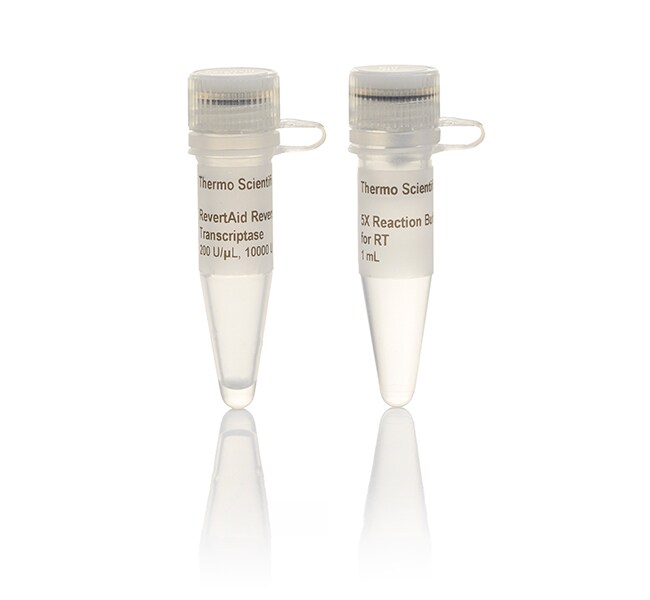
When should I choose regular RevertAid RT or Maxima RT vs. RevertAid H-minus RT or Maxima H-minus RT?
It is generally beneficial to minimize RNase H activity when aiming to produce long transcripts for cDNA cloning. RNase H degrades RNA from RNA-DNA duplexes, which can result in truncated cDNA during reverse transcription of long mRNA. It is also recommended to use RNase H-minus RTs for template-independent addition of C nucleotides. In contrast, reverse transcriptases with intrinsic RNase H activity are often favored in qPCR applications.
Do Thermo Scientific reverse transcriptases (RevertAid RT, RevertAid H-minus RT, Maxima RT, and Maxima H-minus RT) possess terminal deoxynucleotidyl (TdT) activity?
All Thermo Scientific reverse transcriptases possess intrinsic TdT activity although at varying degrees depending upon the reaction conditions. For addition of template-independent C nucleotides (as for SMART and RACE experiments), this specific TdT activity can be induced by Mn2+. We would recommend Maxima H- or RevertAid H- minus RTs for this purpose.
What steps should I take while performing first strand cDNA synthesis using low purity template (e.g., inhibitors in RNA sample)?
Trace amounts of reagents used in RNA purification protocols may remain in solution and inhibit first-strand synthesis, e.g., SDS, EDTA, guanidine salts, phosphate, pyrophosphate, polyamines, spermidine. To remove trace contaminants, we recommend re-precipitating the RNA with ethanol and washing the pellet with 75% ethanol, or re-purifying the RNA.
For reverse transcription, how important is the quality of RNA template?
RNA purity and integrity are essential for synthesis and quantification of cDNA. Always assess the integrity of RNA prior to cDNA synthesis. Use freshly prepared RNA. Multiple freeze/thaw cycles of the RNA sample and synthesized cDNA is not recommended. Avoid RNase contamination and discard low quality RNA.
When should I choose regular RevertAid RT or Maxima RT vs. RevertAid H Minus RT or Maxima H Minus RT?
It is generally beneficial to minimize RNase H activity when aiming to produce long transcripts for cDNA cloning. RNase H degrades RNA from RNA-DNA duplexes, which can result in truncated cDNA during reverse transcription of long mRNA. It is also recommended to use RNase H Minus RTs for template-independent addition of C nucleotides. In contrast, reverse transcriptases with intrinsic RNase H activity are often favored in qPCR applications.