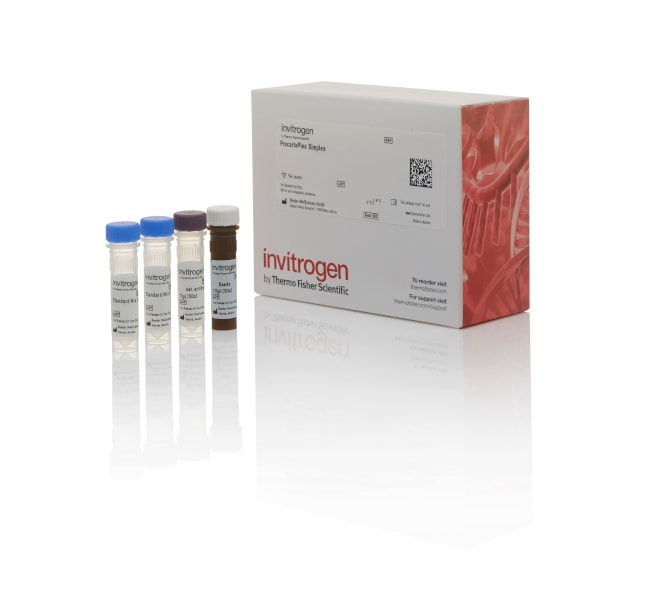
TNF alpha Human ProcartaPlex™ Simplex Kit
Invitrogen™

TNF alpha Human ProcartaPlex™ Simplex Kit

The Human TNF alpha Simplex ProcartaPlex Kit measures TNF alpha protein and is designed to be combinable with other SimplexRead more
Have Questions?
Catalog NumberQuantity
EPX01A-10223-90196 Tests
Catalog number EPX01A-10223-901
Price (CNY)
-
Quantity:
96 Tests
The Human TNF alpha Simplex ProcartaPlex Kit measures TNF alpha protein and is designed to be combinable with other Simplex kits so that you can create your own multiplex panel that utilizes Luminex xMAP technology for protein detection/quantitation. When combining multiple Simplex kits (i.e., when you are not using a pre-configured Multiplex Panel), only one buffer kit (sold separately) is needed for each assay plate regardless of plex size.

About ProcartaPlex Assays for the Luminex Platform

ProcartaPlex immunoassays are based on the principles of a sandwich ELISA, using two highly specific antibodies binding to different epitopes of one protein to quantitate all protein targets simultaneously using a Luminex instrument. ProcartaPlex multiplex assays require as little as 25 μL of plasma or serum, or 50 μL of cell culture supernatant, and just four hours to obtain analyzed results.

More results per sample—measure multiple protein targets simultaneously in a single 25–50 μL sample

Well-established Luminex technology—highly referenced multiplexing platform for protein detection and quantitation

ProcartaPlex assays utilize Luminex xMAP (multianalyte profiling) technology for the simultaneous detection and quantitation of up to 80 protein targets in a single 25–50 μL sample from plasma, serum, cell culture supernatants, and other bodily fluids.

The Luminex beads in the ProcartaPlex assay are internally dyed with precise proportions of red and infrared fluorophores to create spectrally unique signatures that can be identified by the Luminex xMAP detection systems (e.g. Luminex 200, FLEXMAP 3D, and MAGPIX). Similar to a sandwich ELISA, the ProcartaPlex assay uses matched antibody pairs to identify the protein of interest. In a multiplexed assay, each spectrally unique bead is labeled with antibodies specific for a single target protein, and bound proteins are identified with biotinylated antibodies and streptavidin–R-phycoerythrin (RPE). The conjugation of protein-specific antibodies to a distinct bead allows for analysis of multiple targets in a single well.

The most significant difference between a ProcartaPlex assay and ELISA is that the capture antibody in the ProcartaPlex assay is conjugated to a bead and not adsorbed to the microplate well, so the ProcartaPlex assay reagents are free-floating in the solution. For detection, the Luminex 200 instrument, for example, contains two lasers, one to distinguish the spectral signature of each bead and the second to quantify the amount of RPE fluorescence, which is proportional to the amount of protein present in the sample. ProcartaPlex multiplex assays can profile more target proteins using significantly less sample in the same time that it takes to perform a traditional sandwich ELISA.

ProcartaPlex multiplex panels are available in multiple formats across six species (human, mouse, rat, nonhuman primate, porcine, and canine). Visit thermofisher.cn/procartaplex for more information, including a comprehensive list of individual protein targets.
For Research Use Only. Not for use in diagnostic procedures.
Specifications
Assay RangeAs determined for Lot 1: 8.54 - 35,000 pg/mL
Assay SensitivityAs determined for Lot 1: 0.4 pg/mL
Bead TypeTNF alpha [45]
For Use With (Equipment)Luminex™ Instruments
FormatSimplex Kit
Genetumor necrosis factor
Gene AliasDIF-alpha, TNFA, TNFSF2, TNLG1F, TNF
Gene ID (Entrez)7124
Gene SymbolTNF
Product LineProcartaPlex
ProteinTumor necrosis factor
Protein SubtypeCachectin, TNF-alpha
Sample TypeSerum, Plasma, Cell Culture Supernatants
Sample VolumeSerum, Plasma: 25 μL; CCS: 50 μL
Shipping ConditionWet Ice
UniProt IDP01375
CombinabilityCombinable
Product TypeSimplex Kit
Quantity96 Tests
Research AreaImmunology, Oncology, Neurobiology, Toxicology, Cytokines
SpeciesHuman
Unit SizeEach
Contents & Storage

• 1 vial Capture Beads (50X)
• 1 vial biotinylated Detection Antibody (50X)
• 2 vials Human Standard Mix A (lyophilized)

Store at 2°C to 8°C.

Frequently asked questions (FAQs)

What is the size of the Luminex beads you currently use?

The beads used in our Luminex instrument-compatible ProcartaPlex and QuantiGene Plex assays are 6.5 micron superparamagnetic beads.

Find additional tips, troubleshooting help, and resources within our Protein Assays and Analysis Support Center.

I am interested in performing Luminex assays using BioSource kits, and I have a Luminex xMAP system. Besides the kits and system, what other reagents and equipment will I need?

The following is a list of general lab supplies that are required for running BioSource immunoassays on the Luminex xMAP system:
1) Sonicating water bath
2) Orbital shaker
3) Vortexer
4) Repeating and/or multi-channel pipetter (not required, but recommended)
5) Calibrated adjustable precision pipettes, with disposable plastic tips
6) Glass/plastic tubes and racks for preparing reagents
7) Graduated cylinder and container for preparing wash solution
8) Aluminum foil
9) Deionized or distilled water.

Find additional tips, troubleshooting help, and resources within our Protein Assays and Analysis Support Center.

Do the Luminex beads require special care in handling?

The Luminex beads should be protected from light because they are susceptible to photobleaching. We recommend protecting the beads by keeping containers covered with aluminum foil during all incubation steps, and exercising care during handling. The beads should not be frozen, subjected to excessive heat, or exposed to organic solvents.

Find additional tips, troubleshooting help, and resources within our Protein Assays and Analysis Support Center.

Why would the Luminex acquisition software display "Sample Empty" messages during analysis?

(1) The user did not properly aliquot the diluted beads, such that no beads were actually added to the wells (make sure that the bead concentrates are sonicated and vortexed well, then check the pipet tip to ensure that air bubbles were not drawn up)
(2) The user missed loading diluted beads to some wells, which is likely since the small volume is clear and difficult to visualize in the clear plastic plate (we have now addressed this customer difficulty by coloring each of the Buffer Reagent Kit components)
(3) The user applied too much vacuum pressure at some point during the wash steps, or allowed the pressure to spike even once, such that the filter membrane tore in a few wells releasing the beads (make sure that the vacuum manifold pressure is kept below 5mm/in Hg, depending on their system -- a good rule of thumb is that it should take a full 3-second count to GENTLY empty the wells of 200uL)
(4) The user did not properly sonicate and vortex the beads prior to dilution, such that the percent of bead aggregation was high and the instrument was unable to find enough single beads to meet the events/bead value designated by the customer (make sure that the Bead Concentrate tube is put into the waterbath all the way to the cap, since the tube is hollow until the top third)
(5) The user lost beads by shaking the plate too aggressively or handling it improperly (make sure that the orbital shaker is set to a speed that allows for maximum vortex in the wells without spillage)
(6) The user exposed the beads to an excess of light during storage or running of the assay, such that some but not all of the beads were photobleached and therefore falling outside the acceptable range for each bead region (make sure that the plate is covered on the top/sides with foil throughout the assay, away from Windows and spotlights, and that the bead component of the kits is stored in the dark)*
(7) There was a clog in the sample needle, such that the instrument was unable to take up enough sample to meet the number of events requested per bead region (suggest that the user follow the manual instructions for dislodging a clog, which include several Back Flush steps and may require removal of the needle for sonication with probe alignment).

* Some of the older Antibody Bead Kits still have clear plastic tops instead of black ones. In cases where customers store kits in lit refrigerators, or keep them open on the lab bench, even a few hours of light exposure is enough to photobleach beads. It is important to note, in general, that higher number bead regions are more susceptible to photobleaching. In order to draw conclusions about the source of the difficulty, we would ask to see the data, specifically the Masterplex QT file, which would enable us to examine the pattern of "Sample Empty" occurrences in addition to the bead counts per well.

Find additional tips, troubleshooting help, and resources within our Protein Assays and Analysis Support Center.

What are the Luminex beads made of?

The beads are made of polystyrene.

Find additional tips, troubleshooting help, and resources within our Protein Assays and Analysis Support Center.

Citations & References (26)

Citations & References
Abstract
Endotracheal tube-induced sore throat pain and inflammation is coupled to the release of mitochondrial DNA.
Authors:Puyo CA, Peruzzi D, Earhart A, Roller E, Karanikolas M, Kollef MH, Krupnick AS, Kreisel D, Ibrahim M, Gelman AE
Journal:
PubMed ID:28929859
In the absence of infection, the pathophysiology of endotracheal tube-induced sore throat pain is unclear. Activated neutrophils release elastase, reactive oxygen species, and inflammatory cytokines known to contribute to neuropathic pain. Sterile tissue injury can cause the release of damage-associated molecular patterns such as mitochondrial DNA that promote neutrophil activation. ... More
Inflammatory Effects of the Plant Protection Product Stifenia (FEN560) on Vertebrates.
Authors:Teyssier L, Colussi J, Delemasure S, Chluba J, Wendehenne D, Lamotte O, Connat JL
Journal:Front Public Health
PubMed ID:28484691
'Plant defense stimulators (PDSs) rely on the activation of plant innate immunity in order to protect crops against various pests. These molecules are thought to be a safer alternative to classical plant protection products. Given that innate immune systems share common features in plants and vertebrates, PDS can potentially cross-react ... More
Immunomodulating protein aggregates in soy and whey hydrolysates and their resistance to digestion in an in vitro infant gastrointestinal model: new insights in the mechanism of immunomodulatory hydrolysates.
Authors:Kiewiet MBG, Dekkers R, Ulfman LH, Groeneveld A, de Vos P, Faas MM
Journal:Food Funct
PubMed ID:29271442
'Hydrolysates, which are used in hypoallergenic infant formulas, have been found to possess immune modulating effects. For an optimal utilization of hydrolysates, the working mechanisms and responsible proteins underlying the effects should be elucidated. In this study, the immunomodulating activity of whey and soy hydrolysates was studied by quantifying TLR ... More
Circulating monocyte chemoattractant protein-1 (MCP-1) is associated with cachexia in treatment-naïve pancreatic cancer patients.
Authors:Talbert EE, Lewis HL, Farren MR, Ramsey ML, Chakedis JM, Rajasekera P, Haverick E, Sarna A, Bloomston M, Pawlik TM, Zimmers TA, Lesinski GB, Hart PA, Dillhoff ME, Schmidt CR, Guttridge DC
Journal:J Cachexia Sarcopenia Muscle
PubMed ID:29316343
'Cancer-associated wasting, termed cancer cachexia, has a profound effect on the morbidity and mortality of cancer patients but remains difficult to recognize and diagnose. While increases in circulating levels of a number of inflammatory cytokines have been associated with cancer cachexia, these associations were generally made in patients with advanced ... More
Impaired efferocytosis by monocytes in multiple myeloma.
Authors:Liang YY, Schwarzinger I, Simonitsch-Klupp I, Agis H, Oehler R
Journal:Oncol Lett
PubMed ID:29928429
'Efficient clearance of apoptotic cells by efferocytosis is important for tissue homeostasis. Impaired efferocytosis leads to the accumulation of cell debris, which is regarded as a trigger in chronic inflammation and autoimmune diseases. Patients with hematological neoplastic disorders such as multiple myeloma (MM) exhibit high blood levels of apoptotic microparticles. ... More