Search


Citations & References (6)
Invitrogen™
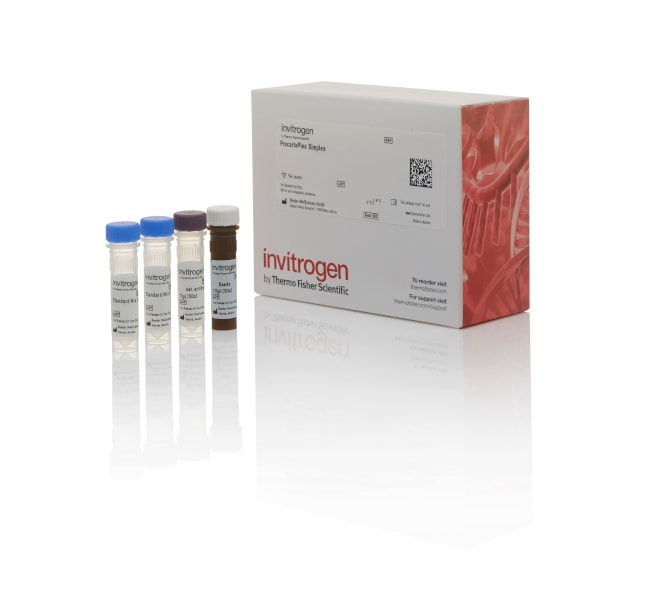
RANTES (CCL5) Human ProcartaPlex™ Simplex Kit
The Human RANTES (CCL5) Simplex ProcartaPlex Kit measures RANTES (CCL5) protein and is designed to be combinable with other SimplexRead more
| Catalog Number | Quantity |
|---|---|
| EPX01A-10287-901 | 96 Tests |
Catalog number EPX01A-10287-901
Price (CNY)
-
Quantity:
96 Tests
The Human RANTES (CCL5) Simplex ProcartaPlex Kit measures RANTES (CCL5) protein and is designed to be combinable with other Simplex kits so that you can create your own multiplex panel that utilizes Luminex xMAP technology for protein detection/quantitation. When combining multiple Simplex kits (i.e., when you are not using a pre-configured Multiplex Panel), only one buffer kit (sold separately) is needed for each assay plate regardless of plex size.
About ProcartaPlex Assays for the Luminex Platform
ProcartaPlex immunoassays are based on the principles of a sandwich ELISA, using two highly specific antibodies binding to different epitopes of one protein to quantitate all protein targets simultaneously using a Luminex instrument. ProcartaPlex multiplex assays require as little as 25 μL of plasma or serum, or 50 μL of cell culture supernatant, and just four hours to obtain analyzed results.
• More results per sample—measure multiple protein targets simultaneously in a single 25–50 μL sample
•Well-established Luminex technology—highly referenced multiplexing platform for protein detection and quantitation
ProcartaPlex assays utilize Luminex xMAP (multianalyte profiling) technology for the simultaneous detection and quantitation of up to 80 protein targets in a single 25–50 μL sample from plasma, serum, cell culture supernatants, and other bodily fluids.
The Luminex beads in the ProcartaPlex assay are internally dyed with precise proportions of red and infrared fluorophores to create spectrally unique signatures that can be identified by the Luminex xMAP detection systems (e.g. Luminex 200, FLEXMAP 3D, and MAGPIX). Similar to a sandwich ELISA, the ProcartaPlex assay uses matched antibody pairs to identify the protein of interest. In a multiplexed assay, each spectrally unique bead is labeled with antibodies specific for a single target protein, and bound proteins are identified with biotinylated antibodies and streptavidin–R-phycoerythrin (RPE). The conjugation of protein-specific antibodies to a distinct bead allows for analysis of multiple targets in a single well.
The most significant difference between a ProcartaPlex assay and ELISA is that the capture antibody in the ProcartaPlex assay is conjugated to a bead and not adsorbed to the microplate well, so the ProcartaPlex assay reagents are free-floating in the solution. For detection, the Luminex 200 instrument, for example, contains two lasers, one to distinguish the spectral signature of each bead and the second to quantify the amount of RPE fluorescence, which is proportional to the amount of protein present in the sample. ProcartaPlex multiplex assays can profile more target proteins using significantly less sample in the same time that it takes to perform a traditional sandwich ELISA.
ProcartaPlex multiplex panels are available in multiple formats across six species (human, mouse, rat, nonhuman primate, porcine, and canine). Visit thermofisher.cn/procartaplex for more information, including a comprehensive list of individual protein targets.
About ProcartaPlex Assays for the Luminex Platform
ProcartaPlex immunoassays are based on the principles of a sandwich ELISA, using two highly specific antibodies binding to different epitopes of one protein to quantitate all protein targets simultaneously using a Luminex instrument. ProcartaPlex multiplex assays require as little as 25 μL of plasma or serum, or 50 μL of cell culture supernatant, and just four hours to obtain analyzed results.
• More results per sample—measure multiple protein targets simultaneously in a single 25–50 μL sample
•Well-established Luminex technology—highly referenced multiplexing platform for protein detection and quantitation
ProcartaPlex assays utilize Luminex xMAP (multianalyte profiling) technology for the simultaneous detection and quantitation of up to 80 protein targets in a single 25–50 μL sample from plasma, serum, cell culture supernatants, and other bodily fluids.
The Luminex beads in the ProcartaPlex assay are internally dyed with precise proportions of red and infrared fluorophores to create spectrally unique signatures that can be identified by the Luminex xMAP detection systems (e.g. Luminex 200, FLEXMAP 3D, and MAGPIX). Similar to a sandwich ELISA, the ProcartaPlex assay uses matched antibody pairs to identify the protein of interest. In a multiplexed assay, each spectrally unique bead is labeled with antibodies specific for a single target protein, and bound proteins are identified with biotinylated antibodies and streptavidin–R-phycoerythrin (RPE). The conjugation of protein-specific antibodies to a distinct bead allows for analysis of multiple targets in a single well.
The most significant difference between a ProcartaPlex assay and ELISA is that the capture antibody in the ProcartaPlex assay is conjugated to a bead and not adsorbed to the microplate well, so the ProcartaPlex assay reagents are free-floating in the solution. For detection, the Luminex 200 instrument, for example, contains two lasers, one to distinguish the spectral signature of each bead and the second to quantify the amount of RPE fluorescence, which is proportional to the amount of protein present in the sample. ProcartaPlex multiplex assays can profile more target proteins using significantly less sample in the same time that it takes to perform a traditional sandwich ELISA.
ProcartaPlex multiplex panels are available in multiple formats across six species (human, mouse, rat, nonhuman primate, porcine, and canine). Visit thermofisher.cn/procartaplex for more information, including a comprehensive list of individual protein targets.
For Research Use Only. Not for use in diagnostic procedures.
Specifications
Assay RangeAs determined for Lot 1: 0.61 - 2500 pg/mL
Assay SensitivityAs determined for Lot 1: 0.2 pg/mL
Bead TypeRANTES [42]
For Use With (Equipment)Luminex™ Instruments
FormatSimplex Kit
GeneC-C motif chemokine ligand 5
Gene AliasD17S136E, RANTES, SCYA5, SIS-delta, SISd, TCP228, eoCP
Gene ID (Entrez)6352
Gene SymbolCCL5
Product LineProcartaPlex
ProteinC-C motif chemokine 5
Protein SubtypeEoCP, Eosinophil chemotactic cytokine, SIS-delta, Small-inducible cytokine A5, TCP228
Sample TypeSerum, Plasma, Cell Culture Supernatants
Sample VolumeSerum, Plasma: 25 μL; CCS: 50 μL
Shipping ConditionWet Ice
UniProt IDP13501
CombinabilityCombinable
Product TypeSimplex Kit
Quantity96 Tests
Research AreaImmunology, Oncology, Neurobiology, Toxicology, Chemokines
SpeciesHuman
Unit SizeEach
Contents & Storage
• 1 vial Capture Beads (50X)
• 1 vial biotinylated Detection Antibody (50X)
• 2 vials Human Standard Mix B (lyophilized)
• 1 bottle Universal Assay Buffer
Store at 2°C to 8°C.
Frequently asked questions (FAQs)
What is the size of the Luminex beads you currently use?
I am interested in performing Luminex assays using BioSource kits, and I have a Luminex xMAP system. Besides the kits and system, what other reagents and equipment will I need?
Do the Luminex beads require special care in handling?
Why would the Luminex acquisition software display "Sample Empty" messages during analysis?
What are the Luminex beads made of?
Citations & References (6)
Citations & References
Abstract
HTLV-2 Enhances CD8+ T Cell-Mediated HIV-1 Inhibition and Reduces HIV-1 Integrated Proviral Load in People Living with HIV-1
Journal:Viruses
PubMed ID:36366570
'People living with HIV-1 and HTLV-2 concomitantly show slower CD4+ T cell depletion and AIDS progression, more frequency of the natural control of HIV-1, and lower mortality rates. A similar beneficial effect of this infection has been reported on HCV coinfection reducing transaminases, increasing the spontaneous clearance of HCV infection
Identification of a TLR2 Inhibiting Wheat Hydrolysate.
Journal:Mol Nutr Food Res
PubMed ID:30354027
'Wheat hydrolysates are used in medical nutrition to provide undernourished patients a readily digestible protein source, for instance to recover from chemotherapy-induced intestinal mucosal inflammation. Since many hydrolysates of different sources can modulate the immune system, likely via Toll-like receptors (TLRs), it is hypothesized that also wheat hydrolysates might interact
Pro-inflammatory cytokines IL-6 and CCL2 suppress expression of circadian gene Period2 in mammary epithelial cells.
Journal:Biochim Biophys Acta Gene Regul Mech
PubMed ID:30343691
'Chronic inflammation is known to contribute to tumor initiation and cancer progression. In breast tissue, the core circadian gene Period (PER)2 plays a critical role in mammary gland development and possesses tumor suppressor function. Interleukin (IL)-6 and C-C motif chemokine ligand (CCL) 2 are among the most abundant cytokines in
Krüppel-like Factor 4 modulates interleukin-6 release in human dendritic cells after in vitro stimulation with Aspergillus fumigatus and Candida albicans.
Journal:Sci Rep
PubMed ID:27346433
'Invasive fungal infections are associated with high mortality rates and are mostly caused by the opportunistic fungi Aspergillus fumigatus and Candida albicans. Immune responses against these fungi are still not fully understood. Dendritic cells (DCs) are crucial players in initiating innate and adaptive immune responses against fungal infections. The immunomodulatory
CD56 Is a Pathogen Recognition Receptor on Human Natural Killer Cells.
Journal:Sci Rep
PubMed ID:28733594
Aspergillus (A.) fumigatus is an opportunistic fungal mold inducing invasive aspergillosis (IA) in immunocompromised patients. Although antifungal activity of human natural killer (NK) cells was shown in previous studies, the underlying cellular mechanisms and pathogen recognition receptors (PRRs) are still unknown. Using flow cytometry we were able to show that