Search


引用和文献 (10)
Invitrogen™
免疫肿瘤学检查点 14-Plex Human ProcartaPlex™ 检测组合 1
人免疫肿瘤学检查点 14-Plex ProcartaPlex 检测组合 1 可通过使用 Luminex xMAP 技术分析 14 种蛋白靶标来研究癌症。
| 货号 | 数量 |
|---|---|
| EPX14A-15803-901 | 96 次测试 |
货号 EPX14A-15803-901
价格(CNY)
-
数量:
96 次测试
The ProcartaPlex Human Immuno-Oncology Checkpoint Panel 1 14plex enables cancer research by analyzing 14 protein targets using Luminex xMAP technology. This panel allows simultaneous detection of the soluble forms of proteins that play a crucial role in the regulation of T cells, leading to either T cell exhaustion or stimulation, thus modifying the antitumor immune response. Analysis of these soluble biomarkers could help to shed light on the biology of the pathways. It complements Human Immuno-Oncology Checkpoint Panel 2 14plex (Cat. No. EPX140-15815-901) and Human Immuno-Oncology Checkpoint Panel 3 9plex (Cat. No. EPX090-15820-901) providing 23 additional protein targets in the same research area.
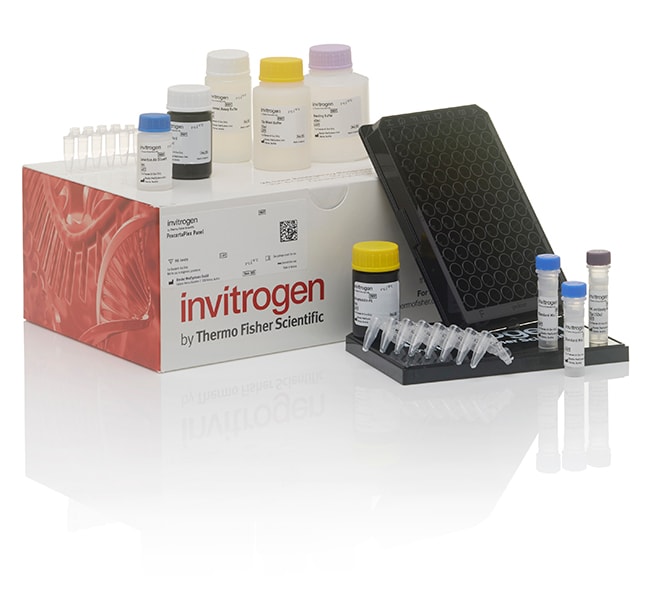
ProcartaPlex preconfigured panels are extensively tested for analyte combinability, interference, and cross-reactivity to provide the highest level of validation and precision. All ProcartaPlex panels are supplied with the necessary reagents to perform the assay.
Target list [bead region]:
- Immune stimulatory: CD27 [27], CD28 [15], CD137 (4-1BB) [26], GITR [57], HVEM [36]
- Immune inhibitory: BTLA [52], CD80 [61], CD152 (CTLA4) [33], IDO [46], LAG-3 [47], PD-1 [65], PD-L1 [66], PD-L2 [67], TIM-3 [14]
人免疫肿瘤学检查点 14-Plex ProcartaPlex 检测组合 1 可通过使用 Luminex xMAP 技术分析 14 种蛋白靶标来研究癌症。该检测组合可同时检测在调节 T 细胞中起关键作用,导致 T 细胞耗竭或刺激,从而调节抗肿瘤免疫应答的可溶性蛋白。对这些可溶性生物标志物进行的分析有助于阐明这些通路的生物学特性。它补充了免疫肿瘤学检查点 14-Plex ProcartaPlex 检测组合 2(货号 EPX140-15815-901)和免疫肿瘤学检查点 9 通路 ProcartaPlex 检测组合 3(货号 EPX090-15820-901),在同一研究领域提供了 23 种额外的蛋白靶标。
对 ProcartaPlex 预配置检测组合进行了广泛的分析物结合、干扰和交叉反应性检测,以提供极高水平的验证和精密度。所有 ProcartaPlex 检测组合均配有进行检测所需的试剂。
靶标列表 [微珠区域]:
免疫刺激:CD27 [27]、CD28 [15]、CD137 (4-1BB) [26]、GITR [57]、HVEM [36]
免疫抑制:BTLA [52]、CD80 [61]、CD152 (CTLA4) [33]、IDO [46]、LAG-3 [47]、PD-1 [65]、PD-L1 [66]、PD-L2 [67]、TIM-3 [14]
关于用于 Luminex 平台的 ProcartaPlex 测定
ProcartaPlex 免疫测定基于夹心式 ELISA 的原理,使用与一种蛋白的不同抗原决定簇结合的两种高度特异性抗体,通过 Luminex 仪器同时定量测定所有蛋白靶标。ProcartaPlex 多通路检测只需 25 μL 血浆或血清,或 50 μL 细胞培养物上清液,只需四小时即可获得分析结果。
其特性包括:
• 可重现的可靠结果—经验证检测组合符合较高行业标准,包括蛋白靶标可结合性和交叉反应性检测
• 每个样品可得到更多结果—在单个 25–50 μL 样品中同时测量多种蛋白靶标
• 成熟的 Luminex 技术 — 经常被引用的蛋白检测和定量多通路平台
ProcartaPlex 检测利用 Luminex xMAP(多分析物分析)技术在单个 25–50 μL 样品(血浆、血清、细胞培养上清液和其他体液)中同时检测和定量多达 80 种蛋白靶标。
ProcartaPlex 检测中的 Luminex 微珠用精确比例的红色和红外荧光基团进行内部染色,生成光谱独特的标记,可通过 Luminex xMAP 检测系统(如 Luminex 200、FLEXMAP 3D 和 MAGPIX)识别。与夹心ELISA类似,ProcartaPlex测定使用匹配的抗体对来鉴定目的蛋白质。在多通路测定中,每种光谱独特的微珠用单一靶蛋白特异性抗体标记,并且用生物素化抗体和链霉素亲和素–R-藻红蛋白 (RPE) 识别结合的蛋白。蛋白特异性抗体与独特微珠偶联可用于在单孔中分析多个靶标。
ProcartaPlex 检测与 ELISA 之间极显著的区别在于 ProcartaPlex 检测中的捕获抗体与微珠偶联并且不吸附于微孔板孔中,因此 ProcartaPlex 检测试剂在溶液中自由漂浮。
仅供科研使用。不可用于诊断程序。
规格
测定范围参见检验报告
检测灵敏度参见检验报告
检测方法荧光
适用于(设备)Luminex™ 仪器
产品规格多通路试剂盒
产品线ProcartaPlex
样品类型血清、血浆、细胞培养物上清液, Plasma, Cell Culture Supernatants
样品体积血清,血浆:25 μL;CCS:50 μL
运输条件湿冰
可组合性可结合使用
产品类型多通路检测组合
数量96 次测试
研究领域Immunology, Oncology
种属人
Unit SizeEach
内容与储存
- 2 小瓶人标准品混合物 L(冻干)
- 1 小瓶捕获微珠混合物 (1 X)
- 1 小瓶生物素化检测抗体混合物 (50 X)
- 1 瓶读取缓冲液 (1X)
- 1 瓶洗涤缓冲液 (10 x)
- 1 瓶链霉素亲和素-PE (1 X)
- 1 瓶 Universal Assay Buffer (1 X)
- 1 瓶检测抗体稀释液 (1 X)
- 8 联排管
- 黏性封板膜
- 平底 96 孔板,黑色
- 储存于 2°C 至 8°C
常见问题解答 (FAQ)
在我的 ProcartaPlex 检测数据分析过程中,我收到一条警告消息,指出存在高度聚集的珠子。我应该怎么办?
在我的 ProcartaPlex 检测数据分析期间,珠子落在珠子图上珠子区域的下方或左下方。为什么是这样?
在我的 ProcartaPlex 检测数据分析期间,珠子没有出现在门控区域中。发生了什么?
我所有的 ProcartaPlex 检测孔的珠数都不稳定。什么地方出了错?
我的 ProcartaPlex 检测标准曲线的微珠计数正确且规则,但对于我的样品,微珠计数不稳定,我收到一条警告消息,提示“采集中至少有一个区域未达到最大计数”。我应该怎么办?
引用和文献 (10)
引用和文献
Abstract
Immune monitoring of trabectedin therapy in refractory soft tissue sarcoma patients - the IMMUNYON study.
Journal:Frontiers in immunology
PubMed ID:40007535
Soft tissue sarcomas (STS) encompass over 50 histologic subtypes, representing more than 1% of solid tumors. Standard treatments include surgical resection and therapies such as anthracyclines or trabectedin for advanced cases, though challenges persist due to the tumor microenvironmentâs complexity and limited immune profiling data. This study evaluates Trabectedin therapy
Soluble lymphocyte activation gene-3 (sLAG3) and CD4/CD8 ratio dynamics as predictive biomarkers in patients undergoing immune checkpoint blockade for solid malignancies.
Journal:British Journal of Cancer
PubMed ID:38233492
The search for biomarkers to identify suitable candidates for immune checkpoint inhibitor (ICI) therapy remains ongoing. We evaluate how soluble levels of the next generation immune checkpoint Lymphocyte Activation Gene-3 (sLAG-3) and its association with circulating T lymphocyte subsets could pose as a novel biomarker to predict outcome to ICI
3D microfluidic ex vivo culture of organotypic tumor spheroids to model immune checkpoint blockade.
Journal:Lab Chip
PubMed ID:30183789
Microfluidic culture has the potential to revolutionize cancer diagnosis and therapy. Indeed, several microdevices are being developed specifically for clinical use to test novel cancer therapeutics. To be effective, these platforms need to replicate the continuous interactions that exist between tumor cells and non-tumor cell elements of the tumor microenvironment
PD-L1 is expressed on human platelets and is affected by immune checkpoint therapy.
Journal:Oncotarget
PubMed ID:29937998
Cancer immunotherapy has been revolutionised by drugs that enhance the ability of the immune system to detect and fight tumors. Immune checkpoint therapies that target the programmed death-1 receptor (PD-1), or its ligand (PD-L1) have shown unprecedented rates of durable clinical responses in patients with various cancer types. However, there
Analysis of Plasma EBV-DNA and Soluble Checkpoint Proteins in Nasopharyngeal Carcinoma Patients after Definitive Intensity-Modulated Radiotherapy.
Journal:Biomed Res Int
PubMed ID:31192256
Tumor immunotherapy and immunological checkpoint-related proteins are research hotspots. Intensity-modulated radiotherapy (IMRT) is the main treatment for nasopharyngeal carcinoma (NPC). Hence, the evaluation of its effect is very important. The aim of this study was to assess the relationship between the concentrations of soluble checkpoint proteins, plasma EBV-DNA, and cytokines