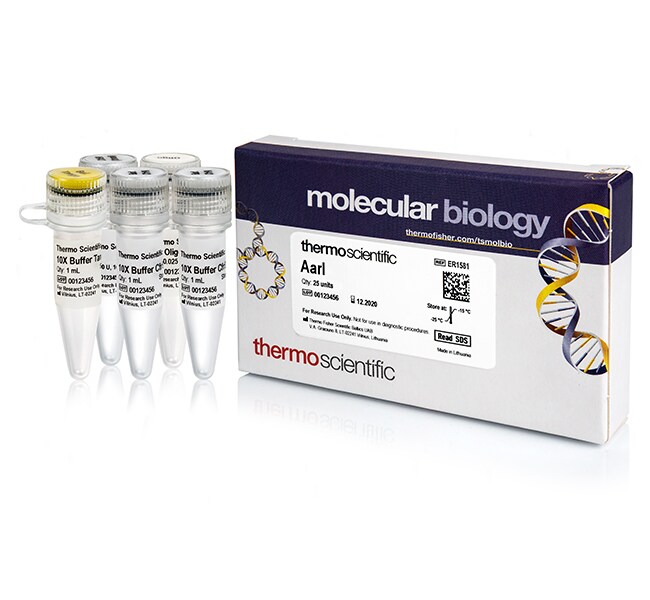
AarI (2 U/μL)
Invitrogen17万+抗体限时买二赠一,靶点广,灵活用!
AarI (2 U/μL)
AarI (2 U/μL)
AarI (2 U/μL)
Thermo Scientific™

AarI (2 U/μL)

AarI限制性内切酶能够识别CACCTGC(4/8)^位点,在其特定的缓冲体系(+oligo)中于37°C达到最佳切割效果。Thermo Scientific传统限制性内切酶产品包含了大量的高品质内切酶,这些酶经过优化,可在五种缓冲液体系中的其中一种中进行酶切,此外,还随酶提供通用Tango缓冲液,以便进行双酶切。所有内切酶在推荐的缓冲液和反应条件下都具有100%的活性。为保证内切酶的性能稳定,Thermo Scientific限制性内切酶反应缓冲液还预先混入了BSA,以增强酶的稳定性并结合可能存在于DNA制备产物中的污染物。特点:• 优异的质量—严格的质量控制和业内领先的生产流程•了解更多信息
Have Questions?
更改视图buttonViewtableView
货号数量
ER158125 U
ER1582125 U
货号 ER1581
价格(CNY)
847.00
飞享价
Ends: 31-Dec-2025
1,210.00
共减 363.00 (30%)
Each
添加至购物车
数量:
25 U
请求批量或定制报价
价格(CNY)
847.00
飞享价
Ends: 31-Dec-2025
1,210.00
共减 363.00 (30%)
Each
添加至购物车
AarI限制性内切酶能够识别CACCTGC(4/8)^位点,在其特定的缓冲体系(+oligo)中于37°C达到最佳切割效果。Thermo Scientific传统限制性内切酶产品包含了大量的高品质内切酶,这些酶经过优化,可在五种缓冲液体系中的其中一种中进行酶切,此外,还随酶提供通用Tango缓冲液,以便进行双酶切。所有内切酶在推荐的缓冲液和反应条件下都具有100%的活性。为保证内切酶的性能稳定,Thermo Scientific限制性内切酶反应缓冲液还预先混入了BSA,以增强酶的稳定性并结合可能存在于DNA制备产物中的污染物。

特点:

• 优异的质量—严格的质量控制和业内领先的生产流程
• 使用颜色标记的五大便捷缓冲系统
• 包含适于双酶切的通用型Tango缓冲液
• 反应缓冲液中预先混入BSA
• 种类齐全,特异性限制性内切酶的广泛选择

应用
• 分子克隆
• 限制性酶切位点作图(Restriction site mapping)
• 基因分型
• Southern blotting
• 限制性片段长度多态性(RFLP)


• SNP

注意事项:关于甲基化敏感度,请参见产品说明。如需使用AarI达到切割目的,至少需要两个识别位点。在反应混合物中加入含有AarI识别序列的0.5 μM寡聚核苷酸能够显著提升DNA的切割效果,特别是针对那些具有单一AarI位点的DNA而言。不过某些AarI的底物很难达到完全的切割效果。使用AarI进行10倍以上的过度消化可能导致星活性的出现。AarI仍可能会与切割后的DNA结合。这一特性的可能导致电泳时DNA条带发生位移。为了避免非典型的DNA条带粗线,请使用6X DNA上样染料与SDS溶液制备样品,或在电泳前于SDS存在的条件下加热消化后的DNA。
仅供科研使用。不可用于诊断程序。
规格
兼容缓冲液独特缓冲液(10X 缓冲液 AarI)
产品类型限制性内切酶
数量25 U
最大浓度2 U/μL
AarI
甲基化敏感性对 CpG 甲基化敏感, 对 Dam 甲基化不敏感, 对 Dcm 甲基化不敏感
最佳反应温度37°C
研究类别传统方法克隆
对热失活敏感
类型 IIS RE
Unit SizeEach

常见问题解答 (FAQ)

Can I double digest my DNA using a Thermo Scientific conventional restriction enzyme and a FastDigest restriction enzyme?

For optimal results with fast reaction and 100% buffer compatibility, we highly recommend using FastDigest restriction enzymes in double digestion. In certain cases however, it may be possible to perform double digestion using a mix of Thermo Scientific conventional and Fastdigest restriction enzymes. For specific recommendations, please contact our technical service with detailed information about the enzymes and DNA template you plan to use.

Why do you recommend only 2 µL of 10X Reaction Buffer when digesting unpurified PCR product in a 30 µL reaction?

We recommend only 2 µl 10X Buffer in digestion of unpurified PCR products in 30 ul since salts and ions from the PCR reaction would be carried over to the digestion reaction.

Find additional tips, troubleshooting help, and resources within our Restriction Enzyme Cloning Support Center.

What are key factors promoting star activity?

Star activty may be contributed by:

• Prolonged incubation
• High enzyme concentration
• High glycerol concentration (usually 5% or higher)
• Small reaction volume

Find additional tips, troubleshooting help, and resources within our Restriction Enzyme Cloning Support Center.

Unexpected DNA bands were observed on agarose gel electrophoresis after restriction digestion. What may have caused this?

Unexpected cleavage patterns may be caused by the following reasons:

• Star activity of the restriction enzyme: Make sure to follow the reaction recommendations as specified in the protocol. Star activity may be improved by changing several key factors such as decreasing the reaction time, increasing the reaction volume, and decreasing the enzyme amount.

• Partial or incomplete cleavage (incomplete restriction reaction): Efficiency of the enzyme can be improved by adding more enzyme, prolonging the reaction time, or purifying DNA samples to remove inhibitory contaminants.

• Contamination with non-specific endonucleases: Non-specific endonucleases may be introduced to the DNA sample and/or the enzyme from improper handling, pipetting, etc.

•Improper reaction setup: Mix the digestion reaction thoroughly.

Find additional tips, troubleshooting help, and resources within ourRestriction Enzyme Cloning Support Center.

What are possible reasons for incomplete/failed restriction digestion?

The main reason for DNA cleavage reaction failure is the presence of contaminating inhibitors in the template DNA (for example: phenol, chloroform, detergents, ethanol, excess salts, EDTA, etc.). The best way to troubleshoot is to perform control reactions:

1) negative control (experimental DNA in the reaction buffer without the restriction enzyme) to access degradation of DNA by contaminants in the DNA template and/or reaction buffer
2) positive control reaction I (digestion of highly pure control DNA with the restriction enzyme) to access reaction conditions and enzyme activity
3) positive control reaction II (highly pure control DNA + experimental DNA + Restriction Enzyme) to access possible issues with the experimental DNA.

In addition, please check for sensitivity of the restriction enzymes to template DNA methylation.

Find additional tips, troubleshooting help, and resources within our Restriction Enzyme Cloning Support Center.