Search


引用和文献 (13)
Invitrogen™
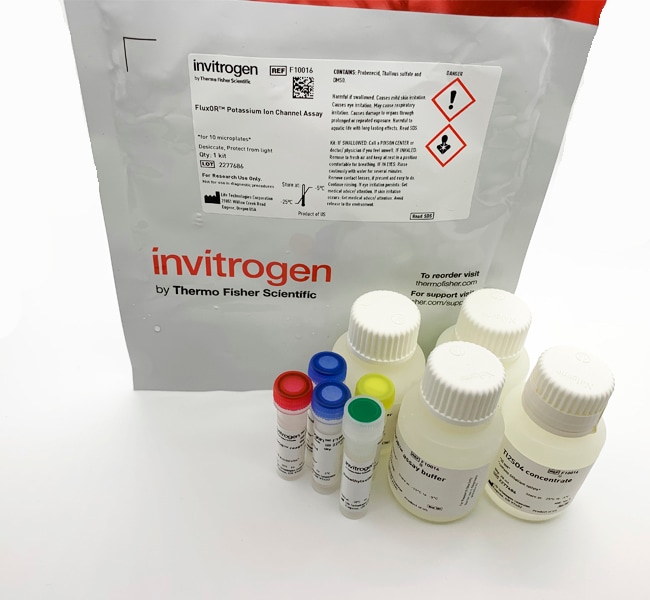
FluxOR™ 钾离子通道检测
FluxOR™ 钾离子通道检测
Have Questions?
更改视图

| 货号 | 数量 |
|---|---|
| F10016 | 10 个微孔板 |
| F10017 | 100 个微孔板 |
货号 F10016
价格(CNY)
12,973.00
Each
数量:
10 个微孔板
价格(CNY)
12,973.00
Each
- K+ channel specific – measure ion flux in both voltage- and ligand-gated potassium channels
- Fast – perform screens in high-throughput mode with reproducible results and excellent S/N without quenching dye
- Pharmacologically relevant – known blockers show dose-dependent inhibition in a large signal window
• K+ 通道特异性—测量电压门控和配体门控钾通道中的离子通量
•快速—在高通量模式下进行筛选,具有可重现的结果和出色的信噪比 (S/N),无需使用淬灭染料
• 药理学相关性—已知的阻滞剂在较宽的信号窗口内显示出剂量依赖性抑制作用
FluxOR™ 钾离子通道检测是一种基于光学的均一测定方法,可对钾离子通道和转运蛋白活性进行高通量筛选 (HTS) 测量。这种均一的测定方法是基于钾通道对铊 I 的通透性。当钾通道受到刺激打开时,可以使用高度灵敏的指示剂染料检测铊从外部培养基的内流。该荧光信号可定量反映出对铊具有通透性的离子通道和转运蛋白(包括 hERG、Kir2.1)以及其他具有重要药理学意义的钾通道的活性。因此,FluxOR™ 系统中报告的荧光成为对铊具有通透性的任何离子通道或转运蛋白活性的替代指标。
FluxOR™ 钾离子通道检测可在新型平衡测量中实现钾通道靶标的快速和稳健高通量筛选 (HTS),从而可重现地提供能够预测在低通量平台中具有阻滞或调节作用的 IC50 值。FluxOR™ 染料足够灵敏,只需较低 mM 水平的细胞外铊即可在高通量模式下产生很强的信号。对于大多数应用,在我们专有的 Powerload™ 配方(目录号 P10020)辅助下,FluxOR™ 染料可溶解于生理性 HBSS 缓冲液以加载至细胞中。
FluxOR™ 钾离子通道检测提供了浓缩的铊溶液以及所有必要的缓冲液,以均一方式提供了尽可能大的靶标灵活性和易用性,已证明可与稳定表达 hERG 的细胞以及我们的 BacMam-hERG 递送和表达试剂(目录号 B10019 和 B10033)配套使用。可以选择与该试剂盒配套使用的是设计融入 Invitrogen 的 BacMam 递送和表达系统中的 hERG 钾通道 cDNA。专有的明亮荧光钾传感器染料以及通过 BacMam 递送的 hERG 钾通道基因的组合提供了优异的检测设计灵活性和卓越的灵敏度,可以在生理条件下的生物相关系统中检测钾通道活性,而无需使用淬灭剂。
•快速—在高通量模式下进行筛选,具有可重现的结果和出色的信噪比 (S/N),无需使用淬灭染料
• 药理学相关性—已知的阻滞剂在较宽的信号窗口内显示出剂量依赖性抑制作用
FluxOR™ 钾离子通道检测是一种基于光学的均一测定方法,可对钾离子通道和转运蛋白活性进行高通量筛选 (HTS) 测量。这种均一的测定方法是基于钾通道对铊 I 的通透性。当钾通道受到刺激打开时,可以使用高度灵敏的指示剂染料检测铊从外部培养基的内流。该荧光信号可定量反映出对铊具有通透性的离子通道和转运蛋白(包括 hERG、Kir2.1)以及其他具有重要药理学意义的钾通道的活性。因此,FluxOR™ 系统中报告的荧光成为对铊具有通透性的任何离子通道或转运蛋白活性的替代指标。
FluxOR™ 钾离子通道检测可在新型平衡测量中实现钾通道靶标的快速和稳健高通量筛选 (HTS),从而可重现地提供能够预测在低通量平台中具有阻滞或调节作用的 IC50 值。FluxOR™ 染料足够灵敏,只需较低 mM 水平的细胞外铊即可在高通量模式下产生很强的信号。对于大多数应用,在我们专有的 Powerload™ 配方(目录号 P10020)辅助下,FluxOR™ 染料可溶解于生理性 HBSS 缓冲液以加载至细胞中。
FluxOR™ 钾离子通道检测提供了浓缩的铊溶液以及所有必要的缓冲液,以均一方式提供了尽可能大的靶标灵活性和易用性,已证明可与稳定表达 hERG 的细胞以及我们的 BacMam-hERG 递送和表达试剂(目录号 B10019 和 B10033)配套使用。可以选择与该试剂盒配套使用的是设计融入 Invitrogen 的 BacMam 递送和表达系统中的 hERG 钾通道 cDNA。专有的明亮荧光钾传感器染料以及通过 BacMam 递送的 hERG 钾通道基因的组合提供了优异的检测设计灵活性和卓越的灵敏度,可以在生理条件下的生物相关系统中检测钾通道活性,而无需使用淬灭剂。
仅供科研使用。不可用于诊断程序。
规格
检测方法荧光
染料类型FluxOR
数量10 个微孔板
运输条件湿冰
发射波长范围525 nm
Excitation Wavelength Range490 nm
适用于(应用)Potassium Ion Channel
适用于(设备)荧光显微镜, 微孔板读数仪
产品线FluxOR
产品类型基于细胞的钾通量
Unit SizeEach
内容与储存
在冷冻冰箱(-5°C 至 -30°C)中避光储存。
引用和文献 (13)
引用和文献
Abstract
Analysis of plasma membrane integrity by fluorescent detection of Tl(+) uptake.
Journal:J Membr Biol
PubMed ID:20623351
'The exclusion of polar dyes by healthy cells is widely employed as a simple and reliable test for cell membrane integrity. However, commonly used dyes (propidium, Yo-Pro-1, trypan blue) cannot detect membrane defects which are smaller than the dye molecule itself, such as nanopores that form by exposure to ultrashort
The Ste20 kinases Ste20-related proline-alanine-rich kinase and oxidative-stress response 1 regulate NKCC1 function in sensory neurons.
Journal:J Biol Chem
PubMed ID:19307180
'NKCC1 is highly expressed in dorsal root ganglion neurons, where it is involved in gating sensory information. In a recent study, it was shown that peripheral nerve injury results in increased NKCC1 activity, not due to an increase in cotransporter expression, but to increased phosphorylation of the cotransporter (Pieraut, S.,
Discovery of novel allosteric modulators of metabotropic glutamate receptor subtype 5 reveals chemical and functional diversity and in vivo activity in rat behavioral models of anxiolytic and antipsychotic activity.
Journal:Mol Pharmacol
PubMed ID:20923853
'Modulators of metabotropic glutamate receptor subtype 5 (mGluR5) may provide novel treatments for multiple central nervous system (CNS) disorders, including anxiety and schizophrenia. Although compounds have been developed to better understand the physiological roles of mGluR5 and potential usefulness for the treatment of these disorders, there are limitations in the
Development of a selective small-molecule inhibitor of Kir1.1, the renal outer medullary potassium channel.
Journal:Mol Pharmacol
PubMed ID:20926757
'The renal outer medullary potassium (K+) channel, ROMK (Kir1.1), is a putative drug target for a novel class of loop diuretic that would lower blood volume and pressure without causing hypokalemia. However, the lack of selective ROMK inhibitors has hindered efforts to assess its therapeutic potential. In a high-throughput screen
Lipid nanopores can form a stable, ion channel-like conduction pathway in cell membrane.
Journal:Biochem Biophys Res Commun
PubMed ID:19450553
Cell permeabilization by electric pulses (EPs), or electroporation, has been well established as a tool to indiscriminately increase membrane flows of water solutes down the concentration and voltage gradients. However, we found that EPs of nanosecond duration (nsEPs) trigger formation of voltage-sensitive and inward-rectifying membrane pores. NsEP-treated cells remain mostly