Search


引用和文献 (14)
Invitrogen™
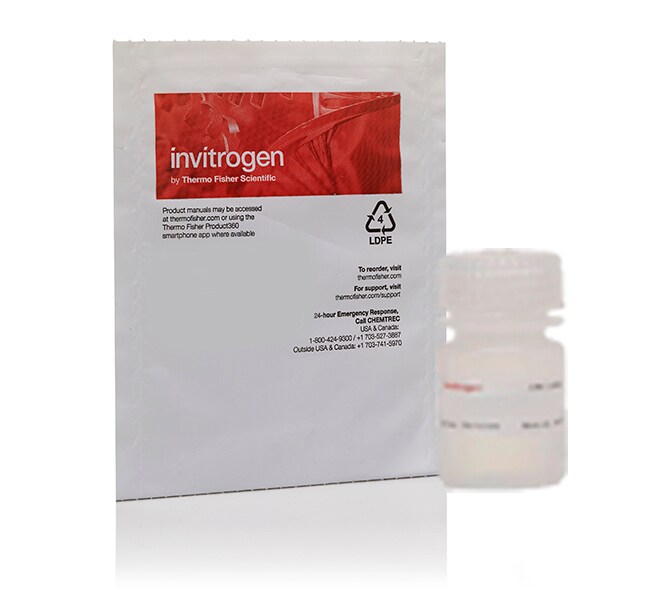
FilmTracer™ SYPRO™ Ruby 生物膜基质染料
F10318 FilmTracer™ SYPRO® Ruby biofilm matrix stain has been used to stain matrices of biofilms. This stain was originally used了解更多信息
| 货号 | 数量 |
|---|---|
| F10318 | 各 1 |
货号 F10318
价格(CNY)
2,257.00
Each
数量:
各 1
价格(CNY)
2,257.00
Each
F10318 FilmTracer™ SYPRO® Ruby biofilm matrix stain has been used to stain matrices of biofilms. This stain was originally used as a gel stain that labels most classes of proteins, including glycoproteins, phosphoproteins, lipoproteins, calcium binding proteins, fibrillar proteins and other proteins that are difficult to stain. FilmTracer™ SYPRO® Ruby biofilm stain comes in a convenient, ready to use 1X concentration.
仅供科研使用。不可用于诊断程序。
规格
颜色红色
检测方法荧光
染料类型SYPRO™ Ruby
发射可见光
激发波长范围450⁄610
适用于(设备)共聚焦显微镜、荧光显微镜、荧光成像仪、微孔板酶标仪
形式液体
产品线FilmTracer、Molecular Probes
数量各 1
运输条件室温
标签类型荧光蛋白
产品类型生物膜基质染色剂
Unit SizeEach
内容与储存
5种组分,室温储存——可短时间暴露于光照
引用和文献 (14)
引用和文献
Abstract
Utilization of the mating scaffold protein in the evolution of a new signal transduction pathway for biofilm development.
Journal:MBio
PubMed ID:21221248
'Among the hemiascomycetes, only Candida albicans must switch from the white phenotype to the opaque phenotype to mate. In the recent evolution of this transition, mating-incompetent white cells acquired a unique response to mating pheromone, resulting in the formation of a white cell biofilm that facilitates mating. All of the
Impact of Environmental Conditions on the Form and Function of Candida albicans Biofilms.
Journal:
PubMed ID:23954841
'Candida albicans, like other pathogens, can form complex biofilms on a variety of substrates. However, as the number of studies of gene regulation, architecture, and pathogenic traits of C. albicans biofilms has increased, so have differences in results. This suggests that depending upon the conditions employed, biofilms may vary widely,
Identification of genes upregulated by the transcription factor Bcr1 that are involved in impermeability, impenetrability, and drug resistance of Candida albicans a/a biofilms.
Journal:Eukaryot Cell
PubMed ID:23563485
Candida albicans forms two types of biofilm, depending upon the configuration of the mating type locus. Although architecturally similar, a/a biofilms are impermeable, impenetrable, and drug resistant, whereas a/a and a/a biofilms lack these traits. The difference appears to be the result of an alternative matrix. Overexpression in a/a cells
Novel observations of Thiobacterium, a sulfur-storing Gammaproteobacterium producing gelatinous mats.
Journal:ISME J
PubMed ID:20220790
The genus Thiobacterium includes uncultivated rod-shaped microbes containing several spherical grains of elemental sulfur and forming conspicuous gelatinous mats. Owing to the fragility of mats and cells, their 16S ribosomal RNA genes have not been phylogenetically classified. This study examined the occurrence of Thiobacterium mats in three different sulfidic marine
Microrheology reveals microscale viscosity gradients in planktonic systems.
Journal:Proc Natl Acad Sci U S A
PubMed ID:33443173