Search


引用和文献 (12)
Invitrogen™
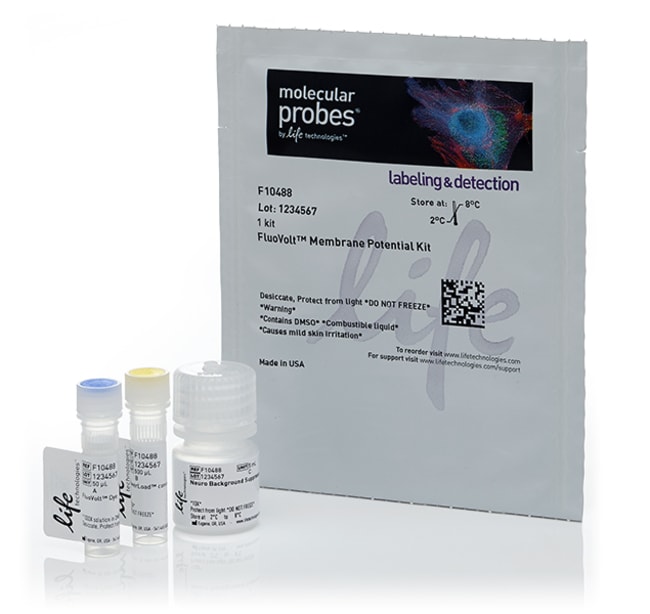
FluoVolt™ 膜电位检测试剂盒
FluoVolt™ 膜电位检测试剂盒是新一代的电压敏感性荧光探针试剂盒的代表。FluoVolt™ 探针将快响应与慢响应膜电位荧光探针的极佳特性结合在一起。FluoVolt™ 探针可在亚毫秒内响应膜电位变化,并显示出很高的响应幅度。了解更多有关离子指示剂(包括钙、钾、pH了解更多信息
| 货号 | 数量 |
|---|---|
| F10488 | 1 Kit |
货号 F10488
价格(CNY)
5,864.00
飞享价
Ends: 31-Dec-2026
8,032.00共减 2,168.00 (27%)
Each
数量:
1 Kit
价格(CNY)
5,864.00
飞享价
Ends: 31-Dec-2026
8,032.00共减 2,168.00 (27%)
Each
FluoVolt™ 膜电位检测试剂盒是新一代的电压敏感性荧光探针试剂盒的代表。FluoVolt™ 探针将快响应与慢响应膜电位荧光探针的极佳特性结合在一起。FluoVolt™ 探针可在亚毫秒内响应膜电位变化,并显示出很高的响应幅度。
了解更多有关离子指示剂(包括钙、钾、pH 值和膜电位指示剂)的信息›
FluoVolt™ 膜电位探针的特点包括:
•快速—在亚毫秒内响应膜电位变化
• 高灵敏度—响应范围通常为 25%/100 mV
• 可采用标准 FITC 设置进行发射/激发工作
• 可用于成像或膜片钳应用
膜电位变化在许多生理过程中发挥核心作用,包括神经脉冲传播、肌肉收缩以及细胞信号转导。电位式荧光探针是研究这些过程的重要工具,通常分为慢响应探针或快响应探针。
慢响应探针和快响应探针的极佳特性
慢响应探针的作用原理为进入去极化细胞、与蛋白质或膜结合并表现出荧光增强。这种膜转位事件会降低这些报告分子对膜电位变化的响应能力,并引入了可能影响细胞健康的电容性负载。然而,这些探针可显示很高的响应幅度;通常在 1%/mV 范围内。
快响应探针是能够根据周围电场改变其结构并检测到瞬态(毫秒)电位变化的分子。然而,与慢速响应探针相比,快速响应探针的电位依赖性荧光变化幅度通常较小(荧光变化为 2–10%/100 mV)。
FluoVolt™ 膜电位探针显示出慢速响应探针和快速响应探针的极佳特性。FluoVolt™ 探针是一种具有卓越电位依赖性荧光响应的快响应探针。可快速响应,足以检测可激发细胞的极短暂(亚毫秒)电位变化,并产生超过 25%/100 mV 的信号变化。
还包括 PowerLoad™ 和背景抑制剂溶液
为了易于细胞加载,FluoVolt™ 膜电位检测试剂盒内含 PowerLoad™ 浓缩液。得益于 PowerLoad™ 溶液的独特性质,它可以在完全培养基中使用,因此减少了更换培养基或在无血清培养基中加载的负面影响。
通过添加随附的 Neuro 背景抑制剂,可以大幅减少由生长培养基中的组分引起的基线自发荧光。该溶液专门配制用于神经元细胞,不会引起渗透压休克。此外,Neuro 背景抑制剂已经成功用于许多不同细胞类型,可有效抑制背景荧光而不会影响在检测中生成的特定细胞荧光。
了解更多有关离子指示剂(包括钙、钾、pH 值和膜电位指示剂)的信息›
FluoVolt™ 膜电位探针的特点包括:
•快速—在亚毫秒内响应膜电位变化
• 高灵敏度—响应范围通常为 25%/100 mV
• 可采用标准 FITC 设置进行发射/激发工作
• 可用于成像或膜片钳应用
膜电位变化在许多生理过程中发挥核心作用,包括神经脉冲传播、肌肉收缩以及细胞信号转导。电位式荧光探针是研究这些过程的重要工具,通常分为慢响应探针或快响应探针。
慢响应探针和快响应探针的极佳特性
慢响应探针的作用原理为进入去极化细胞、与蛋白质或膜结合并表现出荧光增强。这种膜转位事件会降低这些报告分子对膜电位变化的响应能力,并引入了可能影响细胞健康的电容性负载。然而,这些探针可显示很高的响应幅度;通常在 1%/mV 范围内。
快响应探针是能够根据周围电场改变其结构并检测到瞬态(毫秒)电位变化的分子。然而,与慢速响应探针相比,快速响应探针的电位依赖性荧光变化幅度通常较小(荧光变化为 2–10%/100 mV)。
FluoVolt™ 膜电位探针显示出慢速响应探针和快速响应探针的极佳特性。FluoVolt™ 探针是一种具有卓越电位依赖性荧光响应的快响应探针。可快速响应,足以检测可激发细胞的极短暂(亚毫秒)电位变化,并产生超过 25%/100 mV 的信号变化。
还包括 PowerLoad™ 和背景抑制剂溶液
为了易于细胞加载,FluoVolt™ 膜电位检测试剂盒内含 PowerLoad™ 浓缩液。得益于 PowerLoad™ 溶液的独特性质,它可以在完全培养基中使用,因此减少了更换培养基或在无血清培养基中加载的负面影响。
通过添加随附的 Neuro 背景抑制剂,可以大幅减少由生长培养基中的组分引起的基线自发荧光。该溶液专门配制用于神经元细胞,不会引起渗透压休克。此外,Neuro 背景抑制剂已经成功用于许多不同细胞类型,可有效抑制背景荧光而不会影响在检测中生成的特定细胞荧光。
仅供科研使用。不可用于诊断程序。
规格
检测方法Fluorescence
数量1 Kit
子细胞定位细胞膜&脂质
产品线Molecular Probes
产品类型染色剂
Unit SizeEach
内容与储存
包含:
- 50 μL FluoVolt 染料
- 500 μL PowerLoad 浓缩液
- 5 mL Neuro 背景抑制剂
- 储存于 2°C 至 8°C
- 切勿冷冻
常见问题解答 (FAQ)
当我使用膜电位指示剂时,看到神经元周围出现了较高的背景,如何降低背景干扰?
为什么在我用甲醇固定细胞之后,神经元示踪剂信号全部丢失了?
我用DiI一类的亲脂性花青染料进行细胞染色,但是当我试图继续用抗体标记时信号却丢失了。 这是什么原因所致?
我用DiI标记我的神经元,然后固定和通透,但没有获得信号。 哪个环节出了问题?
快反应膜电位探针和慢反应膜电位探针有什么区别?
引用和文献 (12)
引用和文献
Abstract
Screening fluorescent voltage indicators with spontaneously spiking HEK cells.
Journal:
PubMed ID:24391999
Development of improved fluorescent voltage indicators is a key challenge in neuroscience, but progress has been hampered by the low throughput of patch-clamp characterization. We introduce a line of non-fluorescent HEK cells that stably express NaV 1.3 and KIR 2.1 and generate spontaneous electrical action potentials. These cells enable rapid,
Electrophysiology of hiPSC-Cardiomyocytes Co-Cultured with HEK Cells Expressing the Inward Rectifier Channel.
Journal:Int J Mol Sci
PubMed ID:34205607
Patient-specific, re-engineered cardiomyocyte model confirms the circumstance-dependent arrhythmia risk associated with the African-specific common SCN5A polymorphism p.S1103Y: Implications for the increased sudden deaths observed in black individuals during the COVID-19 pandemic.
Journal:Heart Rhythm
PubMed ID:34979239
High-Throughput Drug Screening System Based on Human Induced Pluripotent Stem Cell-Derived Atrial Myocytes ∼ A Novel Platform to Detect Cardiac Toxicity for Atrial Arrhythmias.
Journal:Front Pharmacol
PubMed ID:34413773
Identification of Sodium Transients Through NaV1.5 Channels as Regulators of Differentiation in Immortalized Dorsal Root Ganglia Neurons.
Journal:Front Cell Neurosci
PubMed ID:35465610