Search


引用和文献 (29)
Invitrogen™
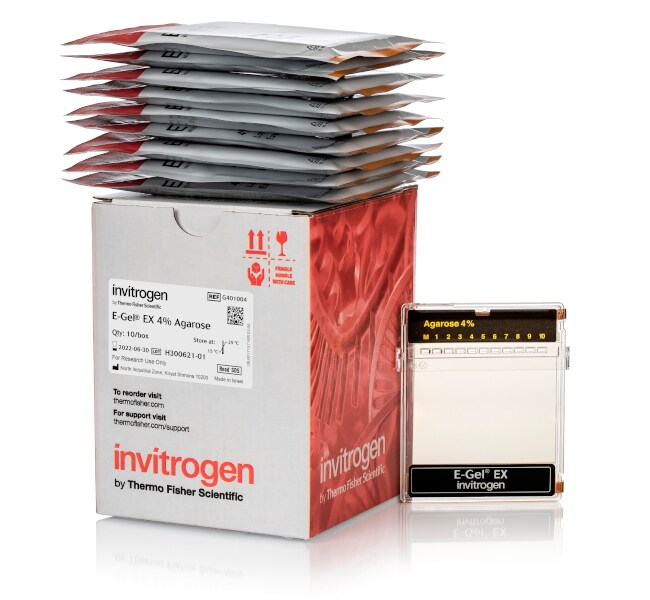
E-Gel™ EX 琼脂糖凝胶
Invitrogen E-Gel EX 预制琼脂糖凝胶设计用于进行超灵敏的便利 DNA 和 RNA 样品电泳,仅需 10–20 分钟即可完成了解更多信息
Have Questions?
更改视图

| 货号 | 数量 | 分离范围 | 凝胶百分比 |
|---|---|---|---|
| G401004 | 10块凝胶/包 | 20 至 800 bp | 4% |
| G401001 | 10块凝胶/包 | 100 bp - 5 kb | 1% |
| G402021 | 20块凝胶/包 | 100 bp 至 5 kb | 1% |
| G401002 | 10块凝胶/包 | 50 bp 至 2 kb | 2% |
| G402022 | 20块凝胶/包 | 50 bp 至 2 kb | 2% |
货号 G401004
价格(CNY)
1,986.00
Each
数量:
10块凝胶/包
分离范围:
20 至 800 bp
凝胶百分比:
4%
价格(CNY)
1,986.00
Each
Invitrogen E-Gel EX 预制琼脂糖凝胶设计用于进行超灵敏的便利 DNA 和 RNA 样品电泳,仅需 10–20 分钟即可完成。每个 E-Gel 琼脂糖凝胶盒均包含有效凝胶分离和分析所需的所有组分和染料—,只需上样并开始电泳即可。E-Gel 琼脂糖凝胶非常适用于分析 PCR 产物、限制性酶切和质粒制备,或用于 DNA 片段文库分析。E-Gel 琼脂糖凝胶也适用于 RNA 样品的快速检验。
E-Gel EX 琼脂糖凝胶的特点包括:
• 瞬时构建—预制 E-Gel 琼脂糖凝胶可在您需要时随时使用,无需凝胶制备或其他缓冲液
• 高灵敏度—可检测到 1 ng 的样品 DNA
• 快速分析—在 10–20 分钟内即可完成 DNA 样品的分离
• 过程控制—实时监测 DNA 样品迁移
• 轻松获取样品—可打开的盒体设计允许轻松取出凝胶,方便切取 DNA 样品或将其转印至膜上
• 适用于 DNA 和 RNA—是进行 DNA 样品分析的理想选择,也适用于 RNA 样品的快速检验
DNA 的超灵敏检测
开发了用 SYBR Gold DNA 染色剂预染色的 E-Gel EX 凝胶,可实现极高的灵敏度,其灵敏度高达含溴化乙锭的同类凝胶灵敏度的 5 倍。这一出色的灵敏度可减少您的样品使用量,从而节省时间和成本。
快速便利的分析
E-Gel EX 凝胶是我们检验速度最快的琼脂糖凝胶,可在短短 10–20 分钟内完成样品分析。每套 E-Gel 琼脂糖凝胶均包含琼脂糖、电极、SYBR Gold DNA 染料以及一个干燥的一次性盒内包装的无缓冲液离子交换系统。E-Gel 技术不需要任何凝胶或缓冲液制备或凝胶过滤步骤。只需将样品上样,并开始电泳即可。
实时监测 DNA 迁移
E-Gel EX 琼脂糖凝胶预先经过 SYBR Gold II DNA 凝胶染料染色,并在蓝光光谱内具有激发波长。不同于紫外光照射,当使用带有集成式蓝光透射仪的 E-Gel Power Snap 电泳仪时,可以进行安全的 DNA 或 RNA 迁移实时监测,而不会有对眼睛或样品造成损害的风险。
RNA 样品的快速检验
除 DNA 分析之外,E-Gel EX 凝胶也可用于 RNA 样品的快速分析,以便在继续进行下游应用前检查其完整性。
方便取出凝胶
E-Gel 凝胶盒设计为方便使用凝胶刀打开(货号 EI9010),以轻松切取特定的条带,或将凝胶转印至膜上进行 Southern 印迹分析。
核酸标记物
了解关于 E-Gel DNA 分子量标准品的更多信息›
电泳和成像设备
E-Gel EX 凝胶需要配合 Invitrogen E-Gel Power Snap 电泳系统进行凝胶电泳和观察。该系统由一个电泳装置和一个摄像头组成,用于快速方便地进行 E-Gel 琼脂糖凝胶分离和分析。
了解关于 E-Gel Power Snap 电泳系统的更多信息›
有多种凝胶规格可供选择
E-Gel 琼脂糖凝胶有多种凝胶百分比、染色和孔形式可供选择。11 孔 E-Gel EX 琼脂糖凝胶有 1%、2% 和 4% 这几种凝胶百分比可供选择。E-Gel 琼脂糖凝胶选择指南
E-Gel EX 琼脂糖凝胶的特点包括:
• 瞬时构建—预制 E-Gel 琼脂糖凝胶可在您需要时随时使用,无需凝胶制备或其他缓冲液
• 高灵敏度—可检测到 1 ng 的样品 DNA
• 快速分析—在 10–20 分钟内即可完成 DNA 样品的分离
• 过程控制—实时监测 DNA 样品迁移
• 轻松获取样品—可打开的盒体设计允许轻松取出凝胶,方便切取 DNA 样品或将其转印至膜上
• 适用于 DNA 和 RNA—是进行 DNA 样品分析的理想选择,也适用于 RNA 样品的快速检验
DNA 的超灵敏检测
开发了用 SYBR Gold DNA 染色剂预染色的 E-Gel EX 凝胶,可实现极高的灵敏度,其灵敏度高达含溴化乙锭的同类凝胶灵敏度的 5 倍。这一出色的灵敏度可减少您的样品使用量,从而节省时间和成本。
快速便利的分析
E-Gel EX 凝胶是我们检验速度最快的琼脂糖凝胶,可在短短 10–20 分钟内完成样品分析。每套 E-Gel 琼脂糖凝胶均包含琼脂糖、电极、SYBR Gold DNA 染料以及一个干燥的一次性盒内包装的无缓冲液离子交换系统。E-Gel 技术不需要任何凝胶或缓冲液制备或凝胶过滤步骤。只需将样品上样,并开始电泳即可。
实时监测 DNA 迁移
E-Gel EX 琼脂糖凝胶预先经过 SYBR Gold II DNA 凝胶染料染色,并在蓝光光谱内具有激发波长。不同于紫外光照射,当使用带有集成式蓝光透射仪的 E-Gel Power Snap 电泳仪时,可以进行安全的 DNA 或 RNA 迁移实时监测,而不会有对眼睛或样品造成损害的风险。
RNA 样品的快速检验
除 DNA 分析之外,E-Gel EX 凝胶也可用于 RNA 样品的快速分析,以便在继续进行下游应用前检查其完整性。
方便取出凝胶
E-Gel 凝胶盒设计为方便使用凝胶刀打开(货号 EI9010),以轻松切取特定的条带,或将凝胶转印至膜上进行 Southern 印迹分析。
核酸标记物
了解关于 E-Gel DNA 分子量标准品的更多信息›
电泳和成像设备
E-Gel EX 凝胶需要配合 Invitrogen E-Gel Power Snap 电泳系统进行凝胶电泳和观察。该系统由一个电泳装置和一个摄像头组成,用于快速方便地进行 E-Gel 琼脂糖凝胶分离和分析。
了解关于 E-Gel Power Snap 电泳系统的更多信息›
有多种凝胶规格可供选择
E-Gel 琼脂糖凝胶有多种凝胶百分比、染色和孔形式可供选择。11 孔 E-Gel EX 琼脂糖凝胶有 1%、2% 和 4% 这几种凝胶百分比可供选择。E-Gel 琼脂糖凝胶选择指南
仅供科研使用。不可用于诊断程序。
规格
可兼容的 LadderE-Gel™ 超低范围 DNA 分子量标准,Century™-Plus RNA 标记物
分离模式分子量
数量10块凝胶/包
上样容量20 µL
样品类型双链 DNA (dsDNA)、单链 RNA
运输条件室温
孔设计Single Comb
凝胶百分比4%
凝胶类型E-Gel
标签或染料SYBR Gold
产品类型EX 琼脂糖凝胶
分离范围20 至 800 bp
系统类型E-Gel™
孔11孔
Unit SizeEach
内容与储存
• E-Gel™ EX 10 套装包含10块凝胶
在室温下储存凝胶。妥善储存时,可保证稳定储存 3 个月。
在室温下储存凝胶。妥善储存时,可保证稳定储存 3 个月。
常见问题解答 (FAQ)
我在进行E-Gel EX琼脂糖凝胶电泳时没有电流。这是为什么?
我的 E-Gel琼脂糖凝胶在成像仪内观察时出现斑块。我应该怎么办?
我在进行E-Gel琼脂糖凝胶电泳时样本从孔内渗出。这是什么原因造成的?
我不小心将 E-Gel琼脂糖凝胶保存在了4°C而不是室温。我还能使用它们吗?
如何才能更好地分离我的条带?
引用和文献 (29)
引用和文献
Abstract
SNP model development for the prediction of eye colour in New Zealand.
Journal:Forensic Sci Int Genet
PubMed ID:23597786
'The ability to predict externally visible characteristics (EVCs) from DNA has appeal for use in forensic science, particularly where a forensic database match is not made and an eye witness account is unavailable. This technology has yet to be implemented in casework in New Zealand. The broad cultural diversity and
Differential selection pressures exerted by host resistance quantitative trait loci on a pathogen population: a case study in an apple × Venturia inaequalis pathosystem.
Journal:New Phytol
PubMed ID:23278324
'Understanding how pathogens evolve according to pressures exerted by their plant hosts is essential for the derivation of strategies aimed at the durable management of resistant cultivars. The spectrum of action of the resistance factors in the partially resistant cultivars is thought to be an important determinant of resistance durability.
Amino-acid substitutions at the domain interface affect substrate and allosteric inhibitor binding in a-isopropylmalate synthase from Mycobacterium tuberculosis.
Journal:Biochem Biophys Res Commun
PubMed ID:23500460
'a-Isopropylmalate synthase (a-IPMS) is a multi-domain protein catalysing the condensation of a-ketoisovalerate (a-KIV) and acetyl coenzyme A (AcCoA) to form a-isopropylmalate. This reaction is the first committed step in the leucine biosynthetic pathway in bacteria and plants, and a-IPMS is allosterically regulated by this amino acid. Existing crystal structures of
Amino acid sequence of the ligand-binding domain of the aryl hydrocarbon receptor 1 predicts sensitivity of wild birds to effects of dioxin-like compounds.
Journal:Toxicol Sci
PubMed ID:22923492
'The sensitivity of avian species to the toxic effects of dioxin-like compounds (DLCs) varies up to 1000-fold among species, and this variability has been associated with interspecies differences in aryl hydrocarbon receptor 1 ligand-binding domain (AHR1 LBD) sequence. We previously showed that LD(50) values, based on in ovo exposures to
An arbuscular mycorrhizal fungus significantly modifies the soil bacterial community and nitrogen cycling during litter decomposition.
Journal:Environ Microbiol
PubMed ID:23360621
'Arbuscular mycorrhizal fungi (AMF) perform an important ecosystem service by improving plant nutrient capture from soil, yet little is known about how AMF influence soil microbial communities during nutrient uptake. We tested whether an AMF modifies the soil microbial community and nitrogen cycling during litter decomposition. A two-chamber microcosm system