Search


引用和文献 (15)
Invitrogen™
E-Gel™ 48 琼脂糖凝胶,内含 SYBR™ Safe DNA 凝胶染色剂,4%
Invitrogen E-Gel 48 高通量预制琼脂糖凝胶(含 SYBR Safe DNA 凝胶染色剂)设计用于进行快速了解更多信息
Have Questions?
更改视图

| 货号 | 数量 | 分离范围 | 凝胶百分比 | dimStainType |
|---|---|---|---|---|
| G800802 | 8 块凝胶 | 50 bp 至 3 kb | 2% | |
| G800801 | 8 块凝胶 | 400 bp 至 10 kb | 1% | |
| G820801 | 8 块凝胶 | 400 bp 至 10 kb | 1% | |
| G820841 | 4 x 8 凝胶 | 400 bp 至 10 kb | 1% | |
| G820802 | 8 块凝胶 | 50 bp 至 3 kb | 2% | |
| G820842 | 4 x 8 凝胶 | 50 bp 至 3 kb | 2% | |
| G800804 | 8 块凝胶 | 10 至 400 bp | 4% | |
| G820804 | 8 块凝胶 | 10 至 500 bp | 4% | |
| G820844 | 4 x 8 凝胶 | 10 至 500 bp | 4% |
货号 G800802
价格(CNY)
2,650.00
Each
数量:
8 块凝胶
分离范围:
50 bp 至 3 kb
凝胶百分比:
2%
价格(CNY)
2,650.00
Each
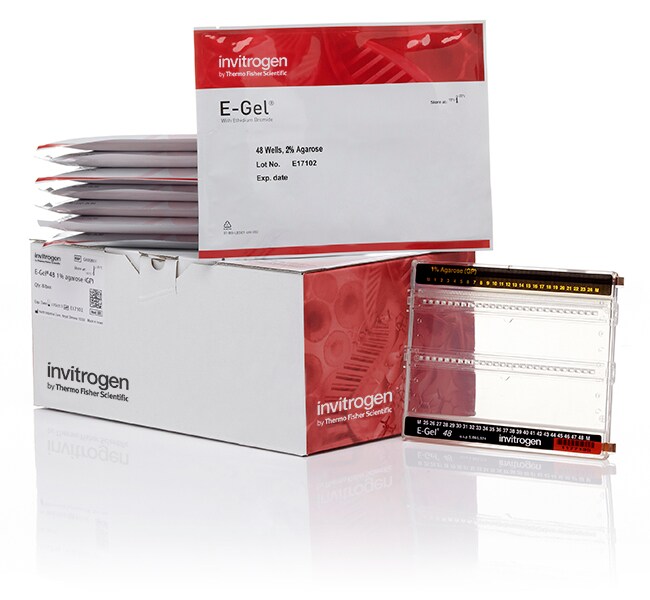
Invitrogen E-Gel 48 高通量预制琼脂糖凝胶(含 SYBR Safe DNA 凝胶染色剂)设计用于进行快速、便利和危害更小的 DNA 样品电泳。每个 E-Gel 琼脂糖凝胶盒均包含有效凝胶分离和分析所需的所有组分和染料—,只需上样并开始电泳即可。
每块凝胶含有 48 个样品孔和 4 个标志物孔,采用 1%、2% 或 4% 高分辨率琼脂糖,运行长度为 3.2 cm。多种百分比的琼脂糖用于分离大小不同的 DNA 片段:
• 1% 琼脂糖凝胶:400 bp 至 10 kb 之间的 DNA 片段
• 2% 琼脂糖凝胶:50 bp 至 3 kb 之间的 DNA 片段
• 4% 琼脂糖凝胶:10 bp 至 500 bp 之间的 DNA 片段
每个凝胶盒都使用 EAN39 条形码单独标记,可被大多数市售的自动条形码读数仪识别。
E-Gel 凝胶的特点:
• 高通量分析—每块凝胶包含 48 个样品泳道和 4 个标记物泳道
• 自动化兼容—适合与多通道移液器和常用的 8 和 12 头液体处理自动化设备配合使用
• 可扩展—通过组合多达四个 E-Base 子母式设备,一次运行即可分离 192 份样品
• 危害更小的选择—内含 SYBR Safe DNA 染色剂,是溴化乙锭的危害更小的替代品
• 高性能—检测 3 ng 样品 DNA,分离时间短至 ∼20 分钟
危害更小的选项
选择含有 SYBR Safe DNA 染色剂的凝胶能够尽可能减少暴露于有害物质和致突变性因素(如溴化乙锭或紫外光)。预制的含有 SYBR Safe 染色剂的 E-Gel 琼脂糖凝胶结合蓝光透射仪可提供更好的样品完整性和危害更小的工作环境。与琼脂糖凝胶中最常掺入的 DNA 染色剂溴化乙锭不同,SYBR Safe DNA 凝胶染色剂是一种无毒、非致突变的 DNA 染色剂,对使用者及环境危害更小,并且可以为实验室节省昂贵的实验废物清理费用。
快速便利的分析
E-Gel 琼脂糖凝胶可实现快速高效的分析,每条带的检测灵敏度为 3 ng 样品 DNA,分离时间比传统的自制凝胶快 3 倍。每片 E-Gel 琼脂糖凝胶包含琼脂糖、电极、SYBR Safe DNA 染料和无缓冲液离子交换系统,采用一次性干燥卡盒包装。E-Gel 技术不需要任何凝胶或缓冲液制备或凝胶染色步骤。只需将样品上样,并开始电泳即可。
核酸标记物
了解关于 E-Gel DNA 分子量标准品的更多信息›
电泳和成像设备
高通量 E-Gel 琼脂糖凝胶需要 Invitrogen E-Base 电泳设备进行凝胶电泳。
了解关于 Invitrogen E-Base 设备的更多信息›
有多种凝胶规格可供选择
E-Gel 琼脂糖凝胶有多种凝胶百分比、染色和孔形式可供选择。可提供凝胶百分比为 1%、2% 和 4% 的内含 SYBR Safe 染色剂的高通量 E-Gel 96 和 48 琼脂糖凝胶。E-Gel 琼脂糖凝胶选择指南
每块凝胶含有 48 个样品孔和 4 个标志物孔,采用 1%、2% 或 4% 高分辨率琼脂糖,运行长度为 3.2 cm。多种百分比的琼脂糖用于分离大小不同的 DNA 片段:
• 1% 琼脂糖凝胶:400 bp 至 10 kb 之间的 DNA 片段
• 2% 琼脂糖凝胶:50 bp 至 3 kb 之间的 DNA 片段
• 4% 琼脂糖凝胶:10 bp 至 500 bp 之间的 DNA 片段
每个凝胶盒都使用 EAN39 条形码单独标记,可被大多数市售的自动条形码读数仪识别。
E-Gel 凝胶的特点:
• 高通量分析—每块凝胶包含 48 个样品泳道和 4 个标记物泳道
• 自动化兼容—适合与多通道移液器和常用的 8 和 12 头液体处理自动化设备配合使用
• 可扩展—通过组合多达四个 E-Base 子母式设备,一次运行即可分离 192 份样品
• 危害更小的选择—内含 SYBR Safe DNA 染色剂,是溴化乙锭的危害更小的替代品
• 高性能—检测 3 ng 样品 DNA,分离时间短至 ∼20 分钟
危害更小的选项
选择含有 SYBR Safe DNA 染色剂的凝胶能够尽可能减少暴露于有害物质和致突变性因素(如溴化乙锭或紫外光)。预制的含有 SYBR Safe 染色剂的 E-Gel 琼脂糖凝胶结合蓝光透射仪可提供更好的样品完整性和危害更小的工作环境。与琼脂糖凝胶中最常掺入的 DNA 染色剂溴化乙锭不同,SYBR Safe DNA 凝胶染色剂是一种无毒、非致突变的 DNA 染色剂,对使用者及环境危害更小,并且可以为实验室节省昂贵的实验废物清理费用。
快速便利的分析
E-Gel 琼脂糖凝胶可实现快速高效的分析,每条带的检测灵敏度为 3 ng 样品 DNA,分离时间比传统的自制凝胶快 3 倍。每片 E-Gel 琼脂糖凝胶包含琼脂糖、电极、SYBR Safe DNA 染料和无缓冲液离子交换系统,采用一次性干燥卡盒包装。E-Gel 技术不需要任何凝胶或缓冲液制备或凝胶染色步骤。只需将样品上样,并开始电泳即可。
核酸标记物
了解关于 E-Gel DNA 分子量标准品的更多信息›
电泳和成像设备
高通量 E-Gel 琼脂糖凝胶需要 Invitrogen E-Base 电泳设备进行凝胶电泳。
了解关于 Invitrogen E-Base 设备的更多信息›
有多种凝胶规格可供选择
E-Gel 琼脂糖凝胶有多种凝胶百分比、染色和孔形式可供选择。可提供凝胶百分比为 1%、2% 和 4% 的内含 SYBR Safe 染色剂的高通量 E-Gel 96 和 48 琼脂糖凝胶。E-Gel 琼脂糖凝胶选择指南
仅供科研使用。不可用于诊断程序。
规格
数量8 块凝胶
运输条件室温
凝胶百分比2%
凝胶类型E-Gel
标签或染料Ethidium Bromide
产品类型琼脂糖凝胶
分离范围50 bp 至 3 kb
孔48孔
Unit SizeEach
内容与储存
•每盒 E-Gel™ 48 凝胶含有8块凝胶和一本手册
在室温下储存。
在室温下储存。
常见问题解答 (FAQ)
我的 E-Gel琼脂糖凝胶在成像仪内观察时出现斑块。我应该怎么办?
我在进行E-Gel琼脂糖凝胶电泳时样本从孔内渗出。这是什么原因造成的?
我不小心将 E-Gel琼脂糖凝胶保存在了4°C而不是室温。我还能使用它们吗?
有用于进行E-Gel 48/96或E-PAGE 48/96凝胶电泳的自动化操作脚本吗?
我的E-Gel琼脂糖凝胶应该使用哪种上样缓冲液?
引用和文献 (15)
引用和文献
Abstract
Excess variants in AFF2 detected by massively parallel sequencing of males with autism spectrum disorder.
Journal:Hum Mol Genet
PubMed ID:22773736
'Autism spectrum disorder (ASD) is a heterogeneous disorder with substantial heritability, most of which is unexplained. ASD has a population prevalence of one percent and affects four times as many males as females. Patients with fragile X E (FRAXE) intellectual disability, which is caused by a silencing of the X-linked
Identifying the last supper: utility of the DNA barcode library for bloodmeal identification in ticks.
Journal:Mol Ecol Resour
PubMed ID:22471892
'Ticks are among the most important vectors of disease in the Northern Hemisphere, and a better understanding of their feeding behaviour and life cycle is critical to the management and control of tick-borne zoonoses. DNA-based tools for the identification of residual bloodmeals in hematophagous arthropods have proven useful in the
Protocols for dry DNA storage and shipment at room temperature.
Journal:
PubMed ID:23789643
'The globalization of DNA barcoding will require core analytical facilities to develop cost-effective, efficient protocols for the shipment and archival storage of DNA extracts and PCR products. We evaluated three dry-state DNA stabilization systems: commercial Biomatrica(®) DNAstable(®) plates, home-made trehalose and polyvinyl alcohol (PVA) plates on 96-well panels of insect
DNA mini-barcodes.
Journal:Methods Mol Biol
PubMed ID:22684963
'Conventional DNA barcoding uses an approximately 650 bp DNA barcode of the mitochondrial gene COI for species identification in animal groups. Similar size fragments from chloroplast genes have been proposed as barcode markers for plants. While PCR amplification and sequencing of a 650 bp fragment is consistent in freshly collected
Rumen microbial and fermentation characteristics are affected differently by bacterial probiotic supplementation during induced lactic and subacute acidosis in sheep.
Journal:BMC Microbiol
PubMed ID:22812531
'Ruminal disbiosis induced by feeding is the cause of ruminal acidosis, a digestive disorder prevalent in high-producing ruminants. Because probiotic microorganisms can modulate the gastrointestinal microbiota, propionibacteria- and lactobacilli-based probiotics were tested for their effectiveness in preventing different forms of acidosis.'