Search


引用和文献 (15)
Invitrogen™
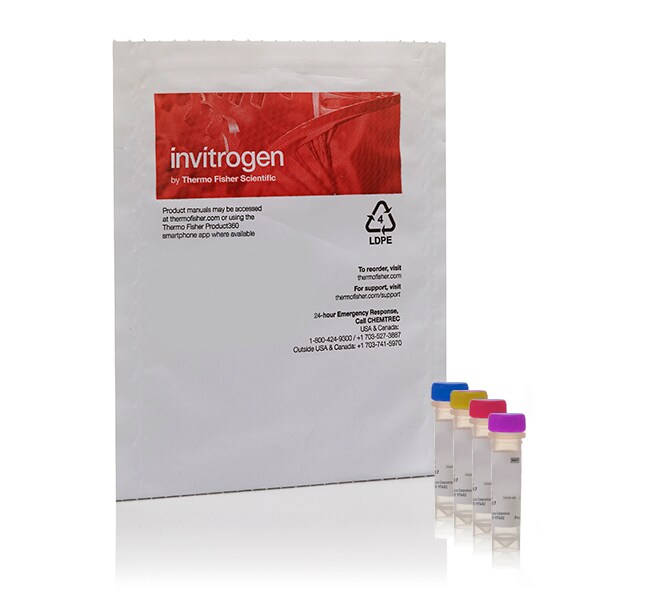
HCS DNA 损伤检测试剂盒
HCS DNA 损伤检测试剂盒能够同时定量测定两个重要的细胞健康参数:DNA 损伤和细胞毒性。DNA 损伤可以使用针对双链断裂 (DSB) 诱导形成的磷酸化 H2AX (Ser139)了解更多信息
| 货号 | 数量 |
|---|---|
| H10292 | 1 kit |
货号 H10292
价格(CNY)
6,379.00
Each
数量:
1 kit
价格(CNY)
6,379.00
Each
HCS DNA 损伤检测试剂盒能够同时定量测定两个重要的细胞健康参数:DNA 损伤和细胞毒性。DNA 损伤可以使用针对双链断裂 (DSB) 诱导形成的磷酸化 H2AX (Ser139) 的抗体进行检测。细胞毒性可以使用 Image-iT® DEAD™ Green 进行检测,这种染料不可透过健康细胞,但会透过细胞膜受损后的细胞。两种指示剂都适用于固定和透化,因此能够与其他感兴趣的生物标记物一起进行多通路检测。还包含蓝色荧光细胞核分隔工具 Hoechst 33342,可对活细胞和死细胞中的 DNA 进行染色。
仅供科研使用。不可用于诊断程序。
规格
检测方法荧光
染料类型Alexa Fluor™ 555,Hoechst 33258
产品规格96 孔板
数量1 kit
运输条件干冰
颜色橙色、蓝色、绿色
适用于(设备)高内涵分析仪
产品线Molecular Probes
产品类型DNA 损伤测定试剂盒
Unit SizeEach
内容与储存
试剂盒包含足够测定96孔板规格的2块微孔板的试剂。在 ≤-20°C 下干燥、避光储存。
常见问题解答 (FAQ)
What are the fluorescence excitation/emission maxima for the dyes contained in the HCS DNA Damage Kit?
引用和文献 (15)
引用和文献
Abstract
Development of a high-content screening method for chemicals modulating DNA damage response.
Journal:J Biomol Screen
PubMed ID:21233308
The cellular response to DNA damage is emerging as a promising target for cancer therapy. In the present study, the authors exploited the relationship between the level of the phosphorylated form of histone H2AX (?H2AX) and the extent of DNA damage and developed a quantitative, cell-based, high-content screening system for
Induction of glutathione-dependent DNA double-strand breaks by the novel anticancer drug brostallicin.
Journal:Mol Cancer Ther
PubMed ID:19584235
Brostallicin is a DNA minor groove binder in phase II clinical trials. Here, we show that brostallicin induces gamma-H2AX nuclear foci that colocalize with 53BP1 and are dependent on glutathione, as shown by inhibition of those gamma-H2AX foci by l-buthionine sulfoximine. To differentiate brostallicin from the clinically approved minor groove
Free radical scavenging, a-glucosidase inhibitory and lipase inhibitory activities of eighteen Sudanese medicinal plants.
Journal:BMC Complement Altern Med
PubMed ID:30340582
'Lifestyle-related diseases such as diabetes are steadily increasing worldwide. In Sudan, there are a variety of plant species used traditionally for the treatment of diabetes, obesity and other symptoms which need to be validated through scientific studies for their claimed traditional uses. Therefore, in the current study, the free radical
Bioactive peptide amphiphile nanofiber gels enhance burn wound healing.
Journal:Burns
PubMed ID:31043333
'Burns are physically debilitating and potentially fatal injuries. The standard-of-care for burn wounds is the coverage with gauze dressings designed to minimize trauma to the regenerating epidermis and dermis during dressing changes. However, deep partial- and full-thickness burns always heal slowly when standard wound care alone is performed. We have
A novel hydroxyphenyl hydrazone derivate YCL0426 inhibits cancer cell proliferation through sequestering iron.
Journal:Anticancer Drugs
PubMed ID:28926421
'Cancer cells have an increased requirement for iron than normal cells, and iron chelators are under active consideration for cancer treatment. The metal-sequestering potential and antiproliferative mechanisms of a novel hydroxyphenyl hydrazone derivate YCL0426 were investigated here. Antiproliferative activity of YCL0426 was detected by MTT assay. The iron-sequestering potential was