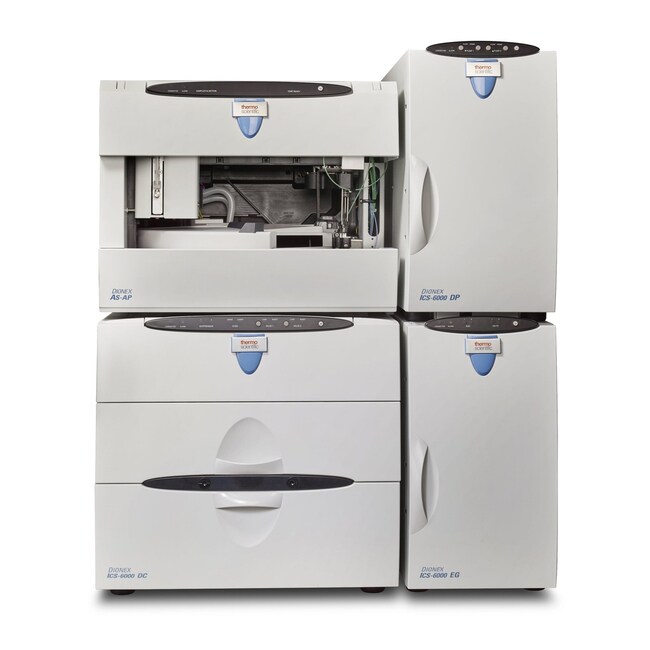
Dionex™ ICS-6000 标准孔和微孔 HPIC™ 系统
Thermo Scientific™

Dionex™ ICS-6000 标准孔和微孔 HPIC™ 系统

采用本款适用于标准孔和微孔色谱柱的高压力模块化 IC 系统可显著提高分离度和通量。

Have Questions?
更改视图buttonViewtableView
货号类型描述
ICS6000-011双通道标准孔 RFIC 系统Dionex ICS-6000 双通道标准孔 RFIC 系统
ICS6000-007单通道标准孔 IC 系统Dionex ICS-6000 单通道标准孔 IC 系统
ICS6000-008单通道梯度标准孔 IC 系统Dionex ICS-6000 单通道梯度标准孔 IC 系统
ICS6000-009单通道标准孔 RFIC 系统Dionex ICS-6000 单通道标准孔 RFIC 系统
ICS6000-010单通道微孔 RFIC 系统Dionex ICS-6000 单通道微孔 RFIC 系统
ICS6000-012双通道微孔 RFIC 系统Dionex ICS-6000 双通道微孔 RFIC 系统
ICS6000-0132D-IC 标准孔-微孔系统Dionex ICS-6000 2D-IC 标准孔-微孔系统
ICS6000-014碳水化合物分析标准孔 HPIC 系统Dionex ICS-6000 碳水化合物分析标准孔系统
ICS6000-015带 ED 的 BioIC 系统Dionex ICS-6000 BioIC 系统(带 ED),适用于碳水化合物(标准孔)和 AAA-Direct(微孔)系统
货号 ICS6000-011
价格(CNY)
-
申请报价
类型:
双通道标准孔 RFIC 系统
描述:
Dionex ICS-6000 双通道标准孔 RFIC 系统

使用世界上首台可以在高达 5000 psi 压力下操作的模块式离子色谱 (IC) 系统,达到分离度和通量显著增加的效果。当配置为 Reagent-Free™ IC (RFIC™) 系统时,Thermo Scientific™ Dionex™ ICS-6000 标准孔和微孔系统可以在高达 5000 psi 压力下持续运行。利用较小粒径 (4 μm) 色谱柱提高分辨率,采用较高流速和 150 mm 色谱柱在不降低所需分辨率的情况下加快运行速度,或采用标准流速和 250 mm 色谱柱提高分辨率。能够对该灵活的模块化系统进行配置,使其适合极广泛的各种应用。

出众的灵敏度和便利性
  • 极佳的灵敏度、稳定性,易于使用
  • 由于极佳的流速准确性,洗脱液发生器电子设备具有稳定性以及导电单元温度可控制,所以加强了基线稳定性和灵敏度。
选择等度和电解梯度分离,优化峰分离度
  • 灵活地支持微孔(内径 1–3 mm)和标准孔(内径 3–7 mm)色谱柱
  • 多种 Thermo Scientific 标准和微孔柱
  • 兼容新款 4 µm 色谱柱
在不影响分离度的情况下分离速度达到两倍
  • 在提升流速的情况下,显著增强当前方法的分离度
  • 使用小粒径 (4 µm) 色谱柱提高分离度并显著改善性能
  • 使用 150 mm 柱在更高流速下获得更短的运行时间,或者使用 250 mm 柱在标准流速下获得更高分离度
配置系统极其灵活,根据需要配置系统

模块和相关产品种类广泛

  • Dionex ICS-6000 标准泵 (SP) 和双泵 (DP),实现高效分离
  • Dionex ICS-6000 EG 洗脱液发生器,发挥 RFIC 系统优势
  • 高效 ICS-6000 DC 检测器/色谱分析区
  • IC 和 RFIC 自动进样器和进样器适用于从单次进样到复杂样品制备的自动化操作
  • Thermo Scientific™ Dionex Chromeleon™ 色谱数据系统软件

灵活的检测器选择

  • 适用于毛细管和分析型号的 Dionex ICS-6000 CD 电导率检测器
  • Dionex ICS-6000 ED 电化学检测器,用于复杂分析物的高灵敏度测定
  • Dionex ICS-6000 系列 VWD 可变波长检测器和 PDA 光电二极管阵列检测器,用于吸光度检测
  • 适用于选择性分析的质谱检测
  • 电感耦合等离子体质谱分析 (ICP-MS),用于元素形态分析
规格
ACT 标签Yes
描述Dionex ICS-6000 双通道标准孔 RFIC 系统
适用于(应用)离子色谱
包括1x DP 泵,Iso/Iso(分析)带脱气装置
1x DC (SB) 带双温区,两个进样阀
1x EG 模块
2x EG 脱气装置 (SB/MB)
2x CD 检测器(带池)
1x EO 洗脱液收集托盘带四个 2 L 瓶
2x IC PEEK Viper 安装套件,用于 Dionex ICS-6000,带 CD(分析)
1x 耗材设备监测器
1x 平板电脑套件(带臂、支架和连接工具包)
型号Dionex ICS-6000
类型双通道标准孔 RFIC 系统
Unit SizeEach

常见问题解答 (FAQ)

What systems are available for speciation analysis?

Any of the Thermo Scientific Dionex IC systems can be used in conjunction with the iCAP RQ ICP-MS system. Visit our site to see all system configurations (https://www.thermofisher.com/us/en/home/industrial/chromatography/ion-chromatography-ic/ic-icp-ms-speciation-analyzer.html)

What example analytes require speciation analysis?

The following are some of the most common analytes screened by speciation analysis:
• Arsenic
• Chromium
• Iodide
• Mercury

Visit our Speciation Analysis by IC-ICP-MS page to view our application note videos where our scientists walk through speciation analysis of example analytes:
• Speciation Analysis of Arsenic in Organic Brown Rice Syrup using the Thermo Scientific iCAP-Q ICP-MS
• Chromium Speciation Analysis in Drinking Water by IC-ICP-MS
• Analysis of Arsenic Species in Apple Juice by IC-ICP-MS

How is speciation analysis performed?

IC-ICP-MS provides a complete inorganic elemental analysis solution for speciation analysis.
• Metal-free ion chromatography (IC) separates the individual ionic species without contributing trace metal contamination
• Ion chromatography-inductively coupled plasma mass spectrometry (IC-ICP-MS) performs trace elemental detection and quantification

Metal-free IC (with high resolution ion exchange columns and simple online connectivity) together with high sensitivity ICP-MS and integrated software are a powerful combination for fast and efficient metal speciation. Visit our Speciation Analysis by IC-ICP-MS page to see our scientists discuss real-life examples and benefits of combining IC and ICP-MS workflows for speciation analysis.

Why is speciation analysis important?

Speciation analysis has become important for food, environmental, and pharmaceutical industries, where simply measuring the total amount of an element is insufficient. Identifying the different species and concentrations of those species provides a more informed understanding of the environmental or health related impact associated with a particular sample. The clinical or environmental approach would be very different depending on the concentration of the toxic species. For example, an exposure to toxic inorganic arsenic (arsenite and arsenate) is a much bigger concern than an exposure to the mildly toxic organic arsenic species. In contrast, organic mercury species are more toxic than inorganic mercury species, so an exposure to methylmercury or ethylmercury poses a more severe health risk.

What is speciation analysis?

Speciation analysis is the process of separating and quantifying different molecular versions of a compound, which can exhibit very different physiochemical properties, including varying toxicities.