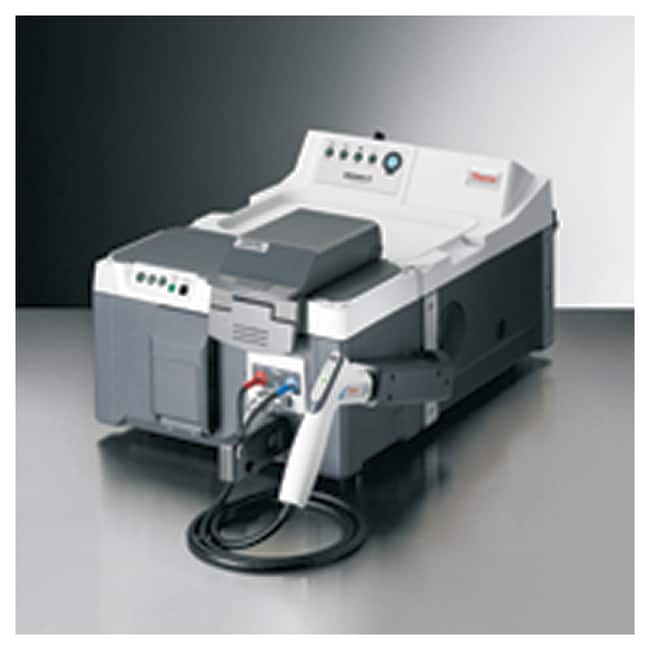
How are probes used for in-line NIR analysis?
Fiber optic probes can be used for analyzing liquid samples in transmission or solid samples in reflection. For samples that have bubbles or solids or change state between liquid and solid, a transflectance probe works the best. A fitting attached to the probe mates it with a port on a tank, pipe, reactor, hopper, or above a conveyor. The common fittings used with probes are Swagelok, sanitary tri-clamp or bolt-on.
How can I use an Antaris FT-NIR analyzer for in-line process analysis?
If the process environment has water hose down, CIP, dust, high temperature, corrosive or explosive chemicals, the Antaris FT-NIR analyzer needs to be placed in a safe area or enclosed in an environmentally stabilized enclosure. Fiber optics run from the NIR analyzer to probes or flow cells installed in production process pipes, tanks, hoppers, conveyors, reactors, etc. The fiber optics carry the NIR source light to the probe sampling window and then carry the light after it has interacted with the sample back to the NIR analyzer detector. The end of the probe will have a window or an air gap for reflection or transmission analysis. The product being analyzed must be self-cleaning or the probe engineered to automatically clean itself by high pressure air. The computer that controls the NIR analyzer is also located in the safe area with Thermo Scientific RESULT Software exporting NIR results to text or Microsoft Excel files, LIMS, OPC or by 4-20 mA.
Can current calibrations from a different manufacturer be transferred to the Antaris FT-NIR analyzer?
Yes, using the Thermo Scientific Standards converter utility program, spectra from other NIR manufacturers can be converted to a format directly compatible with the Antaris FT-NIR analyzer. The utility program converts spectra from wavelength to wave number as well as converts to a standard absorbance format. Then it automatically transfers the converted spectra and all associated wet chemistry data into Thermo Scientific TQ Analyst calibration development software. The method developer then sets the spectral processing and regions in TQ Analyst and calibrates the method into Antaris format.
What is Raman spectroscopy?
In Raman spectroscopy, an unknown sample of material is illuminated with monochromatic (single wavelength or single frequency) laser light, which can be absorbed, transmitted, reflected, or scattered by the sample. Light scattered from the sample is due to either elastic collisions of the light with the sample's molecules (Rayleigh scatter) or inelastic collisions (Raman scatter). Whereas Rayleigh scattered light has the same frequency (wavelength) of the incident laser light, Raman scattered light returns from the sample at different frequencies corresponding to the vibrational frequencies of the bonds of the molecules in the sample.
If you wish to learn more about Raman spectroscopy, visit our online Raman Spectroscopy Academy (https://www.thermofisher.com/us/en/home/industrial/spectroscopy-elemental-isotope-analysis/spectroscopy-elemental-isotope-analysis-learning-center/molecular-spectroscopy-information/raman-technology.html), where you will find basic Raman tutorials, advanced Raman webinars on sample applications, and a helpful instrument guide.