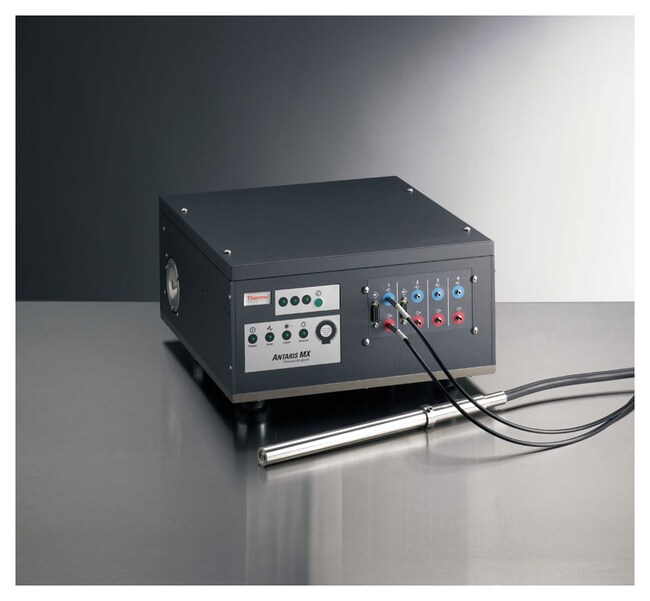

Antaris™ MX FT-NIR 过程分析仪
Thermo Scientific™

Antaris™ MX FT-NIR 过程分析仪

使用 Antaris™ MX FT-NIR 过程分析仪优化您的 QC 检测并使用光纤同步多路复用技术和综合通信远程监控该过程。

Have Questions?
货号分析仪类型源类型光谱范围
IQLAADGABCFADUMAAZ傅里叶变换近红外长寿命、高强度卤素 NIR 源;备用源包括可确保微丝图像对齐的系统12,000 至 3800 cm-1(833 至 2500 nm)
货号 IQLAADGABCFADUMAAZ
价格(CNY)
-
申请报价
分析仪类型:
傅里叶变换近红外
源类型:
长寿命、高强度卤素 NIR 源;备用源包括可确保微丝图像对齐的系统
光谱范围:
12,000 至 3800 cm-1(833 至 2500 nm)

使用 Thermo Scientific™ Antaris™ MX FT-NIR 过程分析仪优化您的 QC 检测,同时使用光纤同步多路复用技术和综合通信远程监测该过程以获得实时反馈。Antaris MX FT-NIR 过程分析仪可为使用点材料分析和在线工艺监测应用提供完整且适合使用的解决方案。

这款易于使用的 NIR 分析仪允许在多个点监测单个过程或者同时监测多个过程。此外,Antaris MX 过程分析仪无需从工艺流中取出探头即可进行背景采集或验证。

Antaris MX FT-NIR 过程分析仪特点:

  • Thermo Scientific™ ValPro™ 仪器验证软件包
  • 内置背景采集始终打开
  • SMA905 工业标准光纤连接器 — 选择适用于您的工艺的探头
  • OPC、4-20 mA 和 Digital I/O 用于过程通信

订购信息:

Antaris MX FT-NIR 过程分析仪可根据您的特定应用需求作为配套系统销售。更多信息,请联系您的 Thermo Scientific 销售代表。

推荐用途:

  • 工艺中液体分析
  • 工艺中固体分析
  • 实验室液体分析
  • 实验室固体分析
规格
分析仪类型傅里叶变换近红外
描述Antaris MX FT-NIR 过程分析仪
检测高灵敏度、高稳定性的匹配 InGaAs
高度(英制)18.97 x 15.98 x 9.72 in.
高度(公制)48.2 x 40.6 x 24.7 cm
界面PC 直接连接以太网,可实现文件系统与 OPC 的通信
干涉仪经验证的、无摩擦、稳定、长寿命 Michelson
工作温度范围15°C 至 35°C(59°F 至 95°F)
光度线性度斜率 1.0 ±0.05,截距 0.0 ±0.05
分辨率4 cm-1 光谱范围(1250 nm 处为 0.6 nm),2 cm-1 光谱范围(1250 nm 处为 0.3 nm)
采样模式光纤多通路
密封和干燥
源类型长寿命、高强度卤素 NIR 源;备用源包括可确保微丝图像对齐的系统
光谱范围12,000 至 3800 cm-1(833 至 2500 nm)
系统状态指示器指示灯可连续报告扫描、激光、电源和光源状态
电压90/264 V
波数准确度±0.1 cm-1(1250 nm 处为 0.02 nm)
波数重复性(系统间)优于 0.05 cm-1(1250 nm 处为 0.008 nm)
波数可重现性(单系统)10 测量标准差 <0.006 cm-1
重量(英制)105.16 lb.
重量(公制)25.8 kg
Unit SizeEach

常见问题解答 (FAQ)

How are probes used for in-line NIR analysis?

Fiber optic probes can be used for analyzing liquid samples in transmission or solid samples in reflection. For samples that have bubbles or solids or change state between liquid and solid, a transflectance probe works the best. A fitting attached to the probe mates it with a port on a tank, pipe, reactor, hopper, or above a conveyor. The common fittings used with probes are Swagelok, sanitary tri-clamp or bolt-on.

How can I use an Antaris FT-NIR analyzer for in-line process analysis?

If the process environment has water hose down, CIP, dust, high temperature, corrosive or explosive chemicals, the Antaris FT-NIR analyzer needs to be placed in a safe area or enclosed in an environmentally stabilized enclosure. Fiber optics run from the NIR analyzer to probes or flow cells installed in production process pipes, tanks, hoppers, conveyors, reactors, etc. The fiber optics carry the NIR source light to the probe sampling window and then carry the light after it has interacted with the sample back to the NIR analyzer detector. The end of the probe will have a window or an air gap for reflection or transmission analysis. The product being analyzed must be self-cleaning or the probe engineered to automatically clean itself by high pressure air. The computer that controls the NIR analyzer is also located in the safe area with Thermo Scientific RESULT Software exporting NIR results to text or Microsoft Excel files, LIMS, OPC or by 4-20 mA.

Can current calibrations from a different manufacturer be transferred to the Antaris FT-NIR analyzer?

Yes, using the Thermo Scientific Standards converter utility program, spectra from other NIR manufacturers can be converted to a format directly compatible with the Antaris FT-NIR analyzer. The utility program converts spectra from wavelength to wave number as well as converts to a standard absorbance format. Then it automatically transfers the converted spectra and all associated wet chemistry data into Thermo Scientific TQ Analyst calibration development software. The method developer then sets the spectral processing and regions in TQ Analyst and calibrates the method into Antaris format.

What is Raman spectroscopy?

In Raman spectroscopy, an unknown sample of material is illuminated with monochromatic (single wavelength or single frequency) laser light, which can be absorbed, transmitted, reflected, or scattered by the sample. Light scattered from the sample is due to either elastic collisions of the light with the sample's molecules (Rayleigh scatter) or inelastic collisions (Raman scatter). Whereas Rayleigh scattered light has the same frequency (wavelength) of the incident laser light, Raman scattered light returns from the sample at different frequencies corresponding to the vibrational frequencies of the bonds of the molecules in the sample.

If you wish to learn more about Raman spectroscopy, visit our online Raman Spectroscopy Academy (https://www.thermofisher.com/us/en/home/industrial/spectroscopy-elemental-isotope-analysis/spectroscopy-elemental-isotope-analysis-learning-center/molecular-spectroscopy-information/raman-technology.html), where you will find basic Raman tutorials, advanced Raman webinars on sample applications, and a helpful instrument guide.