Search
 元素搜索
元素搜索 结构搜索
结构搜索

Thermo Scientific Chemicals
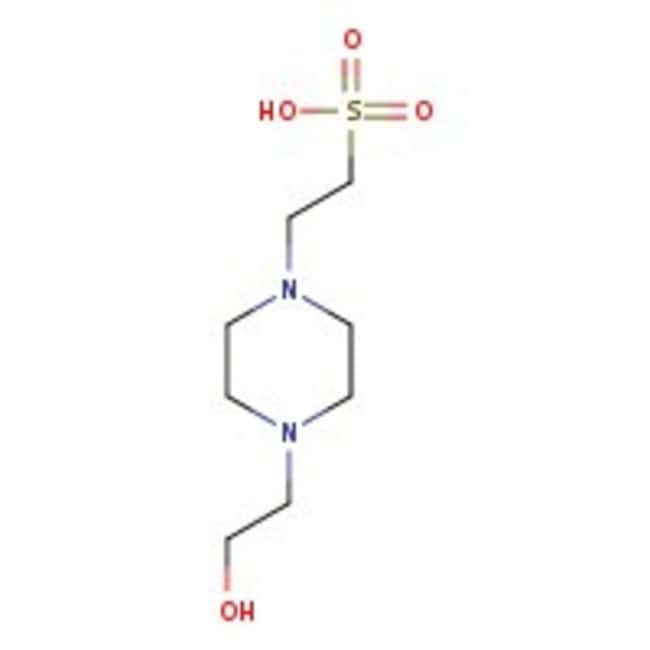
HEPES, 0.5M buffer soln., pH 7.5
CAS: 7365-45-9 | C8H18N2O4S | 238.30 g/mol
Have Questions?
更改视图


规格
CAS7365-45-9
ChEBICHEBI:42334
化学名称或材料HEPES buffer soln.
IUPAC 名称2-[4-(2-hydroxyethyl)piperazin-1-yl]ethanesulfonic acid
InChI 键JKMHFZQWWAIEOD-UHFFFAOYSA-N
查看更多内容
HEPES is typically used in cell culture at concentration between 5mM to 30 mM. It is used in cell culture media, in biopharma buffer formulations (both upstream and downstream), and in diagnostic reagents. HEPES based buffers are used in purification bioprocesses of antibodies, bioactives, proteins and growth factors.
This Thermo Scientific Chemicals brand product was originally part of the Alfa Aesar product portfolio. Some documentation and label information may refer to the legacy brand. The original Alfa Aesar product / item code or SKU reference has not changed as a part of the brand transition to Thermo Scientific Chemicals.
Applications
HEPES is typically used in cell culture at concentration between 5mM to 30 mM. It is used in cell culture media, in biopharma buffer formulations (both upstream and downstream), and in diagnostic reagents. HEPES based buffers are used in purification bioprocesses of antibodies, bioactives, proteins and growth factors.
Solubility
Fully miscible in water.
Notes
Stable under recommended storage conditions. Incompatible with oxidizing agents.
HEPES is typically used in cell culture at concentration between 5mM to 30 mM. It is used in cell culture media, in biopharma buffer formulations (both upstream and downstream), and in diagnostic reagents. HEPES based buffers are used in purification bioprocesses of antibodies, bioactives, proteins and growth factors.
Solubility
Fully miscible in water.
Notes
Stable under recommended storage conditions. Incompatible with oxidizing agents.
RUO – Research Use Only
General References:
- Sheila Timmons; Jack Hawiger. Separation of human platelets from plasma proteins including factor VIIIVWF by a combined albumin gradient-gel filtration method using hepes buffer. Thrombosis Research. 1978, 12,(2), 297-306.
- Raymond Wai-Yin Sun; Rong Chen; Nancy P.-Y. Chung; Chi-Ming Ho; Chen-Lung Steve Lin; Chi-Ming Che. Silver nanoparticles fabricated in Hepes buffer exhibit cytoprotective activities toward HIV-1 infected cells. Chem. Commun. 2005, (40), 5059-5061.