Search
 元素搜索
元素搜索 结构搜索
结构搜索
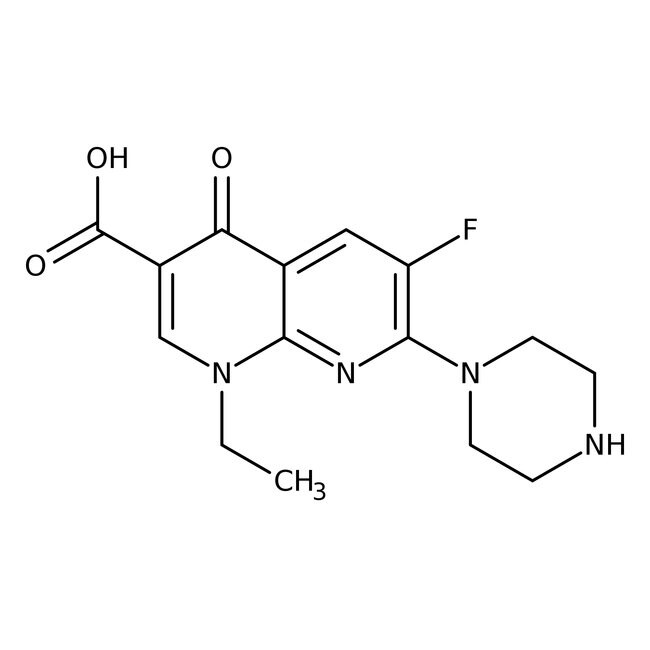

Thermo Scientific Chemicals
Enoxacin
A quinolone antibacteral agent which acts on DNA gyrase | CAS: 74011-58-8 | C15H17FN4O3 | 320.324 g/mol
Have Questions?
更改视图

化学标识符
CAS74011-58-8
IUPAC Name1-ethyl-6-fluoro-4-oxo-7-(piperazin-1-yl)-1,4-dihydro-1,8-naphthyridine-3-carboxylic acid
Molecular FormulaC15H17FN4O3
InChI KeyIDYZIJYBMGIQMJ-UHFFFAOYSA-N
SMILESCCN1C=C(C(O)=O)C(=O)C2=CC(F)=C(N=C12)N1CCNCC1
查看更多内容
 规格表
规格表Enoxacin is an antibacterial agent used in the treatment of gastro enteritis including infectious diarrhea, respiratory tract infections, gonorrhea and urinary tract infections. It is a bactericidal and its mode of action depends on blocking of bacterial DNA replication by binding itself to an enzyme called DNA gyrase.
This Thermo Scientific Chemicals brand product was originally part of the Alfa Aesar product portfolio. Some documentation and label information may refer to the legacy brand. The original Alfa Aesar product / item code or SKU reference has not changed as a part of the brand transition to Thermo Scientific Chemicals.
Applications
Enoxacin is an antibacterial agent used in the treatment of gastro enteritis including infectious diarrhea, respiratory tract infections, gonorrhea and urinary tract infections. It is a bactericidal and its mode of action depends on blocking of bacterial DNA replication by binding itself to an enzyme called DNA gyrase.
Solubility
50 mg/ml in 1 M NaOHSlightly soluble in sodium hydroxide, dimethyl sulfoxide, chloroform and methanol. Insoluble in water.
Notes
Store in cool place. Keep the container tightly closed in a dry and well-ventilated place.
Enoxacin is an antibacterial agent used in the treatment of gastro enteritis including infectious diarrhea, respiratory tract infections, gonorrhea and urinary tract infections. It is a bactericidal and its mode of action depends on blocking of bacterial DNA replication by binding itself to an enzyme called DNA gyrase.
Solubility
50 mg/ml in 1 M NaOHSlightly soluble in sodium hydroxide, dimethyl sulfoxide, chloroform and methanol. Insoluble in water.
Notes
Store in cool place. Keep the container tightly closed in a dry and well-ventilated place.
RUO – Research Use Only
General References:
- Huang, W. Y.; Li, J.; Kong, S. L.; Wang, Z. C.; Zhu, H. L. Cu(II) and Co(II) ternary complexes of quinolone antimicrobial drug enoxacin and levofloxacin: structure and biological evaluation. RSC Adv. 2014, 4 (66), 35193-35204.
- Liu, X.; Qu, X.; Wu, C.; Zhai, Z.; Tian, B.; Li, H.; Ouyang, Z.; Xu, X.; Wang, W.; Fan, Q.; Tang, T.; Qin, A.; Dai, K. The effect of enoxacin on osteoclastogenesis and reduction of titanium particle-induced osteolysis via suppression of JNK signaling pathway. Biomaterials 2014, 35 (22), 5721-5730.