Search
 元素搜索
元素搜索 结构搜索
结构搜索

Thermo Scientific Chemicals
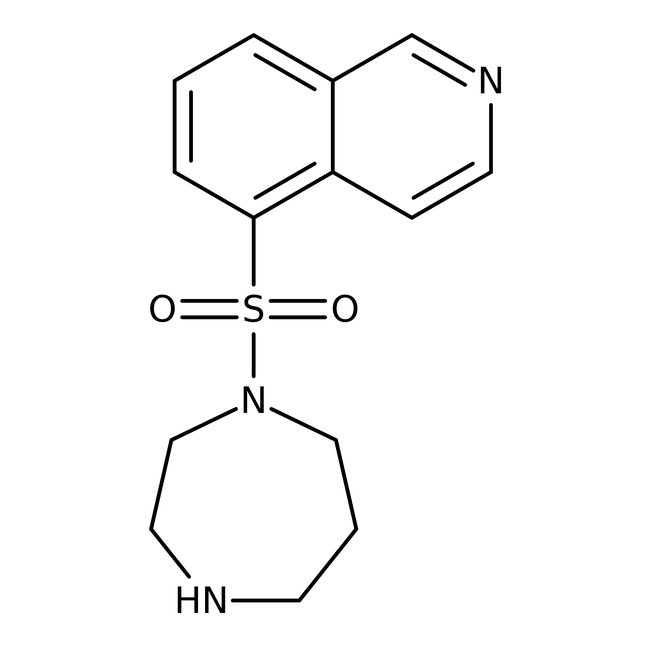
法舒地尔
CAS: 103745-39-7 | C14H17N3O2S | 291.369 g/mol
| 货号 | 数量 |
|---|---|
| J63525.MA 又称 J63525-MA | 10 mg |

规格
CAS103745-39-7
化学名称或材料Fasudil
颜色White
化学式量327.83
IUPAC 名称5-(1,4-diazepan-1-ylsulfonyl)isoquinoline
查看更多内容
HA-1077 dihydrochloride has been shown to be a vasodilating agent as well as a potent inhibitor of Rock-2 (Rho-associated Kinase II), cGKI (cGMP-dependent protein kinase), PKA (cAMP-dependent protein kinase), MYLK, and CaMKII. Rho kinase signaling pathways are thought to cause invasion, migration, and proliferation of certain cells. Studies have shown this compound can also inhibit myosin light chain kinase in vitro and suppress cell rounding by myosin light chain phosphorylation. Mechanistic experiments report that HA-1077 inhibits vascular smooth muscle contraction by acting as a calcium channel protein inhibitor. HA-1077 dihydrochloride is an inhibitor of MSK1, PKC, PRK2 and Rsk-2.
This Thermo Scientific Chemicals brand product was originally part of the Alfa Aesar product portfolio. Some documentation and label information may refer to the legacy brand. The original Alfa Aesar product / item code or SKU reference has not changed as a part of the brand transition to Thermo Scientific Chemicals.
Applications
HA-1077 dihydrochloride has been shown to be a vasodilating agent as well as a potent inhibitor of Rock-2 (Rho-associated Kinase II), cGKI (cGMP-dependent protein kinase), PKA (cAMP-dependent protein kinase), MYLK, and CaMKII. Rho kinase signaling pathways are thought to cause invasion, migration, and proliferation of certain cells. Studies have shown this compound can also inhibit myosin light chain kinase in vitro and suppress cell rounding by myosin light chain phosphorylation. Mechanistic experiments report that HA-1077 inhibits vascular smooth muscle contraction by acting as a calcium channel protein inhibitor. HA-1077 dihydrochloride is an inhibitor of MSK1, PKC, PRK2 and Rsk-2.
Solubility
Soluble in water or DMSO
Notes
Store in cool place. Keep container tightly closed in a dry and well-ventilated place. Keep away from oxidizing agents.
HA-1077 dihydrochloride has been shown to be a vasodilating agent as well as a potent inhibitor of Rock-2 (Rho-associated Kinase II), cGKI (cGMP-dependent protein kinase), PKA (cAMP-dependent protein kinase), MYLK, and CaMKII. Rho kinase signaling pathways are thought to cause invasion, migration, and proliferation of certain cells. Studies have shown this compound can also inhibit myosin light chain kinase in vitro and suppress cell rounding by myosin light chain phosphorylation. Mechanistic experiments report that HA-1077 inhibits vascular smooth muscle contraction by acting as a calcium channel protein inhibitor. HA-1077 dihydrochloride is an inhibitor of MSK1, PKC, PRK2 and Rsk-2.
Solubility
Soluble in water or DMSO
Notes
Store in cool place. Keep container tightly closed in a dry and well-ventilated place. Keep away from oxidizing agents.
RUO – Research Use Only
Wickman, G., C. Lan.; and B. Vollrath. Functional roles of the rho/rho kinase pathway and protein kinase C in the regulation of cerebrovascular constriction mediated by hemoglobin: relevance to subarachnoid hemorrhage and vasospasm. Circ Res. 201292 (7), 809-16.