Search

Thermo Scientific™
Maxima First Strand cDNA Synthesis Kit for RT-qPCR, with dsDNase
RT-qPCR 用 Thermo Scientific Maxima 第一链 cDNA 合成试剂盒是一种针对两步法定量 RT-PCR (RT-qPCR)了解更多信息
Have Questions?
更改视图

| 货号 | 包括 | 反应次数 |
|---|---|---|
| K1642 | Kit only | 200 次反应 |
| K1641 | Kit only | 50 次反应 |
货号 K1642
价格(CNY)
7,744.00
飞享价
Ends: 31-Dec-2026
11,063.00共减 3,319.00 (30%)
Each
包括:
Kit only
反应次数:
200 次反应
价格(CNY)
7,744.00
飞享价
Ends: 31-Dec-2026
11,063.00共减 3,319.00 (30%)
Each
RT-qPCR 用 Thermo Scientific Maxima 第一链 cDNA 合成试剂盒是一种针对两步法定量 RT-PCR (RT-qPCR) 应用中的 cDNA 合成进行优化的便捷系统。该试剂盒采用 Maxima 反转录酶 (RT),这是 M-MuLV RT 经体外进化而得到的一种高级酶。与野生型 M-MuLV RT 相比,该酶具有较高的热稳定性和耐受性且 cDNA 合成速率提高。
RT-qPCR 用 Maxima 第一链 cDNA 合成试剂盒能够在较高温度(42 至 65°C)下从较宽范围的 RNA 总量(1 pg 至 5 µg)进行可重现的 cDNA 合成。合成反应可在15至30分钟内完成。RT-qPCR 用 Maxima 第一链 cDNA 合成试剂盒组分已预混合,因而可节省时间并减少可能出现的移液错误。
产品优势
• 获得高得率的长达 20 kb 的全长 cDNA
• 在 42°C 至 65°C 的较宽温度范围内高效合成 cDNA。
•合成速率提高—可在 15-30 分钟内完成 cDNA 合成
•高灵敏度和特异性
应用
• 两步法 RT-PCR
• 两步法 RT-qPCR
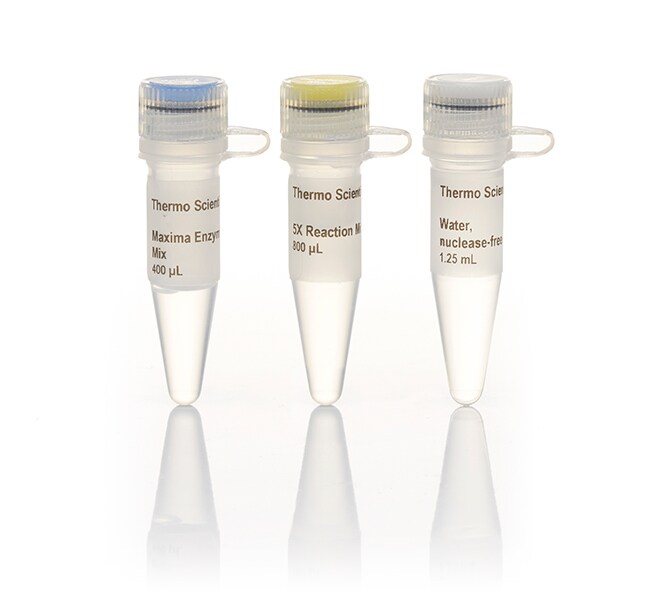
RT-qPCR 用 Maxima 第一链 cDNA 合成试剂盒包含
• Maxima 酶混合物
• 5X 反应混合物
• 无核酸酶水
有关反应组分的其他信息
Maxima 酶混合物包含 Maxima 反转录酶和 Thermo Scientific RiboLock RNase 抑制剂。重组 RiboLock RNase 抑制剂可在高达 55°C 的温度下有效防止 RNase A、B 和 C 引起的 RNA 模板降解。
5X 反应混合物中含有其余的反应组分:反应缓冲液、dNTP、oligo(dT)18 和随机六聚体引物。
无核酸酶水用于样品 RNA 的反应构建和稀释。经适当的质量测试证实,不含脱氧核糖核酸内切酶、脱氧核糖核酸外切酶、核糖核酸酶以及磷酸酶。
相关产品
RT-qPCR 用 Maxima 第一链 cDNA 合成试剂盒(含 dsDNase)
RT-qPCR 用 Maxima 第一链 cDNA 合成试剂盒
Maxima 第一链 cDNA 合成试剂盒反应混合物 (5X)
RT-qPCR 用 Maxima 第一链 cDNA 合成试剂盒能够在较高温度(42 至 65°C)下从较宽范围的 RNA 总量(1 pg 至 5 µg)进行可重现的 cDNA 合成。合成反应可在15至30分钟内完成。RT-qPCR 用 Maxima 第一链 cDNA 合成试剂盒组分已预混合,因而可节省时间并减少可能出现的移液错误。
产品优势
• 获得高得率的长达 20 kb 的全长 cDNA
• 在 42°C 至 65°C 的较宽温度范围内高效合成 cDNA。
•合成速率提高—可在 15-30 分钟内完成 cDNA 合成
•高灵敏度和特异性
应用
• 两步法 RT-PCR
• 两步法 RT-qPCR
RT-qPCR 用 Maxima 第一链 cDNA 合成试剂盒包含
• Maxima 酶混合物
• 5X 反应混合物
• 无核酸酶水
有关反应组分的其他信息
Maxima 酶混合物包含 Maxima 反转录酶和 Thermo Scientific RiboLock RNase 抑制剂。重组 RiboLock RNase 抑制剂可在高达 55°C 的温度下有效防止 RNase A、B 和 C 引起的 RNA 模板降解。
5X 反应混合物中含有其余的反应组分:反应缓冲液、dNTP、oligo(dT)18 和随机六聚体引物。
无核酸酶水用于样品 RNA 的反应构建和稀释。经适当的质量测试证实,不含脱氧核糖核酸内切酶、脱氧核糖核酸外切酶、核糖核酸酶以及磷酸酶。
相关产品
RT-qPCR 用 Maxima 第一链 cDNA 合成试剂盒(含 dsDNase)
RT-qPCR 用 Maxima 第一链 cDNA 合成试剂盒
Maxima 第一链 cDNA 合成试剂盒反应混合物 (5X)
仅供科研使用。不可用于诊断程序。
规格
最终产品类型第一链 cDNA
产品规格试剂盒
包括Kit only
反应次数200 次反应
最佳反应温度50°C 至 55°C
数量Each
反应形式单独组分
试剂类型反转录
逆转录酶Maxima
核糖核酸酶 H 活性是
运输条件干冰
尺寸(最终产品)长达 20 kb
原始材料RNA
技术反转录
适用于(应用)实时 PCR (qPCR)
高 GC PCR 扩增效果高
反应速度30 min。
Unit SizeEach
内容与储存
• Maxima 酶混合物
• 5X 反应混合物
• 无核酸酶水
储存在 –20°C 下。