Search


引用和文献 (3)
Invitrogen™
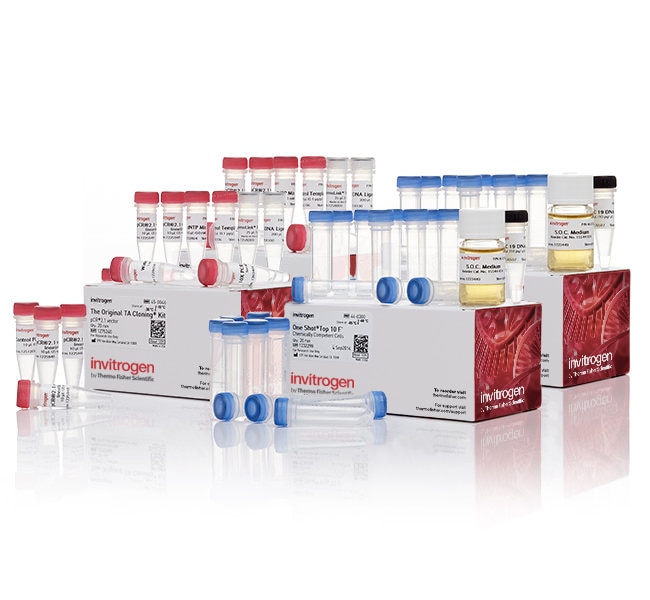
TA Cloning™试剂盒,含 pCR™2.1 载体和 One Shot™ TOP10F' 化学感受态大肠杆菌
TA 克隆™试剂盒(含 PCR™2.1 载体)提供了一种快速的一步法克隆策略,可将经 Taq 扩增的 PCR 产物直接插入质粒载体中了解更多信息
Have Questions?
更改视图

| 货号 | 反应次数 |
|---|---|
| K203040 | 40 次反应 |
| K203001 | 20 次反应 |
货号 K203040
价格(CNY)
6,953.00
飞享价
Ends: 31-Dec-2026
13,902.00共减 6,949.00 (50%)
Each
反应次数:
40 次反应
价格(CNY)
6,953.00
飞享价
Ends: 31-Dec-2026
13,902.00共减 6,949.00 (50%)
Each
TA 克隆™试剂盒(含 PCR™2.1 载体)提供了一种快速的一步法克隆策略,可将经 Taq 扩增的 PCR 产物直接插入质粒载体中。TA Cloning™ 试剂盒使用 pCR™2.1 克隆载体和 ExpressLink™ T4 DNA 连接酶,在十五分钟的室温连接步骤中生成连接产物。反应通常产生 >80% 包含插入片段的重组体。
TA Cloning™ 试剂盒(含 pCR™2.1 载体)的特点:
•快速且方便 — 15分钟、室温连接
•高效 — 蓝/白斑筛选和 >80% 含正确插入片段的克隆体
•灵活 — 可选择卡那霉素或氨苄青霉素抗性,实现灵活的抗生素选择
•轻松 — 无需对 PCR 产物进行任何酶修饰
•流程简化 — 不需要使用包含限制性位点的 PCR 引物
pCR™2.1 载体提供:
• 3'-T 突出端,用于直接连接 Taq 扩增 PCR 产物
• T7 启动子,用于体外 RNA 转录和测序
• 两侧具有 EcoR I 位点的通用性多位点接头,可方便地切除插入片段
• M13 正向和反向引物位点,用于测序
TA Cloning™ 的工作原理
Taq 聚合酶具有非模板依赖性活性,可在 PCR 产物的 3' 末端引入单脱氧腺苷 (A)。该试剂盒中提供的线性化载体具有单个 3' 脱氧胸苷 (T) 残基。这使得 PCR 插入片段高效地与载体连接。
试剂盒配置
TA Cloning™ 试剂盒提供多种配置:不含感受态细胞(K2020-20 和 K2020-40)、含 One Shot™ INVF' 化学感受态大肠杆菌(K2000-01 和 K2000-40)、含 One Shot™ TOP10F' 化学感受态大肠杆菌(K2030-01 和 K2030-40)以及含 One Shot™ TOP10 化学感受态大肠杆菌(K2040-01 和 K2040-40),分 20 和 40 次反应试剂盒规格。
TA Cloning™ 试剂盒(含 pCR™2.1 载体)的特点:
•快速且方便 — 15分钟、室温连接
•高效 — 蓝/白斑筛选和 >80% 含正确插入片段的克隆体
•灵活 — 可选择卡那霉素或氨苄青霉素抗性,实现灵活的抗生素选择
•轻松 — 无需对 PCR 产物进行任何酶修饰
•流程简化 — 不需要使用包含限制性位点的 PCR 引物
pCR™2.1 载体提供:
• 3'-T 突出端,用于直接连接 Taq 扩增 PCR 产物
• T7 启动子,用于体外 RNA 转录和测序
• 两侧具有 EcoR I 位点的通用性多位点接头,可方便地切除插入片段
• M13 正向和反向引物位点,用于测序
TA Cloning™ 的工作原理
Taq 聚合酶具有非模板依赖性活性,可在 PCR 产物的 3' 末端引入单脱氧腺苷 (A)。该试剂盒中提供的线性化载体具有单个 3' 脱氧胸苷 (T) 残基。这使得 PCR 插入片段高效地与载体连接。
试剂盒配置
TA Cloning™ 试剂盒提供多种配置:不含感受态细胞(K2020-20 和 K2020-40)、含 One Shot™ INVF' 化学感受态大肠杆菌(K2000-01 和 K2000-40)、含 One Shot™ TOP10F' 化学感受态大肠杆菌(K2030-01 和 K2030-40)以及含 One Shot™ TOP10 化学感受态大肠杆菌(K2040-01 和 K2040-40),分 20 和 40 次反应试剂盒规格。
仅供科研使用。不可用于诊断程序。
规格
细菌或酵母菌株TOP10F ́
细胞类型化学感受态大肠杆菌
克隆方法TA克隆
适用于(应用)PCR克隆
反应次数40 次反应
产品线One Shot
产品类型克隆试剂盒
促进剂T7
数量40 reactions
载体pCR2.1
产品规格试剂盒
Unit SizeEach
内容与储存
TA Cloning™ 试剂盒包含线性化 pCR™2.1 载体、ExpressLink™ T4 DNA 连接酶、5X ExpressLink™ T4 DNA 连接缓冲液、dNTP、10X PCR 缓冲液、无菌水和对照品。感受态细胞试剂盒包含 One Shot™ 化学感受态大肠杆菌、S.O.C. 培养基和一种超螺旋对照质粒。
在 -80°C 下储存 One Shot™ 大肠杆菌。所有其他组分储存在 -20°C 下。正确存放时,所有试剂均可保证 6 个月的稳定。
在 -80°C 下储存 One Shot™ 大肠杆菌。所有其他组分储存在 -20°C 下。正确存放时,所有试剂均可保证 6 个月的稳定。
常见问题解答 (FAQ)
我可以使用TOP10F’感受态细胞对包含ccdB基因的TOPO载体进行转化吗?
Can I use TOP10F' competent cells for transformation of my TOPO vector that contains the ccdB gene?
引用和文献 (3)
引用和文献
Abstract
Isolation, cloning, and localization of rat PV-1, a novel endothelial caveolar protein.
Journal:J Cell Biol
PubMed ID:10366592
'By using an immunoisolation procedure (Stan, R.-V., W.G. Roberts, K. Ihida, D. Predescu, L. Saucan, L. Ghitescu, and G.E. Palade. 1997. Mol. Biol. Cell. 8:595-605) developed in our laboratory, we have isolated a caveolar subfraction from rat lung endothelium and we have partially characterized the proteins of this subfraction which
Identification and functional analysis of the rat caspase-3 gene promoter.
Journal:J Biol Chem
PubMed ID:11773055
Caspase-3 is the major effector in apoptosis triggered by various stimuli. Previous studies demonstrated a significant increase in transcriptional activity of the caspase-3 gene during neuronal apoptosis. Recent findings suggest that differential expression of the caspase-3 gene may underlie the regulation of apoptotic susceptibility during brain development and after acute
Immunogene therapy of tumors with vaccine based on Xenopus homologous vascular endothelial growth factor as a model antigen.
Journal:Proc Natl Acad Sci U S A
PubMed ID:11553767
Overcoming immune tolerance of the growth factors associated with tumor growth should be a useful approach to cancer therapy by active immunity. We used vascular endothelial growth factor (VEGF) as a model antigen to explore the feasibility of the immunogene tumor therapy with a vaccine based on a single xenogeneic