Search


引用和文献 (5)
Invitrogen™
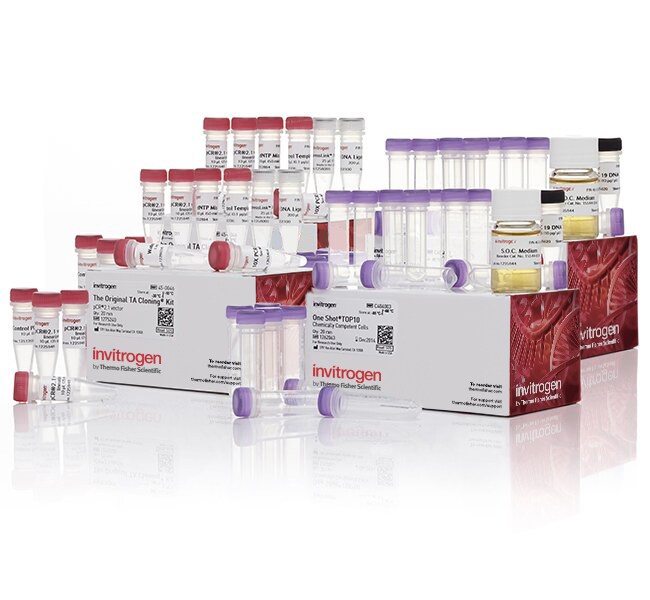
TA Cloning™试剂盒,含 pCR™2.1 载体和 One Shot™ TOP10 化学感受态大肠杆菌
TA 克隆™试剂盒(含 PCR™2.1 载体)提供了一种快速的一步法克隆策略,可将经 Taq 扩增的 PCR 产物直接插入质粒载体中了解更多信息
Have Questions?
更改视图

| 货号 | 反应次数 | 载体 |
|---|---|---|
| K204040 | 40 次反应 | pCR2.1 |
| K204001 | 20 次反应 | pCRII |
货号 K204040
价格(CNY)
6,903.00
飞享价
Ends: 31-Dec-2026
13,803.00共减 6,900.00 (50%)
Each
反应次数:
40 次反应
载体:
pCR2.1
价格(CNY)
6,903.00
飞享价
Ends: 31-Dec-2026
13,803.00共减 6,900.00 (50%)
Each
TA 克隆™试剂盒(含 PCR™2.1 载体)提供了一种快速的一步法克隆策略,可将经 Taq 扩增的 PCR 产物直接插入质粒载体中。TA Cloning™ 试剂盒使用 pCR™2.1 克隆载体和 ExpressLink™ T4 DNA 连接酶,在十五分钟的室温连接步骤中生成连接产物。反应通常产生 >80% 包含插入片段的重组体。
TA Cloning™ 试剂盒(含 pCR™2.1 载体)的特点:
•快速且方便 — 15分钟、室温连接
•高效 — 蓝/白斑筛选和 >80% 含正确插入片段的克隆体
•灵活 — 可选择卡那霉素或氨苄青霉素抗性,实现灵活的抗生素选择
•轻松 — 无需对 PCR 产物进行任何酶修饰
•流程简化 — 不需要使用包含限制性位点的 PCR 引物
pCR™2.1 载体提供:
• 3'-T 突出端,用于直接连接 Taq 扩增 PCR 产物
• T7 启动子,用于体外 RNA 转录和测序
• 两侧具有 EcoR I 位点的通用性多位点接头,可方便地切除插入片段
• M13 正向和反向引物位点,用于测序
TA Cloning™ 的工作原理
Taq 聚合酶具有非模板依赖性活性,可在 PCR 产物的 3' 末端引入单脱氧腺苷 (A)。该试剂盒中提供的线性化载体具有单个 3' 脱氧胸苷 (T) 残基。这使得 PCR 插入片段高效地与载体连接。
试剂盒配置
TA Cloning™ 试剂盒提供多种配置:不含感受态细胞(K2020-20 和 K2020-40)、含 One Shot™ INVF' 化学感受态大肠杆菌(K2000-01 和 K2000-40)、含 One Shot™ TOP10F' 化学感受态大肠杆菌(K2030-01 和 K2030-40)以及含 One Shot™ TOP10 化学感受态大肠杆菌(K2040-01 和 K2040-40),分 20 和 40 次反应试剂盒规格。
TA Cloning™ 试剂盒(含 pCR™2.1 载体)的特点:
•快速且方便 — 15分钟、室温连接
•高效 — 蓝/白斑筛选和 >80% 含正确插入片段的克隆体
•灵活 — 可选择卡那霉素或氨苄青霉素抗性,实现灵活的抗生素选择
•轻松 — 无需对 PCR 产物进行任何酶修饰
•流程简化 — 不需要使用包含限制性位点的 PCR 引物
pCR™2.1 载体提供:
• 3'-T 突出端,用于直接连接 Taq 扩增 PCR 产物
• T7 启动子,用于体外 RNA 转录和测序
• 两侧具有 EcoR I 位点的通用性多位点接头,可方便地切除插入片段
• M13 正向和反向引物位点,用于测序
TA Cloning™ 的工作原理
Taq 聚合酶具有非模板依赖性活性,可在 PCR 产物的 3' 末端引入单脱氧腺苷 (A)。该试剂盒中提供的线性化载体具有单个 3' 脱氧胸苷 (T) 残基。这使得 PCR 插入片段高效地与载体连接。
试剂盒配置
TA Cloning™ 试剂盒提供多种配置:不含感受态细胞(K2020-20 和 K2020-40)、含 One Shot™ INVF' 化学感受态大肠杆菌(K2000-01 和 K2000-40)、含 One Shot™ TOP10F' 化学感受态大肠杆菌(K2030-01 和 K2030-40)以及含 One Shot™ TOP10 化学感受态大肠杆菌(K2040-01 和 K2040-40),分 20 和 40 次反应试剂盒规格。
仅供科研使用。不可用于诊断程序。
规格
细菌或酵母菌株TOP10
细胞类型化学感受态大肠杆菌
克隆方法TA克隆
适用于(应用)PCR克隆
反应次数40 次反应
产品线One Shot
产品类型克隆试剂盒
促进剂T7
数量40 reactions
载体pCR2.1
产品规格试剂盒
Unit SizeEach
内容与储存
TA Cloning™ 试剂盒包含线性化 pCR™2.1 载体、ExpressLink™ T4 DNA 连接酶、5X ExpressLink™ T4 DNA 连接缓冲液、dNTP、10X PCR 缓冲液、无菌水和对照品。感受态细胞试剂盒包含 One Shot™ 化学感受态大肠杆菌、S.O.C. 培养基和一种超螺旋对照质粒。
在 -80°C 下储存 One Shot™ 大肠杆菌。所有其他组分储存在 -20°C 下。正确存放时,所有试剂均可保证 6 个月的稳定。
在 -80°C 下储存 One Shot™ 大肠杆菌。所有其他组分储存在 -20°C 下。正确存放时,所有试剂均可保证 6 个月的稳定。
引用和文献 (5)
引用和文献
Abstract
Differential gene expression between developing queens and workers in the honey bee, Apis mellifera [see comments]
Journal:Proc Natl Acad Sci U S A
PubMed ID:10318926
'Many insects show polyphenisms, or alternative morphologies, which are based on differential gene expression rather than genetic polymorphism. Queens and workers are alternative forms of the adult female honey bee and represent one of the best known examples of insect polyphenism. Hormonal regulation of caste determination in honey bees has
An imprinted, mammalian bicistronic transcript encodes two independent proteins.
Journal:Proc Natl Acad Sci U S A
PubMed ID:10318933
Polycistronic transcripts are common in prokaryotes but rare in eukaryotes. Phylogenetic analysis of the SNRPN (SmN) mRNA in five eutherian mammals reveals a second highly conserved coding sequence, termed SNURF (SNRPN upstream reading frame). The vast majority of nucleotide substitutions in SNURF occur in the wobble codon position, providing strong
PCR-mediated recombination: a general method applied to construct chimeric infectious molecular clones of plasma-derived HIV-1 RNA.
Journal:Nature Medicine
PubMed ID:9930876
A PCR-based approach was developed that provides a powerful tool for engineering recombinant molecules without reliance on restriction sites. DNA sequences were first amplified by high-fidelity PCR using Pfu polymerase; they were then used both as 'megaprimers' and templates in subsequent asymmetric long PCR amplifications to form chimeric clones. To
Sequence evolution and copy number of Ty1-copia retrotransposons in diverse plant genomes.
Journal:Proc Natl Acad Sci U S A
PubMed ID:11752395
Sequence evolution of the reverse transcriptase (RT) gene in retrotransposons belonging to the Ty1-copia class was studied in 11 plant species. Phylogenetic reconstruction of the evolutionary history of RT sequences indicated a strong pattern of purifying selection, manifested as high ratios of third to first plus second codon position substitutions,
Immunogene therapy of tumors with vaccine based on Xenopus homologous vascular endothelial growth factor as a model antigen.
Journal:Proc Natl Acad Sci U S A
PubMed ID:11553767
Overcoming immune tolerance of the growth factors associated with tumor growth should be a useful approach to cancer therapy by active immunity. We used vascular endothelial growth factor (VEGF) as a model antigen to explore the feasibility of the immunogene tumor therapy with a vaccine based on a single xenogeneic