Search


引用和文献 (14)
Invitrogen™
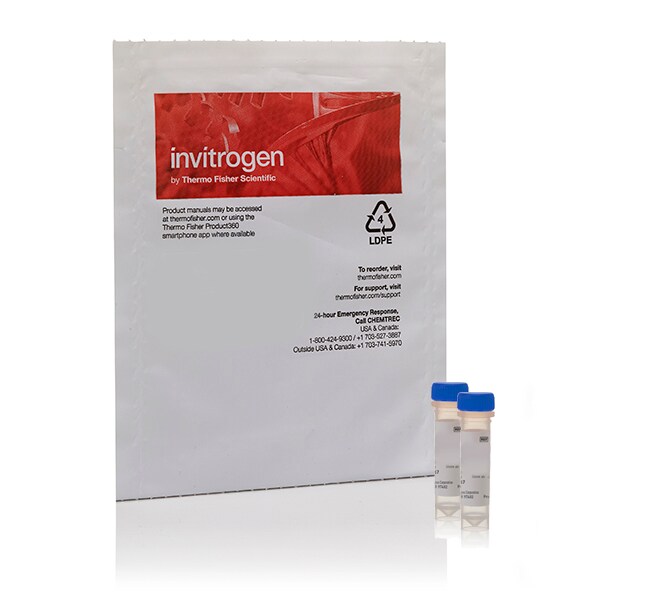
Filmtracer™ LIVE/DEAD™ 生物膜细胞活力检测试剂盒
The FilmTracer™ LIVE⁄DEAD Biofilm Viability kit provides a two-color fluorescence assay of bacterial viability, based on membrane integrity, that has了解更多信息
| 货号 | 数量 |
|---|---|
| L10316 | 1 kit |
货号 L10316
价格(CNY)
5,629.00
飞享价
Ends: 31-Dec-2026
7,817.00共减 2,188.00 (28%)
Each
数量:
1 kit
价格(CNY)
5,629.00
飞享价
Ends: 31-Dec-2026
7,817.00共减 2,188.00 (28%)
Each
The FilmTracer™ LIVE⁄DEAD Biofilm Viability kit provides a two-color fluorescence assay of bacterial viability, based on membrane integrity, that has proven usefule for a diverse array of bacterial genera including those growing in biofilm communities. The LIVE⁄DEAD Biofilm Viability kit utilizes mixtures of our SYTO® 9 green fluorescent nucleic acid stain and the red-fluorescent nucleic acid stain, propidium iodide. These stains differ both in their spectral characteristics and in their ability to penetrate healthy bacterial cells. When used alone, the SYTO® 9 stain generally labels all bacteria in a population—those with intact membranes and those with damaged membranes. In contrast, propidium iodide penetrates only bacteria with damaged membranes, causing a rduction in the SYTO® 9 stain fluorescence with both dyes are present. Thus, with an appropriate mixture of the SYTO™ 9 and propdium iodide stains, bacteria with intact cell membranes stain fluorescent green, whereas bacteria with damaged membranes stain fluorescent red.
仅供科研使用。不可用于诊断程序。
规格
检测方法荧光
染料类型SYTO™ 9、碘化丙啶
形式液体
数量1 kit
运输条件室温
子细胞定位细胞质&细胞液
颜色红色,绿色
发射波长范围可见光
适用于(应用)活力测定试剂盒
适用于(设备)共聚焦显微镜, 荧光显微镜, 流式细胞仪, 微孔板读数仪, 荧光成像仪
产品线FilmTracer、Molecular Probes
产品类型生物膜活力试剂盒
Unit SizeEach
内容与储存
2种组分,冷冻储存(-5°C 至 -30°C);避光
常见问题解答 (FAQ)
我如何为LIVE/DEAD细胞活力实验准备死细胞对照?
How do I prepare dead cell controls for LIVE/DEAD cell viability assays?
引用和文献 (14)
引用和文献
Abstract
Biofilm formations in nasopharyngeal tissues of patients with nasopharyngeal osteoradionecrosis.
Journal:Otolaryngol Head Neck Surg
PubMed ID:23348872
'Objective Determine the presence of nasopharynx biofilms in patients with nasopharyngeal cancer (NPC) and osteoradionecrosis (ORN) and patients with NPC but no ORN. Study Design Cross-sectional study. Setting Tertiary referral medical center. Subjects and Methods We enrolled 27 patients with NPC from our outpatient clinic during January 2010 to June
Comparison of methods for evaluation of the bactericidal activity of copper-sputtered surfaces against methicillin-resistant Staphylococcus aureus.
Journal:Appl Environ Microbiol
PubMed ID:22983970
Bacteria can survive on hospital textiles and surfaces, from which they can be disseminated, representing a source of health care-associated infections (HCAIs). Surfaces containing copper (Cu), which is known for its bactericidal properties, could be an efficient way to lower the burden of potential pathogens. The antimicrobial activity of Cu-sputtered
Fratricide is essential for efficient gene transfer between pneumococci in biofilms.
Journal:Appl Environ Microbiol
PubMed ID:22706053
Streptococcus pneumoniae and a number of commensal streptococcal species are competent for natural genetic transformation. The natural habitat of these bacteria is multispecies biofilms in the human oral cavity and nasopharynx. Studies investigating lateral transfer of virulence and antibiotic resistance determinants among streptococci have shown that interspecies as well as
Comparison of different live/dead stainings for detection and quantification of adherent microorganisms in the initial oral biofilm.
Journal:Clin Oral Investig
PubMed ID:22821430
The aim of the present study was to investigate different fluorescence-based, two-color viability assays for visualization and quantification of initial bacterial adherence and to establish reliable alternatives to the ethidium bromide staining procedure. Bacterial colonization was attained in situ on bovine enamel slabs (n?=?6 subjects). Five different live/dead assays were
Rapid Bacterial Detection during Endodontic Treatment.
Journal:J Dent Res
PubMed ID:28530469