Search


引用和文献 (15)
Invitrogen™
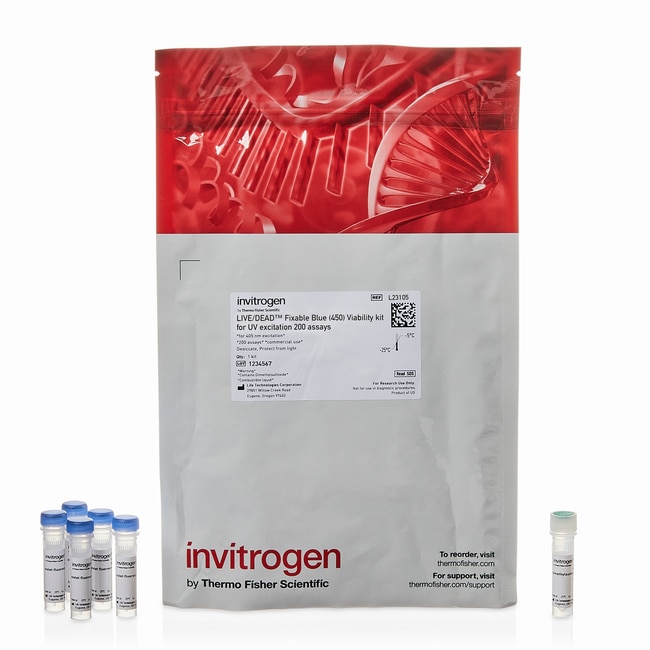
LIVE/DEAD™ 可固定蓝色死细胞染色试剂盒,用于紫外激发
LIVE/DEAD™ 可固定蓝色死细胞染色试剂盒可用于在细胞内抗体染色中的固定和透化步骤前,或在用甲醛固定去除生物危害物质前,确定细胞的活力。本试剂盒经过优化和验证,可与紫外激光流式细胞仪配合使用。•稳定 — 染料在单独小瓶中冷冻干燥,以维持稳定性•稳健 — 染色模式在固定前后相同•明亮信号 — 能够以单通道轻松分辨活/死细胞查看用于流式细胞分析的所有可固定活力染料的选择指南了解更多信息
Have Questions?
更改视图

| 货号 | 数量 |
|---|---|
| L23105 | 200 次检测 |
| L34961 又称 L-34961 | 80 次检测 |
| L34962 | 400 次检测 |
货号 L23105
价格(CNY)
3,060.00
飞享价
Ends: 31-Dec-2026
4,065.00共减 1,005.00 (25%)
Each
数量:
200 次检测
价格(CNY)
3,060.00
飞享价
Ends: 31-Dec-2026
4,065.00共减 1,005.00 (25%)
Each
LIVE/DEAD™ 可固定蓝色死细胞染色试剂盒可用于在细胞内抗体染色中的固定和透化步骤前,或在用甲醛固定去除生物危害物质前,确定细胞的活力。本试剂盒经过优化和验证,可与紫外激光流式细胞仪配合使用。
•稳定 — 染料在单独小瓶中冷冻干燥,以维持稳定性
•稳健 — 染色模式在固定前后相同
•明亮信号 — 能够以单通道轻松分辨活/死细胞
查看用于流式细胞分析的所有可固定活力染料的选择指南。
稳定
与以溶液形式销售的产品不同,LIVE/DEAD™ 可固定蓝色染色剂采用40个供试瓶的便利包装,可确保染料长时间保持稳定性和性能。溶液中的胺反应性染料在短时间内会失去其有效性,因此建议在再水化后将样品瓶全部用完。如果无法做到这一点,将样品瓶内容物等分为小体积,并在 -80°C 下储存,避免冻融循环。
稳健
死细胞鉴别染色剂可在固定剂(如细胞内磷酸化研究所需的甲醛或基于乙醇的固定方法)处理后失去敏感性。LIVE/DEAD™ 可固定蓝色染色剂是一种与细胞内和细胞外胺共价结合的胺反应性染料,在甲醛固定后保留染色模式。
极佳亮度
LIVE/DEAD™ 可固定蓝色染料因其荧光特性而被选中,以在紫外激光激发时发出明亮信号。蓝色荧光活性染料的最大激发波长为 ∼350 nm,极为适合与紫外激光配合使用,其发射波长为 ∼450 nm。实施细胞活力染色时,通过关闭蓝色 488 nm 激光的一个通道并切换为紫外激光,可在流式细胞仪上空出一个通道,以用于不采用 FITC 或 PE 仅凭颜色难以发现的试剂。使用紫外激光时,不会与其他常见染料发生光谱重叠,因此无需采用试剂盒中的其它染色剂对活力染色剂进行补偿。因为可以使用流式细胞仪的单色染料和单通道来区分活细胞和死细胞、所以它是多色实验的理想选择。
工作原理
在细胞膜受损的细胞中,染料可与细胞内部和细胞表面的游离胺基反应,产生强烈的荧光染色。在活细胞中,染料的反应活性仅限于细胞表面的胺,从而导致更少的荧光强度。活细胞与死细胞之间的强度差异通常大于 50 倍,可轻松分辨。
提供多种颜色
LIVE/DEAD™ 可固定死细胞染色剂有多种颜色可供选择,以满足您的多色检测组合需求。
•稳定 — 染料在单独小瓶中冷冻干燥,以维持稳定性
•稳健 — 染色模式在固定前后相同
•明亮信号 — 能够以单通道轻松分辨活/死细胞
查看用于流式细胞分析的所有可固定活力染料的选择指南。
稳定
与以溶液形式销售的产品不同,LIVE/DEAD™ 可固定蓝色染色剂采用40个供试瓶的便利包装,可确保染料长时间保持稳定性和性能。溶液中的胺反应性染料在短时间内会失去其有效性,因此建议在再水化后将样品瓶全部用完。如果无法做到这一点,将样品瓶内容物等分为小体积,并在 -80°C 下储存,避免冻融循环。
稳健
死细胞鉴别染色剂可在固定剂(如细胞内磷酸化研究所需的甲醛或基于乙醇的固定方法)处理后失去敏感性。LIVE/DEAD™ 可固定蓝色染色剂是一种与细胞内和细胞外胺共价结合的胺反应性染料,在甲醛固定后保留染色模式。
极佳亮度
LIVE/DEAD™ 可固定蓝色染料因其荧光特性而被选中,以在紫外激光激发时发出明亮信号。蓝色荧光活性染料的最大激发波长为 ∼350 nm,极为适合与紫外激光配合使用,其发射波长为 ∼450 nm。实施细胞活力染色时,通过关闭蓝色 488 nm 激光的一个通道并切换为紫外激光,可在流式细胞仪上空出一个通道,以用于不采用 FITC 或 PE 仅凭颜色难以发现的试剂。使用紫外激光时,不会与其他常见染料发生光谱重叠,因此无需采用试剂盒中的其它染色剂对活力染色剂进行补偿。因为可以使用流式细胞仪的单色染料和单通道来区分活细胞和死细胞、所以它是多色实验的理想选择。
工作原理
在细胞膜受损的细胞中,染料可与细胞内部和细胞表面的游离胺基反应,产生强烈的荧光染色。在活细胞中,染料的反应活性仅限于细胞表面的胺,从而导致更少的荧光强度。活细胞与死细胞之间的强度差异通常大于 50 倍,可轻松分辨。
提供多种颜色
LIVE/DEAD™ 可固定死细胞染色剂有多种颜色可供选择,以满足您的多色检测组合需求。
仅供科研使用。不可用于诊断程序。
规格
细胞渗透性不透过
细胞类型真核细胞
描述LIVE/DEAD™ 可固定蓝色死细胞染色剂试剂盒,用于紫外激发
检测方法荧光
染料类型LIVE/DEAD™ 可固定蓝色死细胞染色剂
形式实心
产品规格管
数量200 次检测
运输条件室温
溶解度DMSO(二甲亚砜)
颜色蓝色
发射波长范围450 nm
Excitation Wavelength Range350 nm
适用于(应用)活力测定试剂盒
适用于(设备)流式细胞仪
产品线LIVE/DEAD
产品类型死细胞染色试剂盒
Unit SizeEach
内容与储存
包含5小瓶 LIVE/DEAD™ 可固定死细胞染色剂以及 500 μL DMSO。
在 -20°C 下储存。
在 -20°C 下储存。
常见问题解答 (FAQ)
我如何为LIVE/DEAD细胞活力实验准备死细胞对照?
哪一种细胞活力试剂盒兼容固定?
为什么我要在实验中纳入活性染色?
我能用Attune NxT声波聚焦流式细胞仪检测的大小下限是多少?
Attune NxT自动进样器有何作用?
引用和文献 (15)
引用和文献
Abstract
Long-term remission of diabetes in NOD mice is induced by nondepleting anti-CD4 and anti-CD8 antibodies.
Journal:Diabetes
PubMed ID:22751694
Residual ß-cells found at the time of clinical onset of type 1 diabetes are sufficient to control hyperglycemia if rescued from ongoing autoimmune destruction. The challenge, however, is to develop an immunotherapy that not only selectively suppresses the diabetogenic response and efficiently reverses diabetes, but also establishes long-term ß-cell-specific tolerance
Techniques to improve the direct ex vivo detection of low frequency antigen-specific CD8+ T cells with peptide-major histocompatibility complex class I tetramers.
Journal:Cytometry A
PubMed ID:18836993
'The ability to quantify and characterize antigen-specific CD8+ T cells irrespective of functional readouts using fluorochrome-conjugated peptide-major histocompatibility complex class I (pMHCI) tetramers in conjunction with flow cytometry has transformed our understanding of cellular immune responses over the past decade. In the case of prevalent CD8+ T cell populations that
The survival of memory CD8 T cells that is mediated by IL-15 correlates with sustained protection against malaria.
Journal:J Immunol
PubMed ID:23589611
'Ag-specific memory T cell responses elicited by infections or vaccinations are inextricably linked to long-lasting protective immunity. Studies of protective immunity among residents of malaria endemic areas indicate that memory responses to Plasmodium Ags are not adequately developed or maintained, as people who survive episodes of childhood malaria are still
Role of NK cells in host defense against pulmonary type A Francisella tularensis infection.
Journal:Microbes Infect
PubMed ID:23211929
'Pneumonic tularemia is a potentially fatal disease caused by the Category A bioterrorism agent Francisella tularensis. Understanding the pulmonary immune response to this bacterium is necessary for developing effective vaccines and therapeutics. In this study, characterization of immune cell populations in the lungs of mice infected with the type A
Measles virus vaccine attenuation: suboptimal infection of lymphatic tissue and tropism alteration.
Journal:J Infect Dis
PubMed ID:17624839
'The mechanisms of measles virus (MV) vaccine attenuation are insufficiently characterized. Because the Edmonston vaccine strain can enter cells through CD46 in addition to the primary MV receptor signaling lymphocyte activation molecule (SLAM or CD150), we asked whether and how its tropism is altered. In human tonsillar tissue, this vaccine