Search


引用和文献 (37)
Invitrogen™
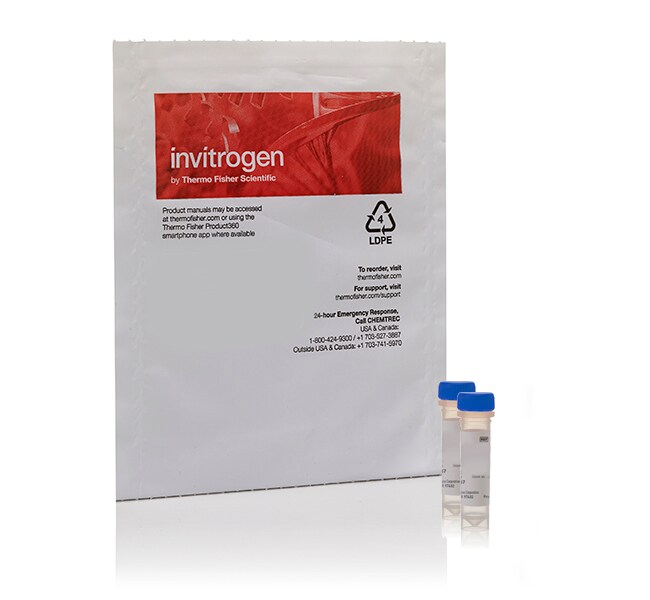
LIVE/DEAD™ 低生物危害性细胞活力检测试剂盒 #1,绿色和红色荧光
LIVE/DEAD 低生物危害性细胞活力检测试剂盒 #1 是一种便利且易于使用的细胞活力检测试剂盒,设计用于降低与处理潜在生物危害(如病毒、细菌或原生动物病原体)相关的风险。该检测利用细胞膜完整性监测细胞活力。已经死亡或即将死亡的细胞会具有膜损伤,从而染为红色,具有完整膜的细胞将会染为绿色。了解更多信息
| 货号 | 数量 |
|---|---|
| L7013 | 1 kit |
货号 L7013
价格(CNY)
4,990.00
Each
数量:
1 kit
价格(CNY)
4,990.00
Each
LIVE/DEAD 低生物危害性细胞活力检测试剂盒 #1 是一种便利且易于使用的细胞活力检测试剂盒,设计用于降低与处理潜在生物危害(如病毒、细菌或原生动物病原体)相关的风险。该检测利用细胞膜完整性监测细胞活力。已经死亡或即将死亡的细胞会具有膜损伤,从而染为红色,具有完整膜的细胞将会染为绿色。
仅供科研使用。不可用于诊断程序。
规格
细胞类型真核细胞
描述LIVE/DEAD™ 低生物危害性细胞活力检测试剂盒 #1,绿色和红色荧光
检测方法荧光
染料类型其他标记或染料
产品规格试管、96 孔板、玻片
数量1 kit
运输条件室温
颜色绿色、红色
发射波长范围516、617 nm
Excitation Wavelength Range490 nm
适用于(应用)活力测定试剂盒
适用于(设备)荧光显微镜, 流式细胞仪, 微孔板读数仪
产品线LIVE/DEAD
产品类型细胞活力试剂盒
Unit SizeEach
内容与储存
在冷柜(-5°C 至 -30°C)中避光储存。
常见问题解答 (FAQ)
我如何为LIVE/DEAD细胞活力实验准备死细胞对照?
哪一种细胞活力试剂盒兼容固定?
I need to use a dead cell control for my viability assay. Do you have a protocol for killing cells for this?
How do I prepare dead cell controls for LIVE/DEAD cell viability assays?
Which cell viability kits are compatible with fixation?
引用和文献 (37)
引用和文献
Abstract
Neurite degeneration induced by heme deficiency mediated via inhibition of NMDA receptor-dependent extracellular signal-regulated kinase 1/2 activation.
Journal:J Neurosci
PubMed ID:17687025
The early stages of many neurodegenerative diseases and age-related degeneration are characterized by neurite damage and compromised synaptic function that precede neuronal cell death. We investigated the signaling mechanisms underlying neurite degeneration using cortical neuron cultures. Inhibition of heme synthesis caused neurite damage, without neuronal death, and was mediated by
Synthesis and characterization of a novel glycopolymer with protective activity toward human anti-alpha-Gal antibodies.
Journal:Glycobiology
PubMed ID:12042251
'An efficient and rapid synthesis of the derivative of the biocompatible polymer poly(styrene co-maleic acid) with Linear B disaccharide (Galili antigen) was achieved. The oligosaccharide portion was obtained by a transglycosylation reaction catalyzed by coffee bean alpha-D-galactosidase using p-nitrophenyl-alpha-D-galactopyranoside both as donor and as acceptor. The reaction was carried out
Increased atrial and brain natriuretic peptides in adults with cyanotic congenital heart disease: enhanced understanding of the relationship between hypoxia and natriuretic peptide secretion.
Journal:Circulation
PubMed ID:15173030
'Brain natriuretic peptide (BNP) levels are used in the evaluation of patients with heart disease, yet there is little understanding of the effect of hypoxia on natriuretic peptide secretion. Furthermore, recent data suggest that oxytocin may mediate stretch-induced atrial natriuretic peptide (ANP) secretion. Ten patients with cyanotic congenital heart defects
Automated image analysis of live/dead staining of the fungus Aureobasidium pullulans on microscope slides and leaf surfaces.
Journal:Biotechniques
PubMed ID:11056819
'An image analysis program and protocol for the identification and enumeration of live versus dead cells of the yeast-like fungus Aureobasidium pullulans was developed for both populations on microscope slides and leaf surfaces. Live cells took up CellTracker Blue, while nonviable cells stained with DEAD Red. Image analysis macro programs
Rapid reduction of intracellular glutathione in human bronchial epithelial cells exposed to occupational levels of toluene diisocyanate.
Journal:Toxicol Sci
PubMed ID:11248147
'Toluene diisocyanate (TDI) is a recognized chemical asthmogen, yet the mechanism of this toxicity and the molecular reactions involved have not been elucidated. We have previously shown that TDI vapor forms adducts with the apical surface of the respiratory epithelium, and that it colocalizes with ciliary tubulin. In vitro, we