Search


引用和文献 (39)
Invitrogen™
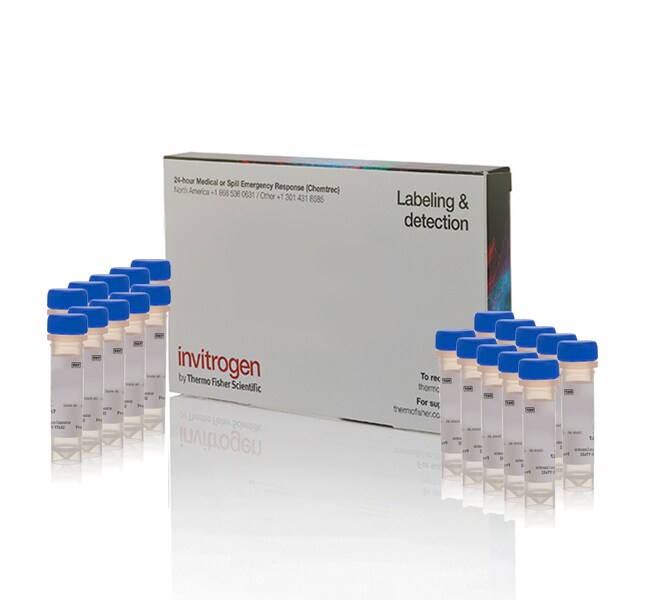
LysoSensor™ Yellow/Blue DND-160 - 特殊包装
LysoSensor™ Yellow/Blue DND-160 是一种比率式探针,可用于测量溶酶体等酸性细胞器的 pH 值。LysoSensor 染料在中性环境下会发蓝色荧光,但在酸性更强的环境下会发黄色荧光。LysoSensor Yellow/Blue了解更多信息
| 货号 | 数量 |
|---|---|
| L7545 | 20 x 50 μL |
货号 L7545
价格(CNY)
4,259.00
飞享价
Ends: 31-Dec-2026
5,915.00共减 1,656.00 (28%)
Each
数量:
20 x 50 μL
价格(CNY)
4,259.00
飞享价
Ends: 31-Dec-2026
5,915.00共减 1,656.00 (28%)
Each
LysoSensor™ Yellow/Blue DND-160 是一种比率式探针,可用于测量溶酶体等酸性细胞器的 pH 值。LysoSensor 染料在中性环境下会发蓝色荧光,但在酸性更强的环境下会发黄色荧光。LysoSensor Yellow/Blue DND-160 的 pKa 为 ∼4.2。
仅供科研使用。不可用于诊断程序。
规格
最大浓度1 mM
检测方法荧光
数量20 x 50 μL
运输条件室温
子细胞定位溶酶体
颜色黄色、蓝色
发射波长范围329⁄440
适用于(设备)荧光显微镜
产品线LysoSensor
产品类型染料
Unit SizeEach
内容与储存
在冷冻冰箱(-5°C 至 -30°C)中避光储存。
常见问题解答 (FAQ)
Can I use a plate reader to measure the pH of acidic organelles, such as lysosomes, with LysoSensor ratiometric probes?
What reagents would you recommend for measuring the pH in acidic organelles, such as lysosomes?
Could you provide me a protocol or reference for measuring the pH in acidic organelles, such as lysosomes?
What is the difference between LysoSensor Yellow/Blue dextran, 10,000 MW, Anionic, Fixable (Cat. No. L22460) and LysoSensor Yellow/Blue DND-160 - Special Packaging (Cat. No. L7545)?
What is the recommended incubation time for LysoTracker Green DND-26 (Cat. No. L7526) and LysoSensor Yellow/Blue DND-160 (Cat. No. L7545)?
引用和文献 (39)
引用和文献
Abstract
A novel acidotropic pH indicator and its potential application in labeling acidic organelles of live cells.
Journal:Chem Biol
PubMed ID:10381401
'BACKGROUND: Ratio imaging has received intensive attention in the past few decades. The growing potential of ratio imaging is significantly limited, however, by the lack of appropriate fluorescent probes, for acidic organelles in particular. The classic fluorescent dyes (such as fluoresceins, rhodamines and coumarins) are not suitable for studying acidic
Fluorescence lifetime characterization of novel low-pH probes.
Journal:Anal Biochem
PubMed ID:11444806
'The structures and functions of the cellular acidic compartments are strongly dependent on the pH gradients across vesicular membranes. Measurement and imaging of the vesicular pH require fluorophores with appropriate pK(a) values. In this report, we characterized the pH-dependent lifetime responses of a family of acidotropic probes, LysoSensors, to evaluate
Glucose acutely decreases pH of secretory granules in mouse pancreatic islets. Mechanisms and influence on insulin secretion.
Journal:J Biol Chem
PubMed ID:16760469
'Glucose-induced insulin secretion requires a rise in beta-cell cytosolic Ca2+ ([Ca2+]c) that triggers exocytosis and a mechanistically unexplained amplification of the action of [Ca2+]c. Insulin granules are kept acidic by luminal pumping of protons with simultaneous Cl- uptake to maintain electroneutrality. Experiments using patched, dialyzed beta-cells prompted the suggestion that
Elevated lysosomal pH in neuronal ceroid lipofuscinoses (NCLs).
Journal:Eur J Biochem
PubMed ID:11722572
'We report here the intracellular (pHi) and lysosomal pH in fibroblasts of six forms of neuronal ceroid lipofuscinoses (NCLs). Acid extrusion rate and pH(i) values were measured by the membrane-permeant acetoxymethyl ester of the indicator dye, 2'',7''-bis(carboxyethyl)-5-(and-6)-carboxy-fluorescein (BCECF) and lysosomal pH by a spectrofluorometric assay utilizing a novel acidotropic probe,
Divalent cations regulate acidity within the lumen and tubulovesicle compartment of gastric parietal cells.
Journal:Gastroenterology
PubMed ID:14699499
'Background & Aims: Until recently, it has not been possible to evaluate factors that regulate the acidity of the microenvironment within the tubulovesicles and luminal (TV/L) spaces of the gastric gland. The goal of this study was to develop a method for monitoring the mechanisms that regulate acidity in the