Search


引用和文献 (19)
Invitrogen™
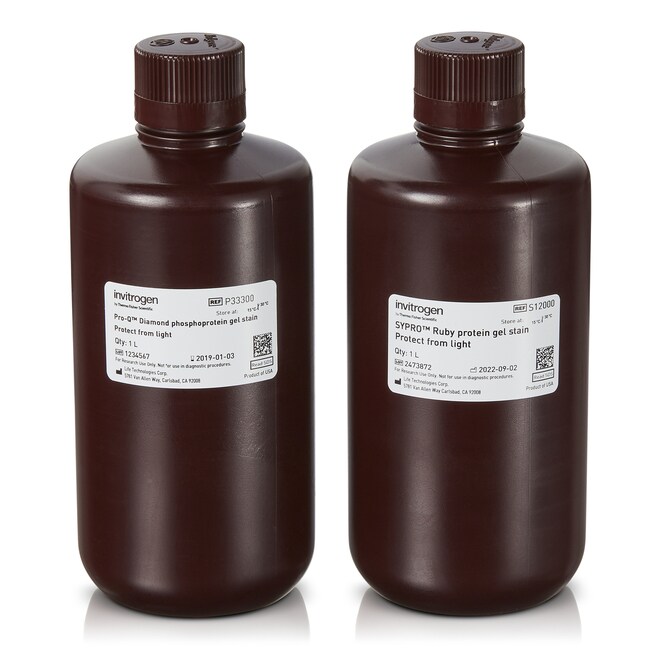
Multiplexed Proteomics™ 磷蛋白凝胶染色试剂盒(含有 Pro-Q™ Diamond 和 SYPRO™ Ruby 凝胶染色剂)
新的 Pro-Q Diamond 磷蛋白凝胶染色剂提供了一种便利的方法,它可选择性地对丙烯酰胺凝胶中的磷蛋白染色,无需印迹或使用磷蛋白特异性抗体,也无需进行 Western 印迹分析。
Have Questions?
更改视图

| 货号 | 数量 |
|---|---|
| M33305 | 每种染料 1 L |
| M33306 | 每种染料 200 mL |
货号 M33305
价格(CNY)
16,238.00
Each
数量:
每种染料 1 L
价格(CNY)
16,238.00
Each
新的 Pro-Q Diamond 磷蛋白凝胶染色剂提供了一种便利的方法,它可选择性地对丙烯酰胺凝胶中的磷蛋白染色,无需印迹或使用磷蛋白特异性抗体,也无需进行 Western 印迹分析。该试剂与我们的总蛋白染色剂(SYPRO Ruby 蛋白凝胶染色剂)联合使用,就能助力实现强大可靠的定量蛋白质组学分析。
新的 Pro-Q Diamond 磷蛋白凝胶染色剂提供了一种便利的方法,它可选择性地对丙烯酰胺凝胶中的磷蛋白染色,无需印迹或使用磷蛋白特异性抗体,也无需进行 Western 印迹分析。该试剂与我们的总蛋白染色剂(SYPRO Ruby 蛋白凝胶染色剂)联合使用,就能助力实现强大可靠的定量蛋白质组学分析。这种便利组合装含有 Pro-Q Diamond 磷蛋白凝胶染色剂和 SYPRO Ruby 蛋白凝胶染色剂各 1 L(货号 M-33305)或各 200 mL(货号 M-33306)。
其特性包括:
•灵敏—Pro-Q Diamond 磷蛋白凝胶染色剂可检测水平低至 1–16 ng 的磷蛋白(就每条带而言)
• 方便—选择性地对丙烯酰胺凝胶中的磷蛋白染色,无需印迹或使用磷蛋白特异性抗体,也无需进行 Western 印迹分析。SYPRO Ruby 凝胶染色剂随后用于总蛋白染色,它简化了磷酸化水平的测定
• 线性信号—轻松定量,因为 Pro-Q Diamond 磷蛋白凝胶染色剂和 SYPRO Ruby 凝胶染色剂在三个数量级显示出优良线性,是定量分析的理想选择
其特性包括:
•灵敏—Pro-Q Diamond 磷蛋白凝胶染色剂可检测水平低至 1–16 ng 的磷蛋白(就每条带而言)
• 方便—选择性地对丙烯酰胺凝胶中的磷蛋白染色,无需印迹或使用磷蛋白特异性抗体,也无需进行 Western 印迹分析。SYPRO Ruby 凝胶染色剂随后用于总蛋白染色,它简化了磷酸化水平的测定
• 线性信号—轻松定量,因为 Pro-Q Diamond 磷蛋白凝胶染色剂和 SYPRO Ruby 凝胶染色剂在三个数量级显示出优良线性,是定量分析的理想选择
For Research Use Only. Not for use in diagnostic procedures.
规格
描述Multiplexed Proteomics™ 磷蛋白凝胶染色试剂盒 #1
检测定位凝胶内检测
检测方法荧光
数量每种染料 1 L
运输条件室温
靶标分子蛋白质(磷酸蛋白)
标签或染料SYPRO Ruby、Pro-Q Diamond
产品线PRO-Q、SYPRO
产品类型磷蛋白凝胶染色试剂盒
Unit SizeEach
内容与储存
• Pro-Q Diamond 磷蛋白凝胶染色剂,1 L
• SYPRO Ruby 蛋白凝胶染色剂,1 L
在室温下避光储存。
• SYPRO Ruby 蛋白凝胶染色剂,1 L
在室温下避光储存。
引用和文献 (19)
引用和文献
Abstract
Initial analysis of the phosphoproteome of Chinese hamster ovary cells using electrophoresis.
Journal:J Biomol Tech
PubMed ID:15585821
'Protein phosphorylation is a common post-translational modification of enormous biological importance. Analysis of phosphorylation at the global level should shed light on the use of this modification to regulate metabolism, signal transduction, and other processes. We have begun a proteomic analysis of phosphorylation using two-dimensional gel electrophoresis. Chinese hamster ovary
Comparative proteomes of the proliferating C(2)C(12) myoblasts and fully differentiated myotubes reveal the complexity of the skeletal muscle differentiation program.
Journal:Mol Cell Proteomics
PubMed ID:15286212
'When cultured in low serum-containing growth medium, the mouse C(2)C(12) cells exit cell cycle and undergo a well-defined program of differentiation that culminates in the formation of myosin heavy chain-positive bona fide multinucleated muscle cells. To gain an understanding into this process, we compared total, membrane- and nuclear-enriched proteins, and
Characterization of dynamic and steady-state protein phosphorylation using a fluorescent phosphoprotein gel stain and mass spectrometry.
Journal:Electrophoresis
PubMed ID:15300772
'Protein phosphorylation plays a vital role in the regulation of most aspects of cellular activity, being key to propagating messages within signal transduction pathways and to modulating protein function. Pro-Q Diamond phosphoprotein gel stain is suitable for the fluorescence detection of phosphoserine-, phosphothreonine-, and phosphotyrosine-containing proteins directly in sodium dodecyl
Chronophin, a novel HAD-type serine protein phosphatase, regulates cofilin-dependent actin dynamics.
Journal:Nat Cell Biol
PubMed ID:15580268
Cofilin is a key regulator of actin cytoskeletal dynamics whose activity is controlled by phosphorylation of a single serine residue. We report the biochemical isolation of chronophin (CIN), a unique cofilin-activating phosphatase of the haloacid dehalogenase (HAD) superfamily. CIN directly dephosphorylates cofilin with high specificity and colocalizes with cofilin in
Determination of in vivo protein phosphorylation in photosynthetic membranes.
Journal:Methods Mol Biol
PubMed ID:19083170
Light- and redox-controlled reversible phosphorylation of thylakoid proteins regulates short- and long-term acclimation of plants to environmental cues. The major phosphoproteins in thylakoids belong to photosystem II and its light-harvesting antenna but phosphorylation of subunits of other thylakoid protein complexes has been detected as well. The detection methods include electrophoretic