Search


引用和文献 (16)
Invitrogen™
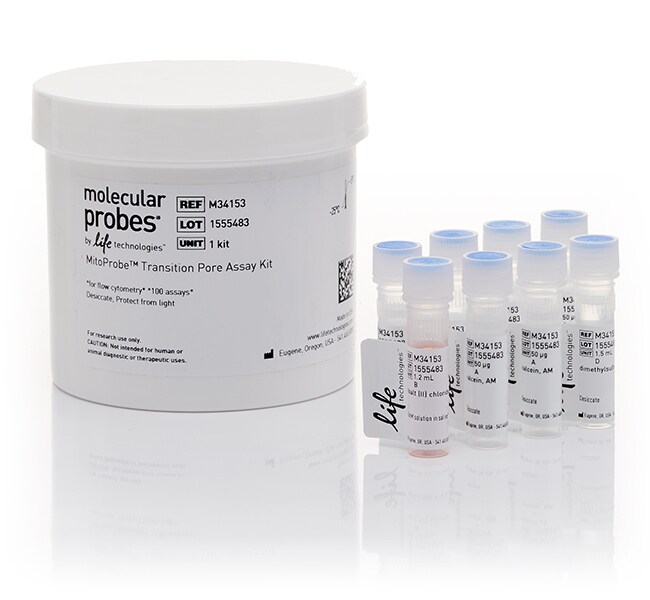
MitoProbe™ 转换孔检测试剂盒,用于流式细胞分析
The MitoProbe™ Transition Pore Assay Kit provides a proven method (Petronilli V. et al. 1989, 1999) of measuring mitochondrial permeability了解更多信息
| 货号 | 数量 |
|---|---|
| M34153 | 1 kit |
货号 M34153
价格(CNY)
6,984.00
飞享价
Ends: 31-Dec-2026
9,279.00共减 2,295.00 (25%)
Each
数量:
1 kit
价格(CNY)
6,984.00
飞享价
Ends: 31-Dec-2026
9,279.00共减 2,295.00 (25%)
Each
The MitoProbe™ Transition Pore Assay Kit provides a proven method (Petronilli V. et al. 1989, 1999) of measuring mitochondrial permeability transition pore opening. The kit includes a dye and a quencher that are easily loaded into cells. In healthy cells, the dye, but not the quencher, enters mitochondria. The mitochondria remain brightly fluorescent until mitochondrial pore activation permits quenching of the fluorescence.
View a selection guide for all apoptosis assays for flow cytometry.
View a selection guide for all apoptosis assays for flow cytometry.
仅供科研使用。不可用于诊断程序。
规格
激发/发射488
反应次数100 Reactions
产品线MitoProbe
产品类型转换孔检测试剂盒
数量1 kit
运输条件室温
偶联物钙黄绿素 AM
产品规格管装
Unit SizeEach
内容与储存
包含 5 样品瓶钙黄绿素,AM(50 µg 干粉/瓶)、1 样品瓶钴 (II) 氯六水合物(1.2 mL,80 mM 的盐水溶液)、1 样品瓶离子霉素 (55 µg)、钙盐和 1 样品瓶 DMSO (1.5 mL)。
在冷冻冰箱(-5 至 -30°C)中储存。
在冷冻冰箱(-5 至 -30°C)中储存。
常见问题解答 (FAQ)
流式细胞术的优势有哪些?
我能在流式细胞仪上进行哪些应用?
What are the advantages of flow cytometry?
What kinds of applications can I run on a flow cytometer?
引用和文献 (16)
引用和文献
Abstract
Cysteine 203 of cyclophilin D is critical for cyclophilin D activation of the mitochondrial permeability transition pore.
Journal:J Biol Chem
PubMed ID:21930693
The mitochondrial permeability transition pore (mPTP) opening plays a critical role in mediating cell death during ischemia/reperfusion (I/R) injury. Our previous studies have shown that cysteine 203 of cyclophilin D (CypD), a critical mPTP mediator, undergoes protein S-nitrosylation (SNO). To investigate the role of cysteine 203 in mPTP activation, we
Transient and long-lasting openings of the mitochondrial permeability transition pore can be monitored directly in intact cells by changes in mitochondrial calcein fluorescence.
Journal:Biophys J
PubMed ID:9929477
'The occurrence and the mode of opening of the mitochondrial permeability transition pore (MTP) were investigated directly in intact cells by monitoring the fluorescence of mitochondrial entrapped calcein. When MH1C1 cells and hepatocytes were loaded with calcein AM, calcein was also present within mitochondria, because (i) its mitochondrial signal was
Calpain and caspase orchestrated death signal to accomplish apoptosis induced by resveratrol and its novel analog hydroxystilbene-1 [correction of hydroxstilbene-1] in cancer cells.
Journal:J Pharmacol Exp Ther
PubMed ID:20484155
'Stomach ulceration is a major side effect of most chemopreventive drugs. We have established that although resveratrol is a promising chemopreventive compound, it delays the ulcer healing process. However, its analog hydroxystilbene-1 (HST-1) was devoid of such an ulcerogenic side effect. Consequently, here we tried to explore the chemopreventive efficacy
Secondary coenzyme Q10 deficiency triggers mitochondria degradation by mitophagy in MELAS fibroblasts.
Journal:FASEB J
PubMed ID:21551238
Mitochondrial encephalomyopathy, lactic acidosis, and stroke-like episodes (MELAS) is a mitochondrial disease most usually caused by point mutations in tRNA genes encoded by mtDNA. Here, we report on how this mutation affects mitochondrial function in primary fibroblast cultures established from 2 patients with MELAS who harbored the A3243G mutation. Both
Imaging the mitochondrial permeability transition pore in intact cells.
Journal:Biofactors
PubMed ID:9914828
The involvement of mitochondrial permeability transition pore (MTP) in cellular processes is generally investigated by indirect means, such as changes in mitochondrial membrane potential or pharmacological inhibition. However, such effects could not be related univocally to MTP. In addition, source of errors could be represented by the increased retention of