Search

Invitrogen™
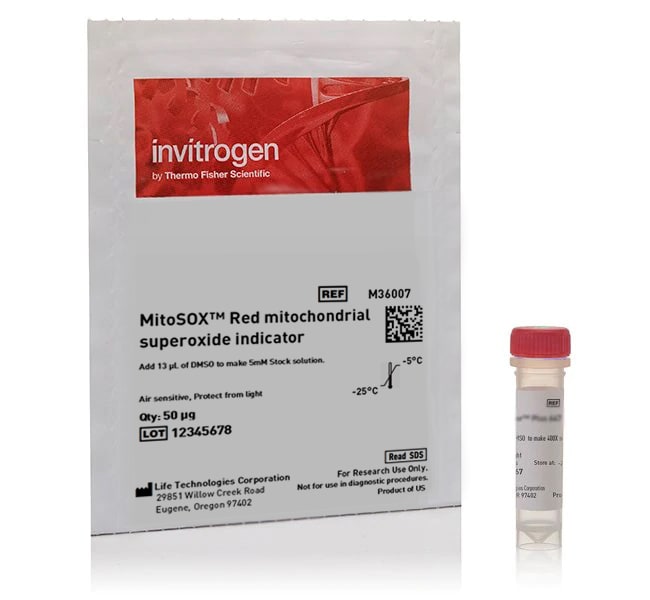
MitoSOX™ 线粒体超氧化物指示剂,用于活细胞成像
MitoSOX 超氧化物指示剂是一种新型荧光染料,专门靶向活细胞中的线粒体。利用线粒体超氧化物氧化 MitoSOX 试剂产生明亮的绿色或红色荧光。
Have Questions?
更改视图

| 货号 | 数量 | 激发/发射 | 指示器 | 颜色 |
|---|---|---|---|---|
| M36007 | 1 小瓶 | ∼396/610 nm | MitoSox Red | 红色 |
| M36005 | 1 小瓶 | ∼488/510 nm | MitoSox Green | 绿色 |
| M36006 | 5 小瓶 | ∼488/510 nm | MitoSox Green | 绿色 |
| M36008 | 10 小瓶 | ∼396/610 nm | MitoSox Red | 红色 |
| M36009 | 2样品瓶(1样品瓶为绿色、1样品瓶为红色) | 488/510 nm(绿色),396/610 nm(红色) | MitoSox Green, MitoSox Red | 绿色、红色 |
货号 M36007
价格(CNY)
1,416.00
飞享价
Ends: 31-Dec-2026
1,966.00共减 550.00 (28%)
Each
数量:
1 小瓶
激发/发射:
∼396/610 nm
指示器:
MitoSox Red
颜色:
红色
价格(CNY)
1,416.00
飞享价
Ends: 31-Dec-2026
1,966.00共减 550.00 (28%)
Each
MitoSOX Green 和 MitoSOX Red 超氧化物指示剂是一种新型荧光染料,专门靶向活细胞中的线粒体。利用线粒体超氧化物氧化 MitoSOX 试剂产生明亮的绿色或红色荧光。
这些指示剂的特点包括:
•易被超氧化物氧化,但不易被其他 ROS 或 RNS 生成系统氧化
• 用于活细胞成像
• 快速且选择性地靶向线粒体
• MitoSOX Green 指示剂:上限吸收/发射波长 ∼488/510 nm(传统 FITC/GFP 滤光片组)
• MitoSox Red 指示剂:上限吸收/发射波长 ∼396/610 nm*(推荐自定义滤光片组)
*Robinson 等人(1) 报告,如果 MitoSOX Red 染料在 396 nm 而非 510 nm 处激发,它可能是线粒体超氧化物的更具选择性标记物。
MitoSOX Green 指示剂以一样品瓶或一包五样品瓶的形式提供。MitoSOX Red 指示剂以一样品瓶或一包十样品瓶的形式提供。我们还提供 MitoSOX Red 和 MitSOX Green 指示剂各一瓶的一件混合装。
快速、简单地检测活细胞中的线粒体超氧化物
可利用 MitoSOX 超氧化物指示剂通过荧光显微镜检查查看线粒体产生超氧化物。指示剂渗透活细胞并在其中选择性地靶向线粒体。这些试剂被超氧化物迅速氧化,但不被其他活性氧 (ROS) 和活性氮 (RNS) 氧化。氧化产物发出强烈的荧光。
MitoSOX 指示剂可用于辨别分离线粒体制备物的伪影与活细胞线粒体中生成的超氧化物的直接测量结果。在研究各种病理中调节氧化应激的因子时,它们也可成为有价值的工具。此外,这些指示剂还用于使用高内涵仪器的代谢通量测定 (2)。MitoSOX 指示剂也用于使用流式细胞分析检测线粒体超氧化物 (3)。
参考文献
:1:Robinson, Kristine M., et al.Selective fluorescent imaging of superoxide in vivo using ethidium-based probes.Proceedings of the National Academy of Sciences 103.41 (2006): 15038-15043.
2: Little, Andrew Charles, et al.High-content fluorescence imaging with the metabolic flux assay reveals insights into mitochondrial properties and functions. Communications biology 3.1 (2020): 1-10.
3: Kauffman, Megan E. et al.MitoSOX-Based Flow Cytometry for Detecting Mitochondrial ROS.Reactive oxygen species (Apex, N.C.) vol. 2,5 (2016): 361-370.
•易被超氧化物氧化,但不易被其他 ROS 或 RNS 生成系统氧化
• 用于活细胞成像
• 快速且选择性地靶向线粒体
• MitoSOX Green 指示剂:上限吸收/发射波长 ∼488/510 nm(传统 FITC/GFP 滤光片组)
• MitoSox Red 指示剂:上限吸收/发射波长 ∼396/610 nm*(推荐自定义滤光片组)
*Robinson 等人(1) 报告,如果 MitoSOX Red 染料在 396 nm 而非 510 nm 处激发,它可能是线粒体超氧化物的更具选择性标记物。
MitoSOX Green 指示剂以一样品瓶或一包五样品瓶的形式提供。MitoSOX Red 指示剂以一样品瓶或一包十样品瓶的形式提供。我们还提供 MitoSOX Red 和 MitSOX Green 指示剂各一瓶的一件混合装。
快速、简单地检测活细胞中的线粒体超氧化物
可利用 MitoSOX 超氧化物指示剂通过荧光显微镜检查查看线粒体产生超氧化物。指示剂渗透活细胞并在其中选择性地靶向线粒体。这些试剂被超氧化物迅速氧化,但不被其他活性氧 (ROS) 和活性氮 (RNS) 氧化。氧化产物发出强烈的荧光。
MitoSOX 指示剂可用于辨别分离线粒体制备物的伪影与活细胞线粒体中生成的超氧化物的直接测量结果。在研究各种病理中调节氧化应激的因子时,它们也可成为有价值的工具。此外,这些指示剂还用于使用高内涵仪器的代谢通量测定 (2)。MitoSOX 指示剂也用于使用流式细胞分析检测线粒体超氧化物 (3)。
参考文献
:1:Robinson, Kristine M., et al.Selective fluorescent imaging of superoxide in vivo using ethidium-based probes.Proceedings of the National Academy of Sciences 103.41 (2006): 15038-15043.
2: Little, Andrew Charles, et al.High-content fluorescence imaging with the metabolic flux assay reveals insights into mitochondrial properties and functions. Communications biology 3.1 (2020): 1-10.
3: Kauffman, Megan E. et al.MitoSOX-Based Flow Cytometry for Detecting Mitochondrial ROS.Reactive oxygen species (Apex, N.C.) vol. 2,5 (2016): 361-370.
仅供科研使用。不可用于诊断程序。
规格
颜色红色
数量1 小瓶
检测方法荧光
激发/发射∼396/610 nm
指示器MitoSox Red
产品线MitoSOX
Unit SizeEach