Search
Invitrogen
HPV Type 16/18 E6 Monoclonal Antibody (C1P5)
{{$productOrderCtrl.translations['antibody.pdp.commerceCard.promotion.promotions']}}
{{$productOrderCtrl.translations['antibody.pdp.commerceCard.promotion.promocode']}}: {{promo.promoCode}} {{promo.promoTitle}} {{promo.promoDescription}}. {{$productOrderCtrl.translations['antibody.pdp.commerceCard.promotion.learnmore']}}
{{$ctrl.translations['antibody.pdp.skuNotes.additionalInformation']}}:
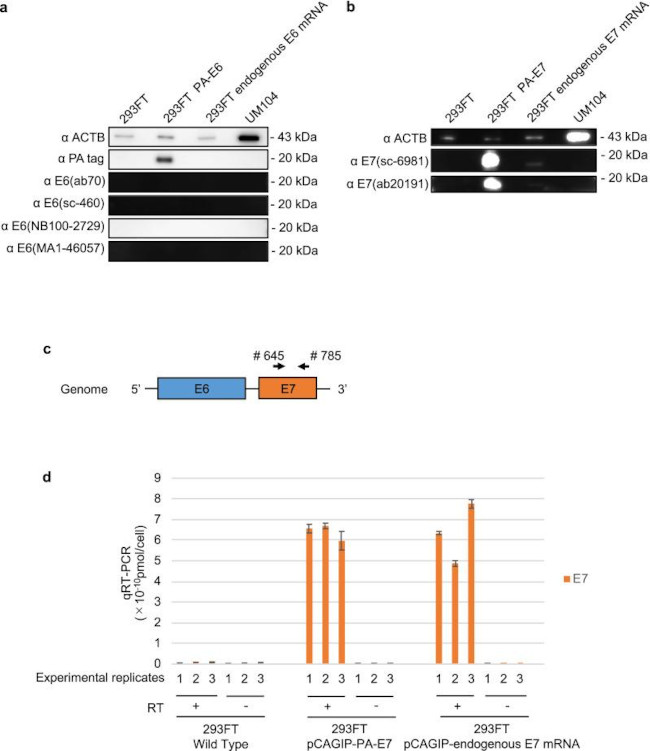
图: 1 / 1
HPV Type 16/18 E6 Antibody (MA1-46057) in WB
Scientific reports 2020 -
Figure 6 E7 protein expression in 293FT cells by overexpression of E7 mRNA having the endogenous structure. ( a , b ) Western blotting of E6 ( a ) and E7 protein ( b ) in 293FT cells (wild-type), 293FT cells transfected with pCAGIP-PA-E6/-PA-E7 or pCAGIP-endogenous E6/E7 mRNA, and UM104 cells. ( c ) E7 primers (# 645 and # 785) designed for binding within the E7 gene for use in qRT-PCR. ( d ) qRT-PCR analys... View More
Please note: We are reviewing Western blot images included in the antibody testing data in our catalog, including those provided by third parties. Unless expressly labeled or annotated as “raw-unedited”, Western blot images included in the antibody testing data in our catalog may have been edited, optimized or otherwise adjusted for presentation.

产品信息
MA1-46057
应用
建议稀释比
已发表文章
产品规格
种属反应
Virus
已发表种属
Virus
宿主/亚型
Mouse
/ IgG1
分类
Monoclonal
类型
Antibody
克隆号
C1P5
抗原
Gel-purified HPV-18 E6-beta galactosidase fusion protein.
偶联物
Unconjugated
Unconjugated
Unconjugated
形式
Liquid
浓度
1 mg/mL
规格
100 µg
纯化类型
Protein A
保存液
PBS
内含物
0.05% sodium azide
保存条件
Store at 4°C short term. For long term storage, store at -20°C, avoiding freeze/thaw cycles.
运输条件
Ambient (domestic); Wet ice (international)
RRID
靶标信息
Human Papilloma virus (HPV) is responsible for the development of type and tissue specific papilloma in the oral cavity and in the larynx. In the skin papilloma virus can cause different types of warts and in the ano-genital region it is associated with condyloma or carcinoma. HPV types 1, 6 and 11 usually are associated with benign transformations of the tissues, while e.g. HPV types 16, 18 and 31 seem to be responsible for the development of some carcinoma like cervical carcinoma. The role of HPV in non-melanoic tumours of the skin is under discussion. Protein E6 is a Transcriptional transactivator, binding double stranded DNA. It has transforming activity inactivating, with E6-AP ubiquitin-protein ligase, the human TP53/p53 tumor suppressor protein by targeting it for degradation. Clinical relevance: Detection of HPV in cervical smears and biopsies. Uses: Analysis of E6 expression in cell transformation studies.
仅用于科研。不用于诊断过程。未经明确授权不得转售。
生物信息学
蛋白别名: HPV-16; HPV-18; HPV16; HPV18; human papillomavirus
Disclaimer

Clicking the images or links will redirect you to a website hosted by BenchSci that provides third-party scientific content. Neither the content nor the BenchSci technology and processes for selection have been evaluated by us; we are providing them as-is and without warranty of any kind, including for use or application of the Thermo Fisher Scientific products presented.

