Search
Invitrogen
Human Serum Albumin Monoclonal Antibody (BGN/1328/33 (UA33))
{{$productOrderCtrl.translations['antibody.pdp.commerceCard.promotion.promotions']}}
{{$productOrderCtrl.translations['antibody.pdp.commerceCard.promotion.promocode']}}: {{promo.promoCode}} {{promo.promoTitle}} {{promo.promoDescription}}. {{$productOrderCtrl.translations['antibody.pdp.commerceCard.promotion.learnmore']}}
{{$ctrl.translations['antibody.pdp.skuNotes.additionalInformation']}}:
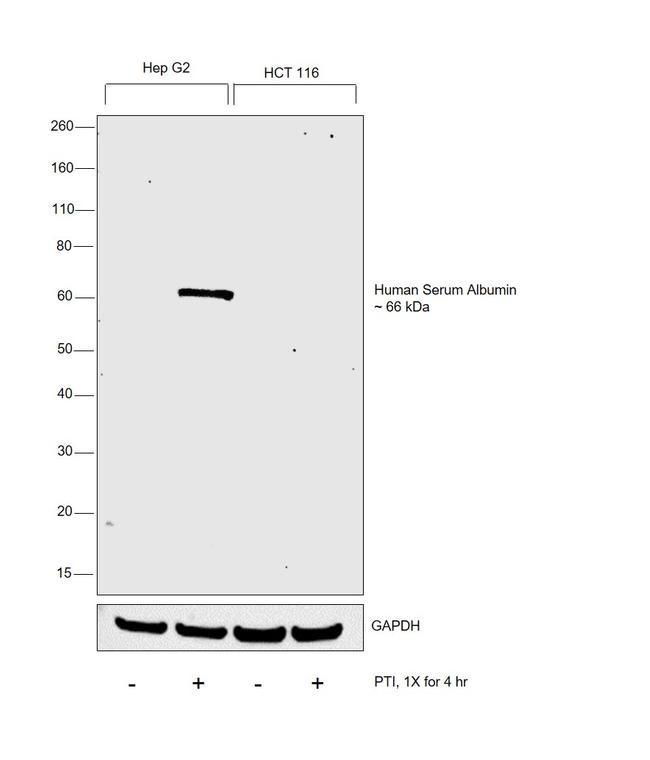
图: 1 / 2
Human Serum Albumin Antibody (MA1-82943) in WB
Western blot was performed using Anti-Human Serum Albumin Monoclonal Antibody (BGN/1328/33 (UA33)) (Product # MA1-82943) and a 66kDa band corresponding to Human Serum Albumin was observed in Hep G2 when compared to HCT 116 which is reported to be a low expressing model. Whole cell extracts (30 µg lysate) of Hep G2 (Lane 1), Hep G2 treated with PTI (1X for 4hrs) (Lane 2), HCT 116 (Lane 3), HCT 116 treated with PTI (1X for 4hrs) (Lane 4) were electrophoresed using NuPAGE™ 4-12% Bis-Tris Protein Gel (Product # NP0322BOX). Resolved proteins we... View More
Please note: We are reviewing Western blot images included in the antibody testing data in our catalog, including those provided by third parties. Unless expressly labeled or annotated as “raw-unedited”, Western blot images included in the antibody testing data in our catalog may have been edited, optimized or otherwise adjusted for presentation.


产品信息
MA1-82943
产品规格
种属反应
Human
宿主/亚型
Mouse
/ IgG1
分类
Monoclonal
类型
Antibody
克隆号
BGN/1328/33 (UA33)
抗原
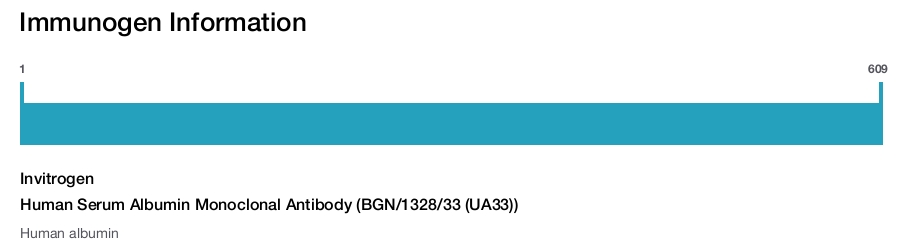
Human albumin
偶联物
Unconjugated
Unconjugated
Unconjugated
形式
Liquid
浓度
1 mg/mL
规格
200 µg
纯化类型
Protein A
保存液
PBS, pH 7.2
内含物
0.09% sodium azide
保存条件
Store at 4°C short term. For long term storage, store at -20°C, avoiding freeze/thaw cycles.
运输条件
Ambient (domestic); Wet ice (international)
RRID
产品详细信息
This antibody does not react with bovine, goat, guinea pig, horse, mouse or rabbit.
Non-reducing conditions are recommended for Western blot applications.
Mouse anti Human Albumin antibody, clone BGN/1328/33 (UA33) recognizes human albumin.
靶标信息
Albumin is a soluble, monomeric protein with a molecular weight of approximately 65-67 kDa that comprises about one-half of the blood serum protein. Human serum albumin (HAS) is the most abundant protein in human blood plasma, and has a serum half-life of approximately 20 days. Albumin functions primarily as a carrier protein for steroids, fatty acids, and thyroid hormones and plays a role in stabilizing extracellular fluid volume. Albumin is a globular, unglycosylated serum protein synthesized in the liver as pre-pro-albumin which has an N-terminal peptide that is removed before the nascent protein is released from the rough `produce the secreted albumin. Serum albumin has a good binding capacity for water, Ca(2+), Na(+), K(+), fatty acids, hormones, bilirubin and drugs. The main function of albumin is the regulation of the colloidal osmotic pressure of blood.
仅用于科研。不用于诊断过程。未经明确授权不得转售。
篇参考文献 (0)
您是否在文献中引用过该产品?请点击下方按钮邮件告知我们。
生物信息学
蛋白别名: DKFZp779N1935; GIG20; GIG42; serum albumin; unnamed protein product
基因别名: FDAHT; HSA; PRO0883; PRO0903; PRO1341
UniProt ID: (Human) P02768
Entrez Gene ID: (Human) 213
Disclaimer

Clicking the images or links will redirect you to a website hosted by BenchSci that provides third-party scientific content. Neither the content nor the BenchSci technology and processes for selection have been evaluated by us; we are providing them as-is and without warranty of any kind, including for use or application of the Thermo Fisher Scientific products presented.

